
Safer vs. venture debt: fixed schedules or revenue-linked payments
Venture debt is often pitched to founders as a cheap way to extend runway between equity rounds. For a deeptech company that has already raised venture capital, it can be useful. But it is still debt, with a repayment schedule that doesn’t care whether your satellite bus slipped a quarter or your energy storage pilot needs another test cycle. Here is how it compares to the Safer.
The quick comparison
| Venture debt | Safer | |
|---|---|---|
| What it is | Term loan to a venture-backed company | Equity purchase with revenue-based repurchase |
| How investor gets paid | Interest, principal, often warrants | Revenue-based repurchases; any remaining Safer converts to equity at an exit or IPO |
| Maturity | Fixed term | None |
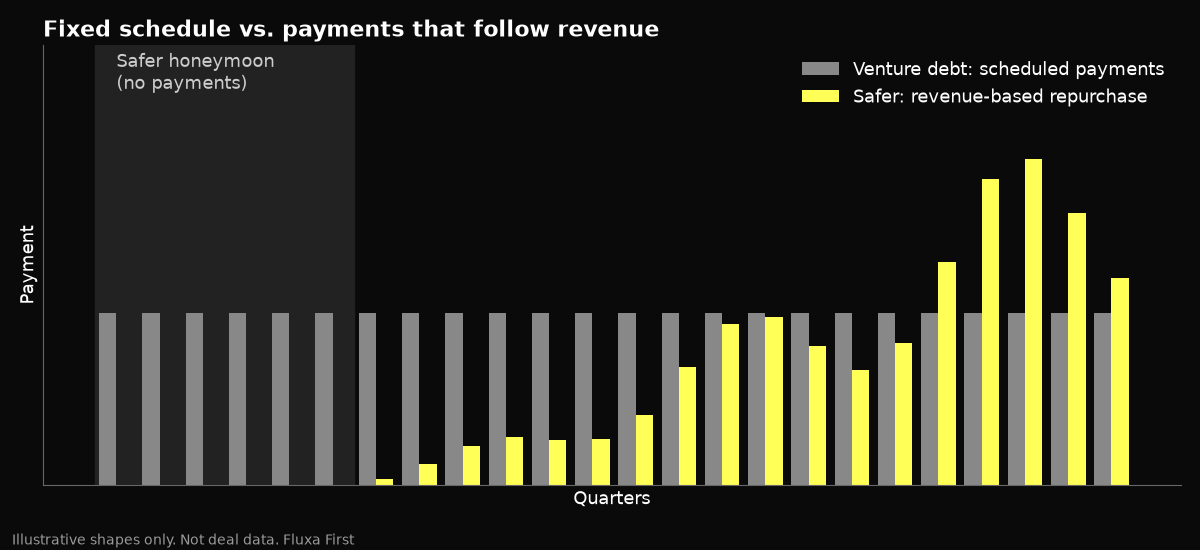
| Mandatory payments | Scheduled, regardless of revenue | None during honeymoon; then revenue-scaled |
| Collateral / covenants | Typically secured; covenants common | No collateral described in public materials |
| Default risk | Lender can enforce on assets | None; a missed payment triggers no default, penalty or acceleration |
| Best fit | Recently funded companies extending runway | Companies expecting revenue that want non-dilutive-feeling capital without a loan |
How venture debt works
Venture debt is a loan made by specialist lenders or bank units to startups that already have venture backing. Lenders lean heavily on the strength of the equity investors behind the company, because the next equity round is often what repays the loan. Typical features include an interest-only period followed by amortization, a security interest in company assets that can include IP, financial or performance covenants, and warrants that give the lender a small equity stake.
How the Safer works, briefly
The Safer (Simple Agreement for Future Equity with Repurchase) is an open-source instrument published by Next Wave Partners. Based on its public materials, the mechanics work like this:
- The investor puts in a purchase amount, and the agreement sets a post-money valuation cap.
- A honeymoon period follows, with no payments due, so the company can put the capital to work first.
- After that, in any quarter with revenue the company must make a repurchase payment sized as a negotiated share of gross revenue. If a payment is missed, nothing happens: there is no default, no penalty and no acceleration. The Safer carries no interest. Those payments buy back part of the investor’s position and stop once a target return set in the agreement is reached.
- The Safer does not convert at later priced rounds. If repurchase payments are not complete by the time of an exit (an acquisition) or an IPO, the remaining Safer converts to equity at the time of that exit, at the agreement’s cap.
- If the company winds down without a liquidity event, nothing happens under the Safer: holders have no claim, are owed no repayment and are not creditors.
Every agreement sets its own numbers. Next Wave publishes typical ranges for the key terms in its public Safer materials; we point founders there rather than restating them. On accounting, Next Wave’s public accounting whitepaper reports that the analysis done with Armanino classifies the Safer as a derivative liability measured at fair value.
Where they really differ
Payment schedule. Venture debt payments are fixed. If revenue comes later than planned, the payments still come due. Safer repurchase payments start only after the honeymoon and are a share of revenue, so a slow quarter means a smaller payment.
Security. Venture lenders usually take a security interest in company assets, and for an early hardware company that often means the IP. The Safer has no collateral, and if the company winds down, holders are owed nothing and are not creditors.
What the investor wants. A venture lender wants principal and interest back on time, and modest upside through warrants. A Safer investor wants revenue-based repurchases up to the target return and equity upside at an exit. The incentives point toward growing revenue rather than protecting a loan.
Dependency on the next round. Venture debt often assumes another equity round will arrive in time. The Safer doesn’t need a next round; it doesn’t even convert at one.
When each makes sense
Venture debt makes sense for a company that just closed a strong equity round, has a clear use for extra runway, and is confident about hitting milestones before the amortization period bites. A drone company scaling a proven production line with a blue-chip investor syndicate is a reasonable candidate.
The Safer makes sense earlier and in situations where a fixed payment schedule is dangerous: a company with real but uneven revenue, long qualification cycles, or no appetite for pledging its IP. A space hardware supplier with signed but slow-paying contracts is one example.
What it means for founders
Venture debt can be less dilutive than equity, but the cost shows up as risk: covenants, a security interest and a schedule that ignores technical setbacks. Read the default and material adverse change clauses carefully. The Safer replaces that with a revenue share after a grace period, plus an equity position that converts only at an exit. You still give up value, just in a way that tracks the business.
What it means for investors
Venture debt sits senior in the capital stack with a predictable coupon and little upside. The Safer sits in a different spot: repurchase cash from operations and equity upside, without loan-style protections. Investors should underwrite it on revenue potential, not on collateral.
For the wider landscape, see the pillar comparison.
The Safer vs. series
- Debt, credit, SAFEs and the Safer: a full comparison (pillar)
- Safer vs. SAFE
- Safer vs. venture debt
- Safer vs. bank loans
- Safer vs. private credit
- Safer vs. revenue-based financing
- Safer vs. convertible notes
- Safer vs. priced equity rounds
This post is general education from Fluxa First, not investment, legal, tax or accounting advice; talk to qualified advisors before signing anything.