
Safer vs. priced equity rounds: when to set a valuation
A priced equity round is the most familiar milestone in startup finance: a lead investor sets a valuation, the company issues preferred stock, and a board forms. For many deeptech companies a priced round is eventually the right move, especially when they’re scaling production or competing for large programs. The question is when, and what the company gives up to get there. Here’s how a priced round compares to the Safer.
The quick comparison
| Priced equity round | Safer | |
|---|---|---|
| What it is | Sale of preferred shares at a set price | Equity purchase with revenue-based repurchase |
| Valuation | Set now, per share | Post-money cap set now; conversion only at a liquidity event |
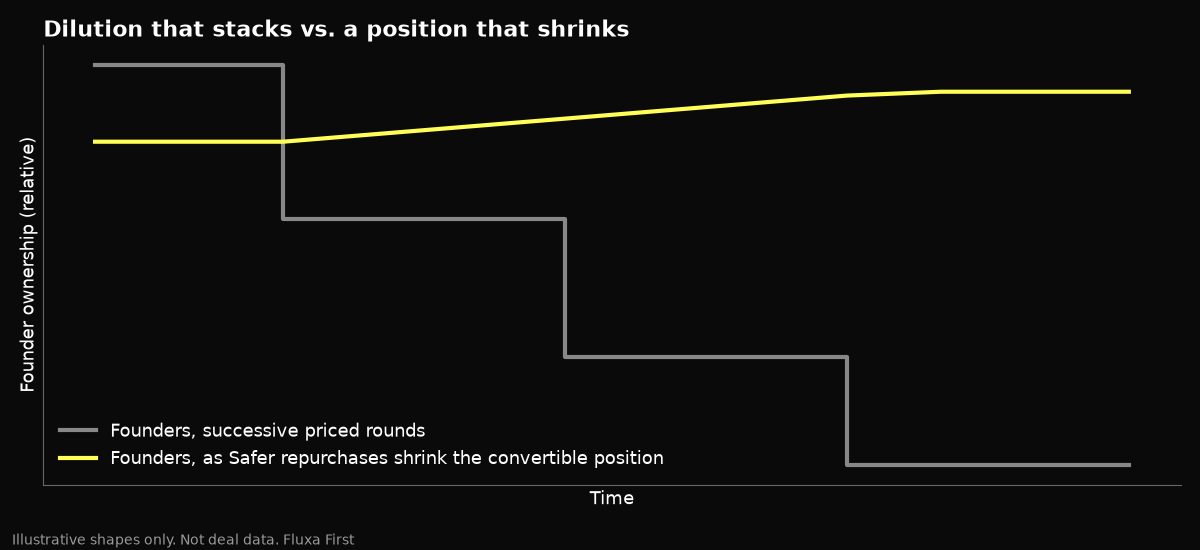
| Founder dilution | Immediate and permanent | Shrinks as repurchase payments retire part of the position |
| Investor rights | Board seats, protective provisions, liquidation preference | Defined by the Safer agreement; no board seats or voting rights per public materials |
| Cash to investor before exit | Rare | Revenue-based repurchases after a honeymoon |
| Needs an exit to pay off | Yes | Partly |
| Best fit | Scaling with institutional partners | Companies with a revenue path that want to delay or avoid big dilution |
How priced rounds work
In a priced round, investors buy newly issued preferred stock at a negotiated price per share. Preferred stock usually comes with a liquidation preference, protective provisions that let investors veto certain decisions, information rights and often board seats. Many U.S. rounds use documents based on the NVCA model legal documents. Y Combinator’s guide to SAFEs and priced equity rounds explains how earlier SAFEs convert into a priced round.
How the Safer works, briefly
The Safer (Simple Agreement for Future Equity with Repurchase) is an open-source instrument published by Next Wave Partners. Based on its public materials, the mechanics work like this:
- The investor puts in a purchase amount, and the agreement sets a post-money valuation cap.
- A honeymoon period follows, with no payments due, so the company can put the capital to work first.
- After that, in any quarter with revenue the company must make a repurchase payment sized as a negotiated share of gross revenue. If a payment is missed, nothing happens: there is no default, no penalty and no acceleration. The Safer carries no interest. Those payments buy back part of the investor’s position and stop once a target return set in the agreement is reached.
- The Safer does not convert at later priced rounds. If repurchase payments are not complete by the time of an exit (an acquisition) or an IPO, the remaining Safer converts to equity at the time of that exit, at the agreement’s cap.
- If the company winds down without a liquidity event, nothing happens under the Safer: holders have no claim, are owed no repayment and are not creditors.
Every agreement sets its own numbers. Next Wave publishes typical ranges for the key terms in its public Safer materials; we point founders there rather than restating them. On accounting, Next Wave’s public accounting whitepaper reports that the analysis done with Armanino classifies the Safer as a derivative liability measured at fair value.
Where they really differ
Valuation pressure. A priced round forces a valuation at a moment when a hardware company may have little to show beyond a prototype. Set it too low and you give away a lot; set it too high and you risk a down round later. The Safer sets a cap but doesn’t convert until a liquidity event.
Ownership path. Priced rounds lock in dilution, and each round stacks on the last. With a Safer, revenue-based repurchases retire part of the investor’s position over time, so founders can win back ownership by building revenue.
Governance. Priced rounds bring boards and protective provisions, which can be valuable but also shift control. The public Safer materials say the instrument carries no board seats and no transferred voting rights.
How investors get paid. Priced equity investors are paid mainly at an exit, often with a liquidation preference. Safer investors get revenue-based repurchases first, and if those are not complete at an exit or IPO, the remaining Safer converts to equity at that time.
When each makes sense
A priced round makes sense when a company needs a lot of capital to scale, for example building a production facility for propulsion systems or certifying an aircraft, and when strong institutional partners bring capital, credibility with customers and governance experience. When the opportunity is clearly venture-scale, the dilution can be worth it.
The Safer makes sense earlier, or for companies whose best path is durable revenue rather than a race to the next round. It also can coexist with priced rounds, since it doesn’t convert at them, though later investors will want to understand how the repurchase payments and conversion work.
What it means for founders
Raise a priced round when you know what the money buys and who you want in the boardroom. Before then, think hard about selling large ownership at your lowest valuation. The Safer offers a different trade: a revenue obligation later in exchange for a path to keep more of the company.
What it means for investors
Priced equity gives you governance rights, preference and full upside, with a long wait for liquidity. The Safer gives you earlier cash from revenue, conversion that isn’t diluted by later rounds, and equity upside on what isn’t repurchased, with fewer control rights. Many portfolios can use both.
For the wider landscape, see the pillar comparison.
The Safer vs. series
- Debt, credit, SAFEs and the Safer: a full comparison (pillar)
- Safer vs. SAFE
- Safer vs. venture debt
- Safer vs. bank loans
- Safer vs. private credit
- Safer vs. revenue-based financing
- Safer vs. convertible notes
- Safer vs. priced equity rounds
This post is general education from Fluxa First, not investment, legal, tax or accounting advice; talk to qualified advisors before signing anything.