
Safer vs. SAFE: same family, very different paths
The SAFE became the default way to raise an early round in the United States, and for good reason: it is short, standard and fast. The Safer borrows its name and some of its structure, but it behaves very differently once the money is in the bank. For founders building aerospace hardware, autonomous systems, energy technology or advanced manufacturing tools, those differences show up in ownership, cash and control years later.
The quick comparison
| SAFE (YC post-money) | Safer | |
|---|---|---|
| What it is | Right to future equity, no debt | Equity purchase with revenue-based repurchase |
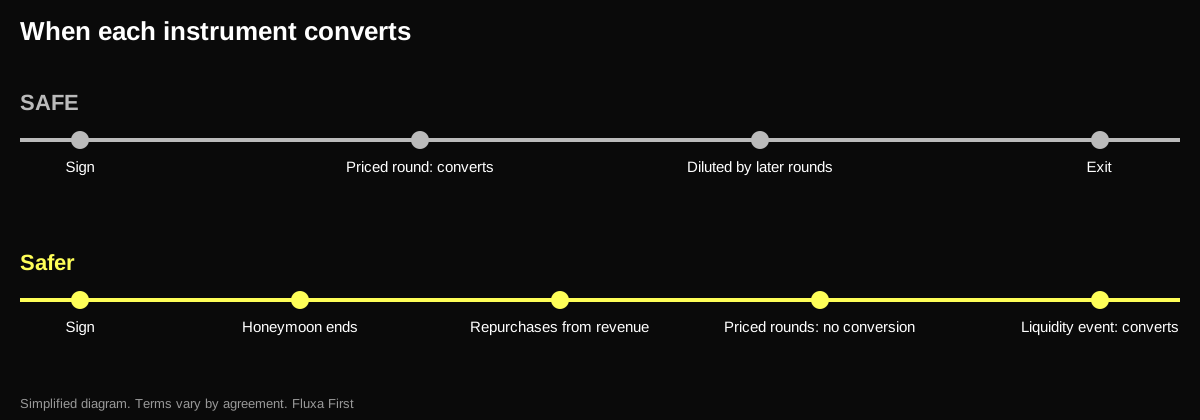
| Converts when | Next priced equity round (or liquidity event) | Only at a liquidity event, not on priced rounds |
| Cash to investor before exit | None | Quarterly repurchase payments after a honeymoon period |
| Mandatory payments | None | Revenue-scaled, ending at a target return |
| Founder dilution | Locked in at conversion; stacks across SAFEs | Shrinks as repurchase payments retire part of the position |
| Needs an exit to pay off | Yes | Partly; repurchases pay out from operations |
| Best fit | Venture-scale path with a clear next round | Companies expecting real revenue that may not want a fast exit |
How the SAFE works
Y Combinator introduced the SAFE in 2013 and moved to the post-money version in 2018; the forms and a user guide are on its documents page. A SAFE investor pays now and receives shares later, typically when the company raises a priced equity round, at a price set by a valuation cap, a discount, or both. There is no interest, no maturity date and no repayment obligation. The post-money version makes the investor’s ownership at conversion easier to calculate, which also means founders absorb the dilution from each additional SAFE they sign. If the company never raises a priced round or exits, the SAFE investor may get nothing.
How the Safer works, briefly
The Safer (Simple Agreement for Future Equity with Repurchase) is an open-source instrument published by Next Wave Partners. Based on its public materials, the mechanics work like this:
- The investor puts in a purchase amount, and the agreement sets a post-money valuation cap.
- A honeymoon period follows, with no payments due, so the company can put the capital to work first.
- After that, in any quarter with revenue the company must make a repurchase payment sized as a negotiated share of gross revenue. If a payment is missed, nothing happens: there is no default, no penalty and no acceleration. The Safer carries no interest. Those payments buy back part of the investor’s position and stop once a target return set in the agreement is reached.
- The Safer does not convert at later priced rounds. If repurchase payments are not complete by the time of an exit (an acquisition) or an IPO, the remaining Safer converts to equity at the time of that exit, at the agreement’s cap.
- If the company winds down without a liquidity event, nothing happens under the Safer: holders have no claim, are owed no repayment and are not creditors.
Every agreement sets its own numbers. Next Wave publishes typical ranges for the key terms in its public Safer materials; we point founders there rather than restating them. On accounting, Next Wave’s public accounting whitepaper reports that the analysis done with Armanino classifies the Safer as a derivative liability measured at fair value.
Where they really differ
Timing of conversion. A SAFE turns into equity at the next priced round, so the early investor becomes a regular shareholder and gets diluted by every later round along with the founders. The Safer stays outstanding through priced rounds and converts only at a liquidity event, at the cap set when it was signed.
Cash before an exit. A SAFE pays nothing until conversion and an exit. A Safer starts quarterly repurchase payments once the honeymoon period ends, sized as a share of revenue, and they stop at the target return. For investors, this is a return that comes from operations rather than from a sale.
Ownership over time. With a SAFE, the stake the founders give up is set at conversion. With a Safer, each repurchase payment buys back part of the investor’s position, so the share that could ever convert gets smaller as the company earns revenue.
Downside. In a failure, both instruments look like a normal venture loss. If a Safer-funded company winds down, nothing is owed: holders have no claim and are not creditors.
When each makes sense
A SAFE makes sense when you are clearly on a venture-capital path: you plan to raise a priced Series A soon, you want the fastest and most familiar paperwork, and your investors expect their return from an exit. Many software companies and some hardware companies with strong institutional demand fit that pattern.
A Safer makes sense when you expect meaningful revenue after a build period, for example from paid pilots, government or commercial contracts, or early product sales, and you want a path where early investors get paid without forcing a sale. A maritime autonomy company selling to port operators, or a component maker with contracted orders from aerospace primes, might fit better here than on a pure exit timeline.
What it means for founders
The SAFE is simple to sign but can be expensive later, especially when several SAFEs stack before a priced round. The Safer adds a revenue obligation after the honeymoon, so model whether your margins can carry the repurchase payments while you keep investing in engineering. In exchange, you can buy back ownership as you grow instead of handing it over permanently in the earliest, cheapest rounds.
What it means for investors
A SAFE gives you full upside and no cash flow until an exit, plus dilution after you convert. A Safer offers a cash return from revenue and keeps equity upside on the part of the position that isn’t repurchased, with conversion that isn’t diluted by later rounds. The tradeoff is that your result depends on the company actually earning revenue, and your equity stake shrinks as repurchases happen.
For the full landscape, see the pillar comparison.
The Safer vs. series
- Debt, credit, SAFEs and the Safer: a full comparison (pillar)
- Safer vs. SAFE
- Safer vs. venture debt
- Safer vs. bank loans
- Safer vs. private credit
- Safer vs. revenue-based financing
- Safer vs. convertible notes
- Safer vs. priced equity rounds
This post is general education from Fluxa First, not investment, legal, tax or accounting advice; talk to qualified advisors before signing anything.