
Safer vs. private credit: different stages, different risks
Private credit has grown into one of the biggest stories in finance, as non-bank lenders and funds took over lending that banks used to do. It now reaches into growth-stage technology companies too. For founders in deeptech, private credit can be a serious option at the right stage, but it is built for a very different company profile than the one the Safer targets.
The quick comparison
| Private credit | Safer | |
|---|---|---|
| What it is | Privately negotiated loans from non-bank lenders and funds | Equity purchase with revenue-based repurchase |
| Typical borrower | Established, cash-generating companies | Early companies expecting revenue |
| How investor gets paid | Interest (often floating), fees, sometimes equity kickers | Revenue-based repurchases; any remaining Safer converts to equity at an exit or IPO |
| Maturity | Fixed term | None |
| Collateral / covenants | Usually secured, with negotiated covenants | No collateral described in public materials |
| Upside | Limited | Equity upside on the unrepurchased portion |
| Best fit | Later-stage scale-ups, acquisitions, refinancing | Building companies that want returns tied to revenue |
How private credit works
Private credit refers to lending by non-bank institutions such as direct lending funds and business development companies. Loans are negotiated directly with the borrower instead of being syndicated or traded, often carry floating rates, and usually come with collateral and covenants. The Federal Reserve’s note on private credit and the IMF’s analysis of the private credit market describe its features and risks. Lenders can be more flexible than banks, but they price that flexibility.
How the Safer works, briefly
The Safer (Simple Agreement for Future Equity with Repurchase) is an open-source instrument published by Next Wave Partners. Based on its public materials, the mechanics work like this:
- The investor puts in a purchase amount, and the agreement sets a post-money valuation cap.
- A honeymoon period follows, with no payments due, so the company can put the capital to work first.
- After that, in any quarter with revenue the company must make a repurchase payment sized as a negotiated share of gross revenue. If a payment is missed, nothing happens: there is no default, no penalty and no acceleration. The Safer carries no interest. Those payments buy back part of the investor’s position and stop once a target return set in the agreement is reached.
- The Safer does not convert at later priced rounds. If repurchase payments are not complete by the time of an exit (an acquisition) or an IPO, the remaining Safer converts to equity at the time of that exit, at the agreement’s cap.
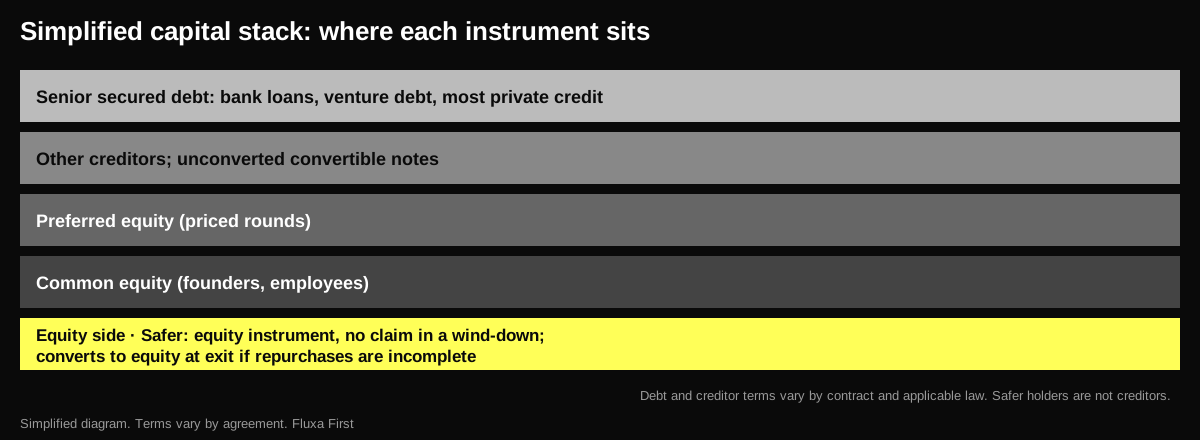
- If the company winds down without a liquidity event, nothing happens under the Safer: holders have no claim, are owed no repayment and are not creditors.
Every agreement sets its own numbers. Next Wave publishes typical ranges for the key terms in its public Safer materials; we point founders there rather than restating them. On accounting, Next Wave’s public accounting whitepaper reports that the analysis done with Armanino classifies the Safer as a derivative liability measured at fair value.
Where they really differ
Stage. Private credit lenders typically want meaningful revenue or cash flow and enterprise value to lend against. A company still in prototype or early pilots rarely qualifies. The Safer is designed for that earlier phase, with a honeymoon before any payments start.
Payment shape. Private credit carries scheduled interest, often floating, so payments can rise with rates whatever the business is doing. Safer repurchase payments follow revenue.
Control in stress. When a private credit borrower struggles, the lender’s covenants and security give it a lot of say in what happens next, up to restructuring. The Safer has no such covenants, and if the company winds down, Safer holders have no claim and are not creditors.
Upside. Private lenders give up most upside in exchange for seniority. Safer investors keep equity upside.
When each makes sense
Private credit makes sense for a later-stage hard-tech company with real revenue that needs capital for a factory expansion, an acquisition or working capital, and that prefers not to issue more equity. An advanced manufacturing company with long-term supply contracts is a classic fit.
The Safer makes sense earlier, when revenue is coming but not yet large or stable enough to support a loan, and when founders want early investors paid out of revenue rather than through a sale.
What it means for founders
Private credit can be fast and flexible, but read the covenants as if things will go wrong, because that’s when they matter. Floating rates and a maturity date add risk that has nothing to do with your engineering. The Safer swaps that for a revenue share and a convertible equity position. It is not cheap capital, but it bends with the business.
What it means for investors
Private credit offers contractual income and seniority in a crowded and competitive market. The Safer offers an early-stage, revenue-linked return with equity upside, and no covenant package. They serve different parts of a portfolio and different stages of a company’s life.
For the wider landscape, see the pillar comparison.
The Safer vs. series
- Debt, credit, SAFEs and the Safer: a full comparison (pillar)
- Safer vs. SAFE
- Safer vs. venture debt
- Safer vs. bank loans
- Safer vs. private credit
- Safer vs. revenue-based financing
- Safer vs. convertible notes
- Safer vs. priced equity rounds
This post is general education from Fluxa First, not investment, legal, tax or accounting advice; talk to qualified advisors before signing anything.