
Safer vs. convertible notes: no maturity cliff
Convertible notes were the standard early-stage instrument before the SAFE, and they have come back into favor with investors who want more protection. For hardware and deeptech founders, a note’s maturity date and debt status can create real risk if the next round takes longer than planned, which in hard tech it often does. Here’s how notes compare to the Safer.
The quick comparison
| Convertible note | Safer | |
|---|---|---|
| What it is | Debt designed to convert into equity | Equity purchase with revenue-based repurchase |
| Interest | Accrues, usually paid in shares at conversion | None; returns come from repurchase and conversion |
| Maturity | Fixed date; repayment or renegotiation if no conversion | None |
| Converts when | Next qualified financing, at a discount and/or cap | Only at a liquidity event |
| Security | Sometimes secured, including IP in some deals | No collateral described in public materials |
| Cash before exit | Usually none | Revenue-based repurchases after a honeymoon |
| Best fit | Bridges with a near-term priced round | Companies expecting revenue and not depending on the next round |
How convertible notes work
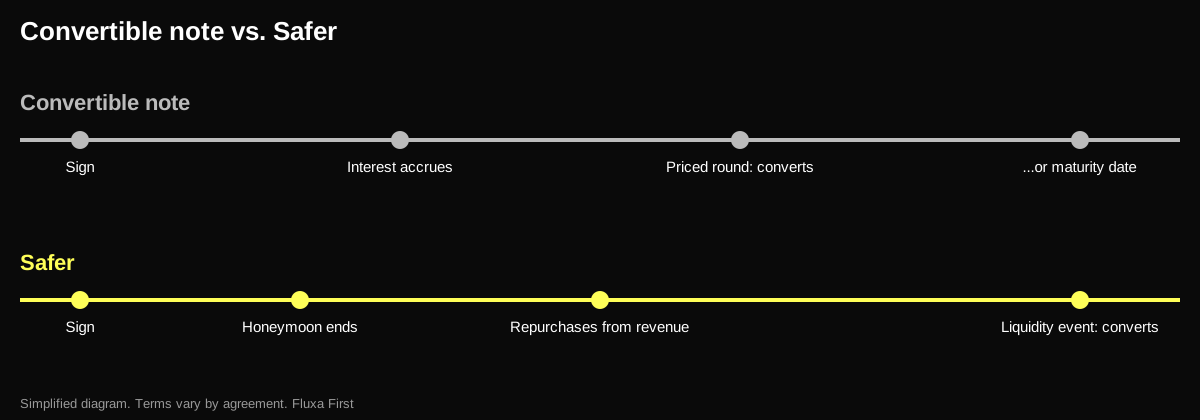
A convertible note is a short-term loan that is meant to turn into equity. It carries an interest rate and a maturity date. When the company raises a qualifying priced round, the principal and accrued interest convert into shares, usually at a discount to the round price or at a valuation cap. If no qualifying round happens by maturity, the noteholders can, depending on the terms, demand repayment, extend, or convert on other terms. See the SEC’s investor education site on convertible securities.
How the Safer works, briefly
The Safer (Simple Agreement for Future Equity with Repurchase) is an open-source instrument published by Next Wave Partners. Based on its public materials, the mechanics work like this:
- The investor puts in a purchase amount, and the agreement sets a post-money valuation cap.
- A honeymoon period follows, with no payments due, so the company can put the capital to work first.
- After that, in any quarter with revenue the company must make a repurchase payment sized as a negotiated share of gross revenue. If a payment is missed, nothing happens: there is no default, no penalty and no acceleration. The Safer carries no interest. Those payments buy back part of the investor’s position and stop once a target return set in the agreement is reached.
- The Safer does not convert at later priced rounds. If repurchase payments are not complete by the time of an exit (an acquisition) or an IPO, the remaining Safer converts to equity at the time of that exit, at the agreement’s cap.
- If the company winds down without a liquidity event, nothing happens under the Safer: holders have no claim, are owed no repayment and are not creditors.
Every agreement sets its own numbers. Next Wave publishes typical ranges for the key terms in its public Safer materials; we point founders there rather than restating them. On accounting, Next Wave’s public accounting whitepaper reports that the analysis done with Armanino classifies the Safer as a derivative liability measured at fair value.
Where they really differ
The maturity cliff. A note’s maturity date is a deadline. If a certification test or a customer pilot slips and the priced round hasn’t happened, noteholders hold leverage, and in a tough market that leverage can be painful. The Safer has no maturity date.
Debt vs. equity. A note is debt until it converts, which puts it ahead of equity in a downturn and, when it is secured, can put the company’s IP at risk. The Safer is an equity instrument with no collateral, and if the company winds down, holders have no claim and are not creditors.
Conversion. Notes convert at the next priced round, so early investors join the cap table and are diluted by later rounds. The Safer converts only at a liquidity event.
Cash before an exit. Note investors usually see no cash unless the note is repaid. Safer investors receive revenue-based repurchase payments after the honeymoon.
When each makes sense
A convertible note makes sense for a quick bridge when a priced round is clearly coming soon, when investors want creditor protection, and when founders are comfortable with the maturity date. A robotics company with a term sheet process already underway might use one to close a short gap.
The Safer makes sense when the timeline to a priced round, or to any round, is uncertain, and when the company expects revenue that can pay early investors back. A maritime sensor company selling to research fleets and port authorities could be a good candidate.
What it means for founders
Treat a note’s maturity date as a real risk and read any security provisions with care; giving lenders a claim on your IP is a big deal when it is your main asset. The Safer avoids maturity and collateral, and you’ll owe revenue-based repurchase payments once the honeymoon ends. Check that your margins can carry them.
What it means for investors
Notes give you creditor rights plus a conversion discount, but no cash yield until conversion or repayment, and you’re diluted after you convert. The Safer gives you a revenue-linked cash return and conversion that isn’t diluted by later rounds, without the protections of debt. Underwrite revenue, not leverage.
For the wider landscape, see the pillar comparison.
The Safer vs. series
- Debt, credit, SAFEs and the Safer: a full comparison (pillar)
- Safer vs. SAFE
- Safer vs. venture debt
- Safer vs. bank loans
- Safer vs. private credit
- Safer vs. revenue-based financing
- Safer vs. convertible notes
- Safer vs. priced equity rounds
This post is general education from Fluxa First, not investment, legal, tax or accounting advice; talk to qualified advisors before signing anything.