
Safer vs. bank loans: when hard-tech companies should borrow
Bank loans are the oldest tool in business finance, and for many durable companies they are the right one. For early deeptech companies, though, banks often say no, or say yes only with personal guarantees and liens on everything. Here is how a conventional bank loan compares to the Safer for founders building in aerospace, maritime, autonomy, energy and advanced manufacturing.
The quick comparison
| Bank loan | Safer | |
|---|---|---|
| What it is | Loan from a bank, sometimes government-guaranteed | Equity purchase with revenue-based repurchase |
| Underwriting basis | Cash flow, collateral, credit history | Revenue potential and venture judgment |
| Maturity | Fixed term | None |
| Mandatory payments | Scheduled principal and interest | Revenue-scaled after a honeymoon, ending at a target return |
| Collateral / guarantees | Usually required; personal guarantees common for small businesses | No collateral described in public materials |
| Upside to lender | None | Equity upside on the unrepurchased portion |
| Best fit | Companies with cash flow and hard assets | Early companies expecting revenue but without bank-ready financials |
How bank loans work
A bank lends money and expects it back with interest on a set schedule. Banks underwrite mostly on historical cash flow, collateral and credit, and typically include covenants. In the United States, the Small Business Administration backs certain small business loans through programs like 7(a) and 504, which can make banks more willing to lend to small companies; the SBA’s loan program overview explains the options. Equipment financing is a common variant for hardware companies, with the equipment itself as collateral.
How the Safer works, briefly
The Safer (Simple Agreement for Future Equity with Repurchase) is an open-source instrument published by Next Wave Partners. Based on its public materials, the mechanics work like this:
- The investor puts in a purchase amount, and the agreement sets a post-money valuation cap.
- A honeymoon period follows, with no payments due, so the company can put the capital to work first.
- After that, in any quarter with revenue the company must make a repurchase payment sized as a negotiated share of gross revenue. If a payment is missed, nothing happens: there is no default, no penalty and no acceleration. The Safer carries no interest. Those payments buy back part of the investor’s position and stop once a target return set in the agreement is reached.
- The Safer does not convert at later priced rounds. If repurchase payments are not complete by the time of an exit (an acquisition) or an IPO, the remaining Safer converts to equity at the time of that exit, at the agreement’s cap.
- If the company winds down without a liquidity event, nothing happens under the Safer: holders have no claim, are owed no repayment and are not creditors.
Every agreement sets its own numbers. Next Wave publishes typical ranges for the key terms in its public Safer materials; we point founders there rather than restating them. On accounting, Next Wave’s public accounting whitepaper reports that the analysis done with Armanino classifies the Safer as a derivative liability measured at fair value.
Where they really differ
Who qualifies. Banks look backward at track record and assets. A pre-revenue company designing an unmanned surface vessel usually doesn’t have the history a bank needs. The Safer is a venture instrument, underwritten on where the company is going.
What happens in a bad year. A missed bank payment can trigger default, acceleration and enforcement on collateral, sometimes including the founder’s personal assets under a guarantee. Safer repurchase payments are a share of revenue, so they shrink when revenue shrinks.
Cost structure. A bank loan’s cost is interest and fees, with no equity. The Safer’s cost is the repurchase return plus whatever equity the remaining position converts into at an exit. When things go very well, a bank loan is usually cheaper. When they go badly, it can be far more dangerous.
When each makes sense
A bank loan makes sense once a company has steady revenue, assets to pledge and a predictable use of funds, such as buying a CNC line for a contract manufacturer with booked orders, or financing working capital against receivables. For durable, cash-generating businesses, cheap senior debt is often the best capital there is.
The Safer makes sense earlier, when the company has a credible revenue path but not the history, assets or cash flow a bank requires, and when the founders don’t want to sign personal guarantees.
What it means for founders
Don’t let the low headline rate of a bank loan hide the real risk of personal guarantees and covenants while your product is still maturing. And don’t dismiss banks later, either: once you have contracts and equipment, a mix of bank debt and earlier risk capital can be very efficient. The Safer’s payments track revenue, and you give up no assets, but you do give up a return and some potential equity.
What it means for investors
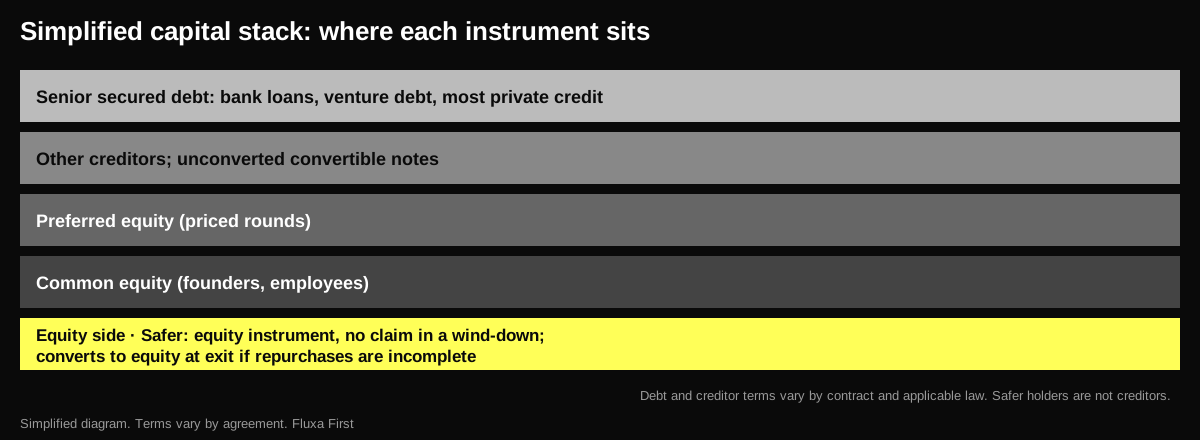
Banks take senior, secured, low-upside risk with clear rules. A Safer investor takes venture-style risk, earns cash only as the company earns revenue, and keeps equity upside. The two can coexist in a capital stack, and lenders will want to understand how repurchase payments interact with their covenants.
For the wider landscape, see the pillar comparison.
The Safer vs. series
- Debt, credit, SAFEs and the Safer: a full comparison (pillar)
- Safer vs. SAFE
- Safer vs. venture debt
- Safer vs. bank loans
- Safer vs. private credit
- Safer vs. revenue-based financing
- Safer vs. convertible notes
- Safer vs. priced equity rounds
This post is general education from Fluxa First, not investment, legal, tax or accounting advice; talk to qualified advisors before signing anything.