
Safer vs. revenue-based financing: both follow revenue, only one holds equity
Revenue-based financing and the Safer look alike at first glance: both pay investors as a share of revenue. Underneath, they are very different instruments. RBF is a financing advance with no equity. The Safer is an equity purchase where revenue-based repurchases retire part of the investor’s position. For deeptech founders, that difference matters most in what happens at an exit.
The quick comparison
| Revenue-based financing | Safer | |
|---|---|---|
| What it is | Advance repaid as a share of revenue | Equity purchase with revenue-based repurchase |
| Equity involved | None | Yes; unrepurchased portion converts at a liquidity event |
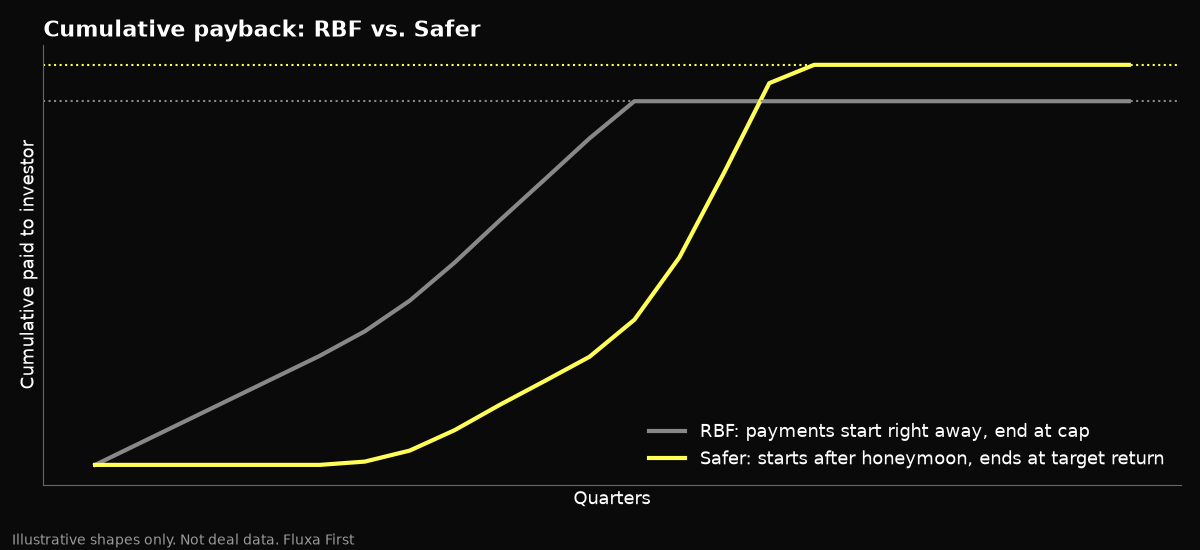
| Payments start | Usually right away | After a honeymoon period |
| Payments end | When a repayment cap is reached | When the target return is reached, or at liquidity/dissolution |
| Upside to investor | Capped | Repurchase return plus equity upside |
| Founder dilution | None | Shrinks as repurchase payments retire part of the position |
| Best fit | Predictable recurring revenue, healthy margins | Companies with a build period before revenue, plus long-term upside |
How RBF works
In revenue-based financing, an investor provides capital and the company repays it through a fixed share of ongoing revenue until a total repayment amount, usually a multiple of the original capital, is reached. There is typically no equity, no board seat and often light covenants. Because payments scale with revenue, a slow month means a smaller payment, but the total due doesn’t change. RBF providers usually want existing, predictable revenue, which is why it is popular with subscription software and e-commerce companies.
How the Safer works, briefly
The Safer (Simple Agreement for Future Equity with Repurchase) is an open-source instrument published by Next Wave Partners. Based on its public materials, the mechanics work like this:
- The investor puts in a purchase amount, and the agreement sets a post-money valuation cap.
- A honeymoon period follows, with no payments due, so the company can put the capital to work first.
- After that, in any quarter with revenue the company must make a repurchase payment sized as a negotiated share of gross revenue. If a payment is missed, nothing happens: there is no default, no penalty and no acceleration. The Safer carries no interest. Those payments buy back part of the investor’s position and stop once a target return set in the agreement is reached.
- The Safer does not convert at later priced rounds. If repurchase payments are not complete by the time of an exit (an acquisition) or an IPO, the remaining Safer converts to equity at the time of that exit, at the agreement’s cap.
- If the company winds down without a liquidity event, nothing happens under the Safer: holders have no claim, are owed no repayment and are not creditors.
Every agreement sets its own numbers. Next Wave publishes typical ranges for the key terms in its public Safer materials; we point founders there rather than restating them. On accounting, Next Wave’s public accounting whitepaper reports that the analysis done with Armanino classifies the Safer as a derivative liability measured at fair value.
Where they really differ
When it fits. RBF lenders want revenue now. The Safer includes a honeymoon so the company can build before repurchase payments start, which matters for hardware that takes time to ship.
What the investor owns. An RBF provider owns a payment stream and nothing else. A Safer investor owns a position that is partly repurchased through revenue and partly converts to equity at a liquidity event.
At an exit. When an RBF-funded company is acquired, the remaining balance is usually settled and the provider’s involvement ends. When a Safer-funded company is acquired or goes public before repurchase payments are complete, the remaining Safer converts to equity at that time, so the investor can share in a big outcome.
Founder ownership. RBF never touches the cap table. The Safer touches it at the start, then gives founders a path to buy part of that back through revenue.
When each makes sense
RBF makes sense for a company with steady recurring revenue and good gross margins that needs growth capital without dilution: think a software layer on top of a fleet of autonomous systems, already selling subscriptions to operators.
The Safer makes sense when there is a build period before revenue, when investors are taking venture-style risk that a capped return wouldn’t justify, and when the company might become a much larger business. An energy hardware startup with paid pilots and an eye on larger deployments might fit here.
What it means for founders
RBF is clean and non-dilutive, but payments begin immediately and can drain cash you need for engineering. The Safer gives you breathing room up front and payments that track revenue later, in exchange for an equity position that could convert at an exit. Compare the total cost under both strong and weak scenarios.
What it means for investors
RBF is a capped, cash-flow product: steady, limited upside, exposed if revenue stalls. The Safer combines a revenue-linked return with equity upside, which suits investors underwriting earlier, riskier companies that could also break out.
For the wider landscape, see the pillar comparison.
The Safer vs. series
- Debt, credit, SAFEs and the Safer: a full comparison (pillar)
- Safer vs. SAFE
- Safer vs. venture debt
- Safer vs. bank loans
- Safer vs. private credit
- Safer vs. revenue-based financing
- Safer vs. convertible notes
- Safer vs. priced equity rounds
This post is general education from Fluxa First, not investment, legal, tax or accounting advice; talk to qualified advisors before signing anything.