
Debt, credit, SAFEs and the Safer: a full comparison
Founders building hard things ask us the same question all the time: what kind of money should I take, and what will it cost me later? At Fluxa First we are a deeptech venture studio. We build and invest in companies that strengthen American sovereignty across aerospace, maritime, autonomy, energy, advanced manufacturing, defense and dual-use, and other durable hard-tech businesses. Our founders build satellites, autonomous vessels, power systems and factory tooling, and they live with long development cycles, capital-heavy prototypes and customers who buy slowly. The financing instrument they pick shapes their company for years.
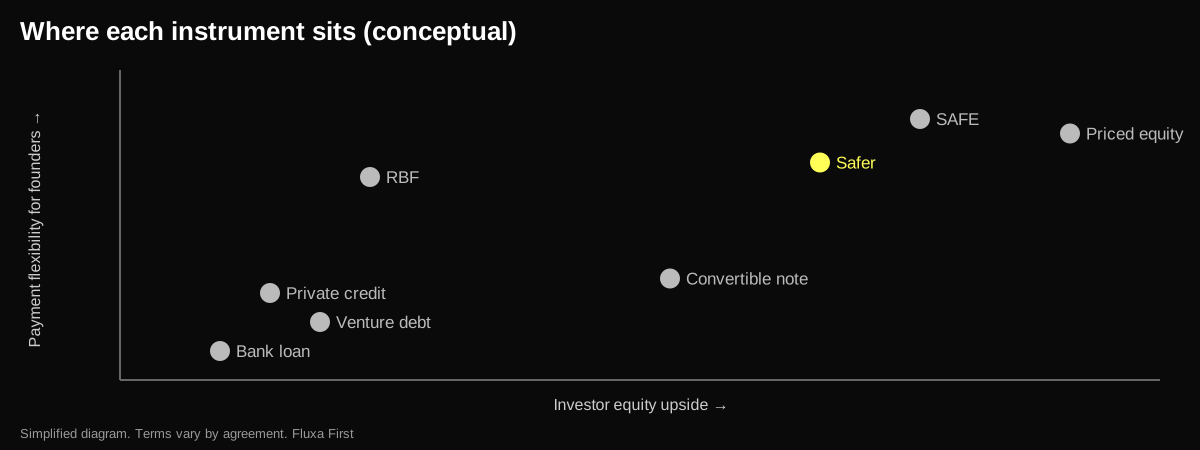
This pillar post puts the main options side by side: bank and venture debt, private credit, revenue-based financing, convertible notes, the SAFE, the Safer and priced equity. Each one gets a head-to-head post later in the series. We favor capital that fits the business, which is why we pay close attention to the Safer, but no instrument is right for everyone.
The full comparison table
| Bank / venture debt | Private credit | Revenue-based financing | Convertible note | SAFE (YC post-money) | Safer | Priced equity | |
|---|---|---|---|---|---|---|---|
| What it is | A loan from a bank, or from a lender that specializes in venture-backed companies | Loans from non-bank lenders and funds, usually negotiated privately | An advance repaid as a share of future revenue | Debt that is meant to convert into equity in a later round | A contract for future equity, no debt | Equity purchase with revenue-based repurchase; converts only at a liquidity event | Shares sold at a set price per share |
| How the investor gets paid | Interest plus principal; venture lenders often add warrants | Interest and fees, sometimes equity kickers | Revenue share until a repayment cap is reached | Converts to equity, usually at a discount or cap; repayable if it doesn’t convert | Equity at conversion, then exit proceeds | Quarterly repurchase payments from revenue, then conversion of any remaining Safer to equity at an exit or IPO | Exit proceeds, dividends if any, liquidation preference |
| Needs an exit? | No | No | No | Mostly yes, for real upside | Yes | No for the repurchase stream; yes for equity upside | Yes |
| Maturity | Fixed term | Fixed term | Ends when the cap is repaid | Fixed maturity date | None | None; ends at liquidity or dissolution | None |
| Mandatory payments | Yes, scheduled | Yes, scheduled | Yes, but scale with revenue | Interest accrues; usually no cash until maturity | None | None during the honeymoon; then revenue-scaled, ending at the target return | None |
| Collateral / covenants | Often secured, with covenants | Usually secured, with covenants | Varies; often light covenants | Sometimes secured; can carry protective provisions | None | No collateral described in the public materials | Protective provisions and board rights, not collateral |
| Downside | Default, foreclosure, loss of assets | Default, restructuring, lender control | Cash drag if margins are thin | Maturity cliff; debt claim in a downturn | Investor can lose everything; founders face stacked dilution later | Revenue drag during repurchase; failures act like normal venture losses | Dilution, control shifts, preference overhang |
| Capital stack position | Senior | Senior or mezzanine | Creditor-like, depends on contract | Debt until converted | Junior to debt; in many cases treated like equity | No claim in a wind-down; holders are not creditors | Equity, preferred ahead of common |
| Upside | None, beyond warrants | Little, beyond kickers | Capped | Equity upside after conversion | Full equity upside | Repurchase return plus equity upside on the unrepurchased portion | Full equity upside |
| Founder dilution | Minimal (warrants only) | Minimal | None | Yes, at conversion | Yes, at conversion, and it stacks | Shrinks over time as repurchase payments retire part of the position | Yes, immediate |
| Best fit | Companies with collateral, steady cash flow or strong VC backing | Larger, cash-generating companies | Predictable recurring revenue, healthy margins | Fast bridges, investors who want creditor protection | Fast early rounds on a venture-scale path | Companies that expect real revenue and want a path that doesn’t depend on an exit | Companies ready to set a valuation and scale with institutional partners |
Sources for how these instruments generally work: Y Combinator’s SAFE documents, the SBA’s overview of loan programs, the Federal Reserve’s note on private credit, the NVCA model legal documents for priced rounds, and the SEC’s investor glossary entry on convertible securities. Terms vary widely from deal to deal, so read the table as typical shapes, not rules.
How the Safer works, briefly
The Safer (Simple Agreement for Future Equity with Repurchase) is an open-source instrument published by Next Wave Partners. Based on its public materials, the mechanics work like this:
- The investor puts in a purchase amount, and the agreement sets a post-money valuation cap.
- A honeymoon period follows, with no payments due, so the company can put the capital to work first.
- After that, in any quarter with revenue the company must make a repurchase payment sized as a negotiated share of gross revenue. If a payment is missed, nothing happens: there is no default, no penalty and no acceleration. The Safer carries no interest. Those payments buy back part of the investor’s position and stop once a target return set in the agreement is reached.
- The Safer does not convert at later priced rounds. If repurchase payments are not complete by the time of an exit (an acquisition) or an IPO, the remaining Safer converts to equity at the time of that exit, at the agreement’s cap.
- If the company winds down without a liquidity event, nothing happens under the Safer: holders have no claim, are owed no repayment and are not creditors.
Every agreement sets its own numbers. Next Wave publishes typical ranges for the key terms in its public Safer materials; we point founders there rather than restating them. On accounting, Next Wave’s public accounting whitepaper reports that the analysis done with Armanino classifies the Safer as a derivative liability measured at fair value.
How to read the table as a hardware founder
Debt wants a cash flow you may not have yet. A lender wants to know how the loan gets repaid on schedule. A company still qualifying a propulsion system or certifying a vessel usually can’t promise that, so it ends up putting up its IP or equipment as collateral. That pressure is real.
Equity-style paper wants an exit. SAFEs, notes and priced rounds all reward investors mainly through a sale or IPO. Hard-tech exits can take a long time, and the path from first prototype to a liquidity event often runs through several dilutive rounds.
Revenue-linked instruments sit in between. RBF and the Safer both connect returns to the top line. The difference is that RBF is a financing advance with a cap and no equity, while the Safer is an equity instrument whose repurchase payments retire part of the investor’s position, leaving the rest with equity upside at an exit.
What it means for founders
Match the instrument to the shape of your revenue and your timeline. If you will have contracted revenue within a reasonable window after the capital lands, a revenue-linked structure can give back ownership as you grow. If your revenue is many years out, plan for equity and choose investors who understand long cycles. Either way, model the downside: what happens if a milestone slips by a year?
What it means for investors
Each instrument puts you in a different spot on risk, liquidity and upside. Debt and credit trade upside for seniority. SAFEs and priced equity trade near-term liquidity for upside. The Safer, as publicly described, aims to give early investors a cash return from operations while keeping some equity upside, which matters in sectors where exits are lumpy.
Where Fluxa First stands
We back durable companies with studio-aligned capital, and we like capital that rewards real progress instead of only the next markup. The rest of this series takes each instrument head-to-head with the Safer so you can see the tradeoffs clearly.
The Safer vs. series
- Debt, credit, SAFEs and the Safer: a full comparison (pillar)
- Safer vs. SAFE
- Safer vs. venture debt
- Safer vs. bank loans
- Safer vs. private credit
- Safer vs. revenue-based financing
- Safer vs. convertible notes
- Safer vs. priced equity rounds
This post is general education from Fluxa First, not investment, legal, tax or accounting advice; talk to qualified advisors before signing anything.