
Your first funnel is a hypothesis: the commitment ladder for hard-tech founders
Key takeaways
- A first funnel is a hypothesis about how customers move toward a purchase, built from decisions you already made about your customer, model and price.
- Prospects advance only when they take an observable action, such as booking a call, sharing data or approving a pilot, never because a meeting felt good.
- Pick one primary acquisition motion and one selling category for your first phase, then work backward from your revenue target to the activity required.
- Label every number as known, supported, estimated or guessed, and treat contradictions the funnel exposes as findings, not failures.
Most first-time founders treat their sales funnel as a forecast. It is better treated as a hypothesis: a simple, testable model of how a specific customer moves from never having heard of you to paying you. The discipline that makes it testable is the commitment ladder, where a prospect moves forward only when they do something you can see.
What is a funnel actually for?
A funnel is a simplification. Real buyers pause, go backward, skip steps and pull in new people. But a funnel gives a team shared language for where customers enter, what they do next, where they drop out and how much activity it takes to produce revenue.
It also ties go-to-market to the financial plan. A revenue line in a pro forma without acquisition assumptions behind it is a guess. The funnel is the bridge between the two.
Treat marketing and sales as one system. Marketing creates the conditions for a sale: awareness, understanding, interest, trust and a first action. Sales turns that interest into commitment through discovery, qualification, evaluation and a decision. Early-stage companies cannot afford to run these as separate departments with separate stories.
Why does the business model decide the funnel?
Your funnel should follow from choices you have already made about who buys, what they buy and how it reaches them. Selling to government agencies means procurement-led cycles, contract vehicles, compliance and long qualification. Selling to businesses usually means several decision-makers and an ROI case. Selling through an equipment maker that bundles your product means educating that partner while they handle the end customer. Selling to consumers means faster, more emotional decisions.
You may eventually sell in more than one of these ways. For your first phase, pick one. Focus lets you learn a single customer deeply and prove a model before expanding. If building the funnel reveals that your chosen buyer cannot be reached through your chosen channel, write that down as a finding instead of quietly redesigning the whole venture.
What is the commitment ladder?
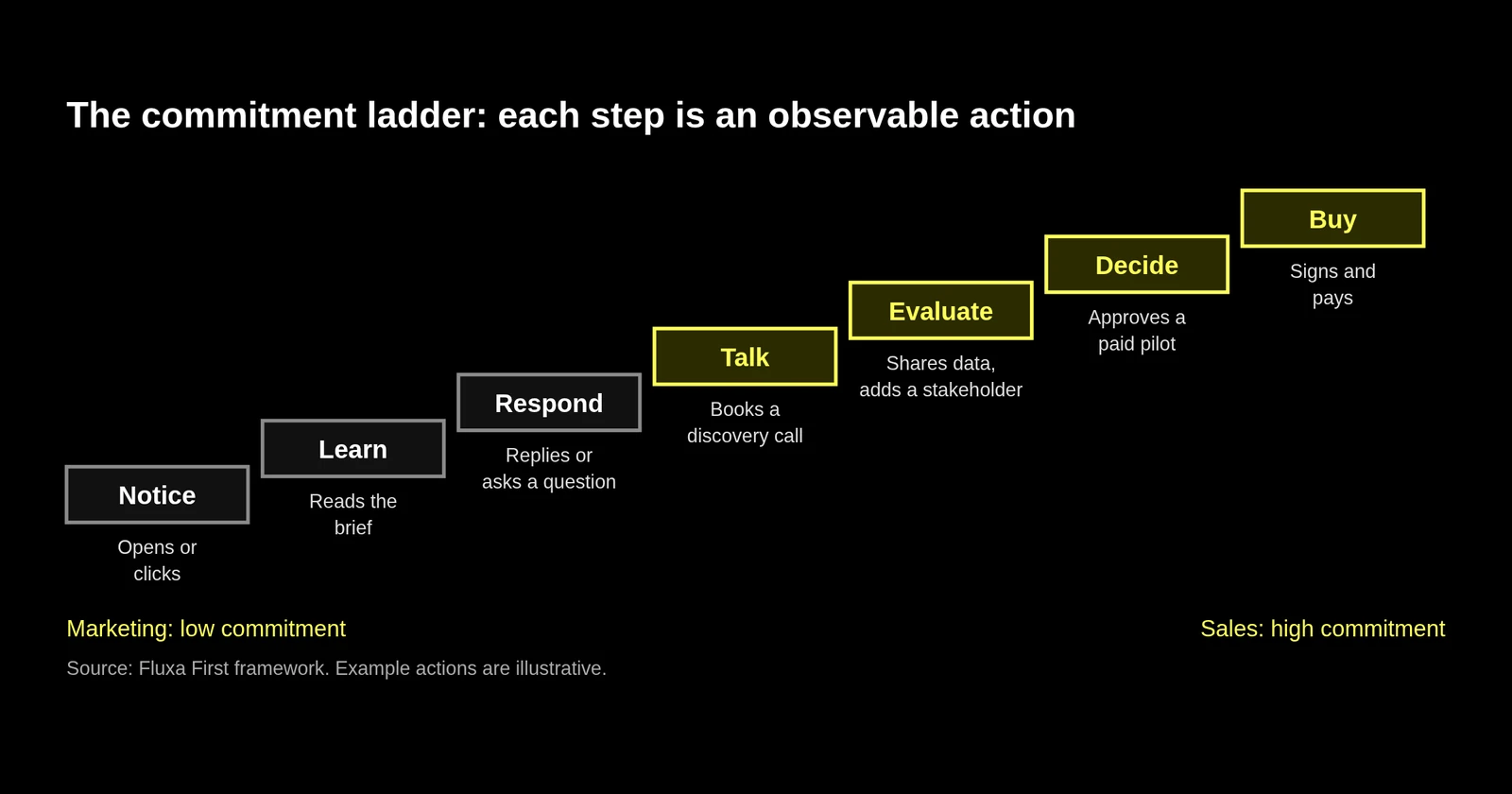
A closed deal is a string of small yeses. The commitment ladder makes those yeses explicit, moving from low-commitment marketing steps to high-commitment sales steps.
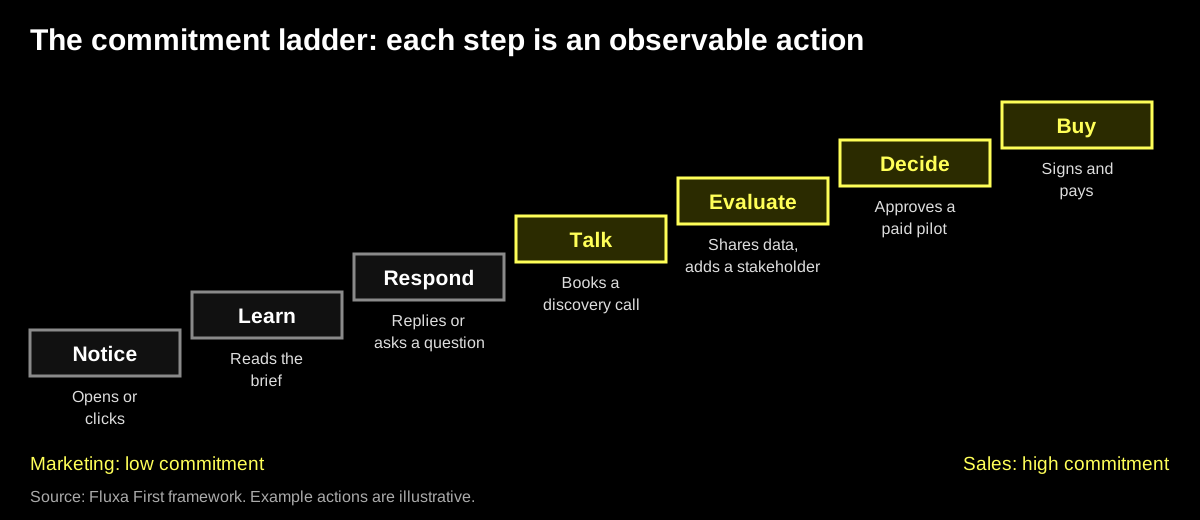
The rule is strict: a prospect moves up a step only when they take an observable action. They reply, book a call, share operating data, introduce a colleague, review an offer, approve a pilot or pay. A warm conversation is not a step. Neither is a promise to circle back.
This also tells you what to ask for. If a prospect has only just responded, the right ask is a second conversation, not a contract. Asking for the top step too early is the fastest way to lose a deal you could have won.
For each stage, write down four things:
- What the customer does at this stage.
- What commitment moves them to the next one.
- What evidence shows they are qualified to advance, including the problem, fit, ability to pay, access to the buying process and urgency.
- Where they are most likely to stop.
We covered who sits on the customer’s side in mapping the buying table. The ladder is the operating version of that map.
Which acquisition motion should you start with?
There are four broad ways to start a relationship: inbound, where the customer finds you; outbound marketing, where you put a message in front of an audience; outbound sales, where you contact a specific person or account; and channel-led, where a partner gives you access, credibility or distribution. Hybrids are fine, but one motion should be primary for the first funnel. Do not get stuck on taxonomy. The practical question is who starts the interaction, how you reach them and what you want them to do next.
How do you work backward from revenue?
Start with the revenue target already in your plan, divide by average sale price to get customers, then divide by expected conversion at each stage. Here is a hypothetical funnel for a company selling an industrial monitoring system to water utilities:
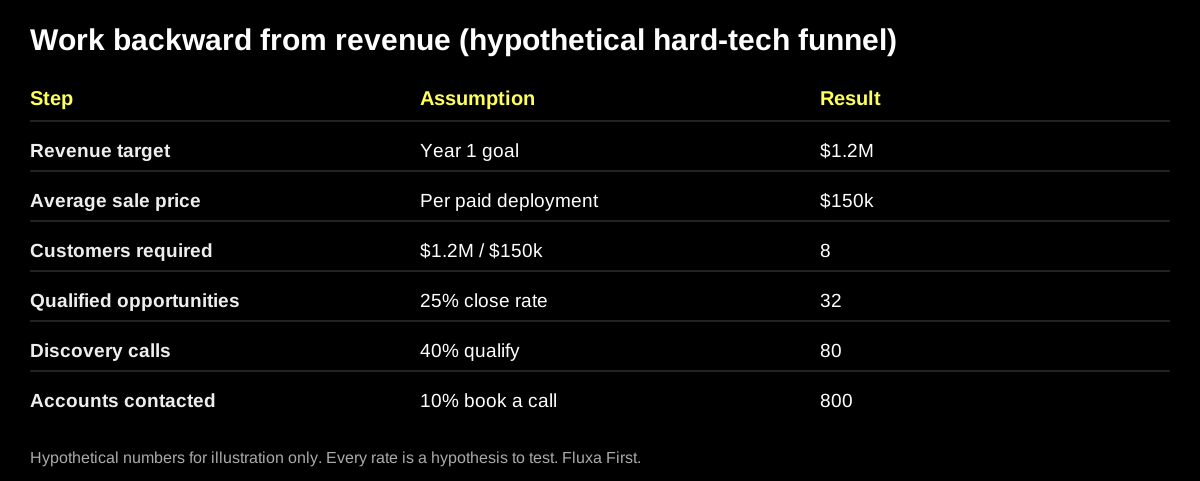
At $150,000 per deployment, a $1.2 million target needs 8 customers. If a quarter of qualified opportunities close, you need 32 opportunities. If 40% of discovery calls qualify, that is 80 calls, and if one in ten contacted accounts books a call, 800 accounts. These rates are invented for illustration. Yours are hypotheses until evidence supports them.
Then ask the operational question: can your team actually run 80 discovery calls, support the pilots that follow and deliver eight systems, all within the time your capital allows? A funnel must be mathematically credible and operationally possible. We connect this to cash and product timing in phasing your capital plan with your product roadmap.
How do you keep the funnel honest?
Label every number as known, supported, estimated or guessed. Most first funnels are mostly guesses, and that is fine if you say so. Pick the three least certain assumptions and design one experiment to test the riskiest first, such as a small outbound campaign to 50 utilities to measure the real call-booking rate.
Welcome contradictions. If the sales effort costs more than the sale is worth, if you need more customers than the market holds, or if the sales cycle is longer than your runway, the funnel has done its job. It showed you a problem while it is still cheap to fix. Founders who understand the pain and urgency behind pricing power usually find these problems early.
The first funnel is not a promise to investors. It is the first honest model of how your company will make money, and the best ones change every month as customers teach you how they really buy.
Frequently asked questions
What is a commitment ladder?
A commitment ladder breaks a purchase into small steps, from noticing a company to buying from it. Each step is defined by something the customer does that you can observe, such as replying, booking a call, inviting a colleague or approving a pilot. A deal advances one step at a time, and only on evidence.
How do you build a first sales funnel for a hardware startup?
Start from your existing choices about customer, buyer, business model, price and revenue target. Pick one primary acquisition motion. Define five to seven stages with the customer action and commitment needed at each. Then divide your revenue target by average price and your expected conversion rates to see how much activity the plan really requires.