
Who sits at the buying table in hard tech
Key takeaways
- The buying table is everyone who evaluates, influences, approves or can block a purchase.
- In hard tech the table is crowded, with operators, engineers, safety, cyber, procurement, legal and budget owners all involved.
- Deals need both a champion who wants you to win and an economic buyer who controls the budget; either one alone tends to stall.
- Large purchases are built from many small agreements, so plan the next commitment before every meeting ends.
Most hard-tech founders lose their first deals for the same reason. They find one enthusiastic person at a customer, run a great demo and send a contract. Then nothing happens. The reason is almost never the product. It is that one person does not make the decision. A group does, and the founder has only met one seat at the table.
At Fluxa First we teach founders to map the buying table before they write a product spec. It is one of the most practical tools in our studio curriculum, and it matters even more in aerospace, maritime, energy and industrial markets than in software.
What is the buying table?
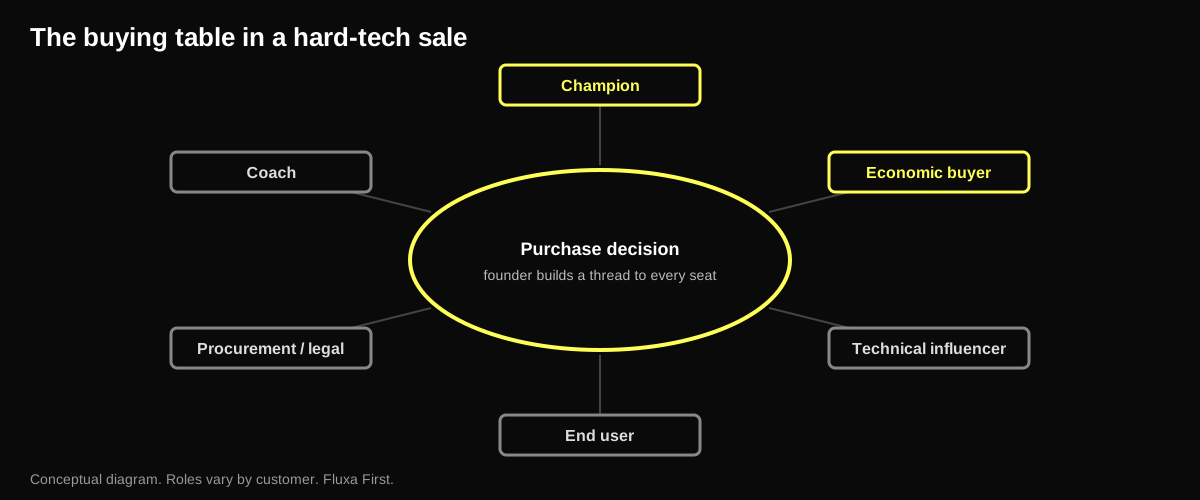
The buying table is everyone involved in evaluating, influencing, recommending and approving or blocking a purchase. Five roles show up again and again:
| Role | Who they usually are | What they need from you |
|---|---|---|
| Champion | Someone close to the problem, often near the end user | Proof that you will make them look good |
| Economic buyer | The person who controls the budget | A clear return and low risk |
| Influencer | Engineers, operators, trusted advisors | Technical credibility and fit |
| Blocker or gatekeeper | Procurement, legal, security, safety, insurance | Compliance, documentation, no surprises |
| Coach | An insider who explains how decisions get made | Respect and a reason to help |
Here is the rule of thumb we use. A champion who cannot reach the budget owner will cheer for you and still lose. A budget owner with nobody inside pushing for you has no reason to act. You need both, plus the influencers and gatekeepers who can quietly stop a purchase.
Why is the table so crowded in hard tech?
Physical systems touch more of an organization than software does. Picture a port operator evaluating an autonomous inspection system. The crane operators will use it. The operations director feels the pain of downtime and may become your champion. The CFO or a capital budget committee signs. Engineering checks integration with existing equipment. Safety and insurance want to know what happens when it fails. IT and cyber want to know what it connects to. Procurement wants three quotes and a standard contract.
Government buyers add their own seats: a program office, a contracting officer, the end users in the field and test and evaluation teams. Each has a different definition of success.
Every one of those people has goals, and every goal comes paired with a pain. The operations director wants uptime and fears an accident on their watch. The CFO wants payback inside budget cycles and fears a stranded asset. When you listen for both halves of each pair, you learn what each seat actually needs to hear.
How do you build relationships at the table?
Start with the champion, then widen. Find the person who feels the pain most directly and earn their trust first. Then ask them to help you meet the others. Deals with several engaged stakeholders are far sturdier than deals that run through one person.
Tailor the message to the seat. The CFO cares about return on capital. The operator cares about whether it is easier to use than what they have. The safety lead cares about failure modes. One pitch deck will not serve all of them.
Keep discovering. Discovery is not a phase you finish. A buyer’s situation changes during a long hardware sale: budgets move, people leave, priorities shift. Keep asking open questions all the way to the close. When someone raises an objection, acknowledge it and answer with a question that uncovers the reason behind it. Price objections are often a stand-in for a concern about risk.
Why do small commitments matter so much?
Big purchases rarely happen in one leap. They are built from a series of small agreements, each one a little larger than the last. Sending a contract after one call skips all of them. It asks for a big commitment before the buyer understands what they are agreeing to, and it usually ends in silence.
Instead, build a ladder:
- They take a first call.
- They introduce a colleague who also feels the problem.
- They share data or a process document that helps you understand their operation.
- They host a site visit.
- They agree to a pilot with written success criteria.
- They fund the pilot or a paid study.
- They buy.
Each step costs the buyer a little more and makes the next step easier. Before every meeting ends, agree on the next step. That habit alone fixes many stalled pipelines. The patient path is usually the quicker one.
How we use this in the studio
When we build a company with founders, we map the buying table during problem discovery, long before there is a product to sell. It shapes what we build: if the safety lead and insurer are the hardest seats, then certification data and failure analysis belong in the first version, not the fifth. It shapes the business model too, because the person who signs determines whether you sell a product, a service or a subscription.
Founders who learn this early sell faster, raise money more easily and build products that buyers can actually approve. Investors, it turns out, sit at a buying table of their own.
More of our founder playbooks are collected under topics.
Frequently asked questions
What is a buying table in sales?
The buying table is the full group of people involved in a purchase decision. It includes the person who signs, the people who will use the product, the technical evaluators who shape the choice, and gatekeepers such as procurement, legal or security who can slow or stop it. Mapping it early tells a founder who to talk to and in what order.
What is the difference between a champion and an economic buyer?
A champion is usually close to the problem and personally wants your solution to win, so they sell for you internally. The economic buyer controls the budget and can approve the purchase even when others hesitate. Most deals need both, and founders who only have one tend to stall.