
Your first big partner may become your biggest competitor
Key takeaways
- Large early partners, such as primes, OEMs, distributors and anchor customers, often have the resources and incentive to copy your solution or cut you out once they understand it.
- Partnerships are still valuable; the goal is to enter them deliberately and avoid giving away leverage before you have real defensibility.
- Practical protections include clear IP ownership, narrow and conditional exclusivity, sharing outcomes rather than methods, and keeping several partners in play.
- Run competitive analysis on your partners as well as your competitors, including the option of them building it themselves.
Founders in hard tech spend months chasing their first big partner: a prime contractor, an OEM, a utility, a national distributor. Landing one feels like the finish line. It is often the start of a new competitive risk. In our studio we teach a simple warning early: the organization that opens your first door may also be the one best placed to replace you.
Why do early partners become competitors?
Large partners usually have three things a startup lacks: resources, relationships with your target customers and the engineering capacity to build their own version of your product once they understand how it works. Early in a partnership you have to explain your approach to make the deal happen. That explanation is valuable. Some partners will use it.
This does not require bad intent. A prime that sees a new capability becoming essential to its programs has a rational reason to bring it in-house. A distributor that learns your customers’ buying patterns can find a cheaper supplier. A large customer that funds your pilot may decide to build version two internally.
Is partnership still worth it?
Yes. For many hard-tech companies, partners are the only realistic path to customers in the first few years. A defense prime may hold the contract vehicle. An OEM may own the installed base. A utility may control the test site.
Sometimes the partnership is the exit. Perciv AI, a Delft radar perception startup, worked with defense company Destinus for about a year before Destinus acquired it in October, keeping the founders in charge of radar perception. German telematics provider YellowFox fully acquired Peregrine, an AI video company it had co-developed products with for more than three years, according to Dealroom. Those are good outcomes, and both came from partners who saw the value up close. We discuss why strategic buyers act this way in our post on strategic acquirers.
The difference between that outcome and being copied is usually leverage: how much the partner needs you, and how hard you are to replace.
How should founders structure early partnerships?
Before signing anything, answer five questions honestly:
- If this partner already has the customers or distribution, what stops them from taking our playbook and cutting us out?
- What are the real rewards of partnering this early, against the risks?
- How does our go-to-market path, direct, through partners or a hybrid with services, change our exposure?
- Are we walking into an exclusivity trap, or can we work with several partners?
- What would make us the most attractive option for this partner even without exclusivity?
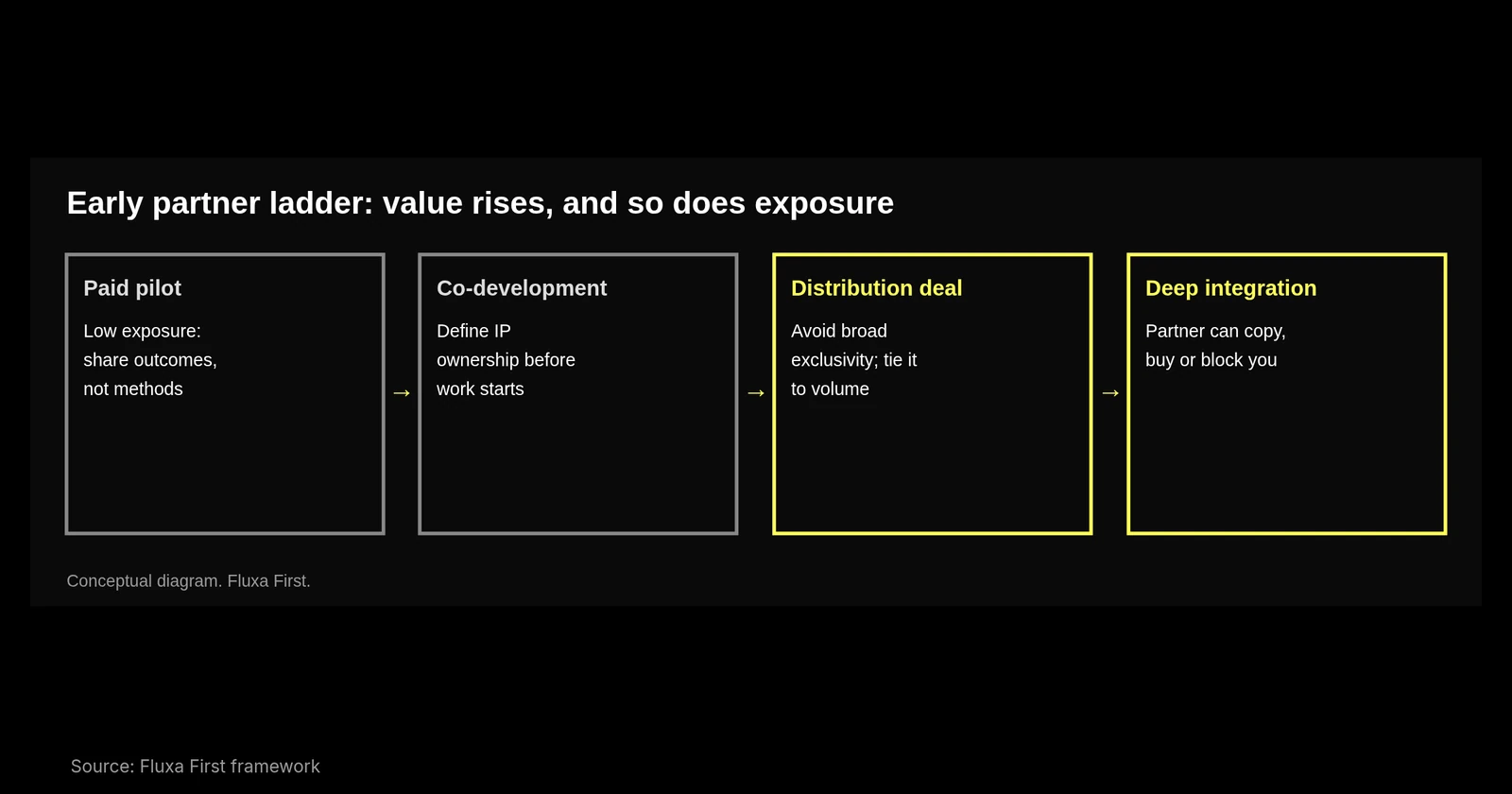
Then build protections into the relationship as it deepens.
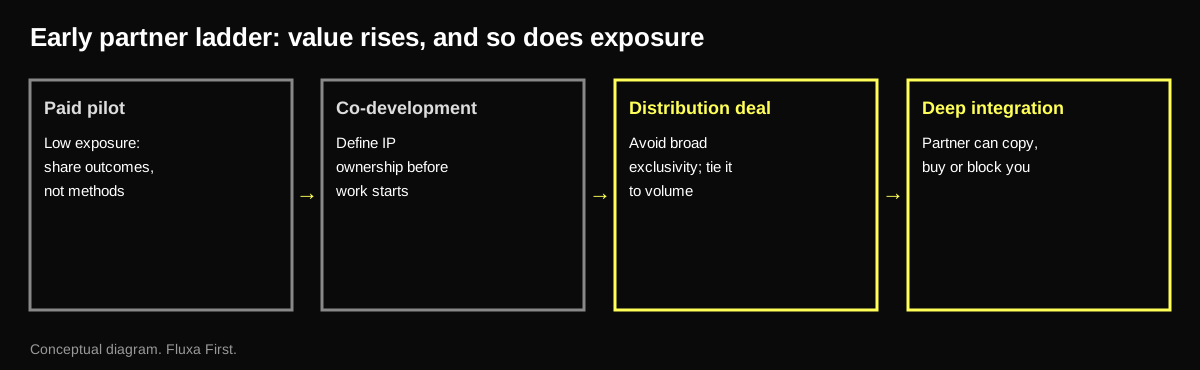
| Stage | What you gain | What to protect |
|---|---|---|
| Paid pilot | Validation, data, a reference | Share results, not your methods or source |
| Co-development | Engineering help, funding, a design partner | Written IP ownership before work begins |
| Distribution deal | Reach into an installed base | Narrow, conditional exclusivity tied to volume |
| Deep integration | Locked-in revenue | Interfaces you control; multiple customers |
Share outcomes, not methods. In pilots, a partner needs to see that your system works. It rarely needs your process recipes, training data or code.
Settle IP before the work. Background IP, new IP and licenses should be in writing before the first engineering meeting. Get good counsel.
Keep exclusivity narrow. If you must grant it, limit it by market, geography or time, and tie it to minimum purchases.
Keep several partners in play. Competition among partners for your attention is the best protection there is.
Make yourself hard to replace. Speed of improvement, layered IP, certifications and a customer base beyond any single partner all raise the cost of copying you.
Run your competitive analysis on partners too
Most founders map existing competitors. Fewer map potential new entrants, and fewer still put their own partners on that list. We ask founders to run two separate analyses: one on companies already competing for their customers, and one on who could enter, including well-funded startups, adjacent players and early partners with the capability and incentive to build their own version. Include the status quo too, because doing nothing is often the strongest competitor in industrial markets.
Be blunt in that analysis. The goal is not to feel good about the partnership. It is to see clearly enough to negotiate from strength.
How we use this at Fluxa First
Partner strategy belongs in company design from the start, alongside the buying table and the capital plan. Founders should decide early which partner to approach first, what to disclose at each stage and what the agreement must protect.
We also think about financing the same way. Capital that lets a company reach revenue without depending on a single partner’s goodwill gives founders the leverage to say no to bad terms. Partnerships should make a company stronger, whether it stays independent or eventually becomes part of the partner. Either way, it should be a choice the founders make, not one made for them.
More founder playbooks are collected under topics.
Frequently asked questions
Should a hardware startup give an early partner exclusivity?
Rarely broad exclusivity, and never for free. If exclusivity is needed to win the deal, limit it by market, geography or time, and tie it to minimum volumes or payments so the partner cannot lock you up and then underbuy. Keep the right to work with others outside the defined scope.
How do you protect IP in a co-development agreement?
Agree in writing before work starts who owns background IP, who owns new IP and what license each side gets. Share what is needed for the project, document what you disclose, and keep core know-how such as process recipes, training data and source code under your control wherever possible. Get experienced counsel to review the agreement.