
Pain and urgency come before pricing power
Key takeaways
- Pricing power rarely comes from features; it comes from a problem customers feel they must solve, soon.
- We score problems on pain (cost of doing nothing) and urgency (how fast it must be solved) before we look at solutions.
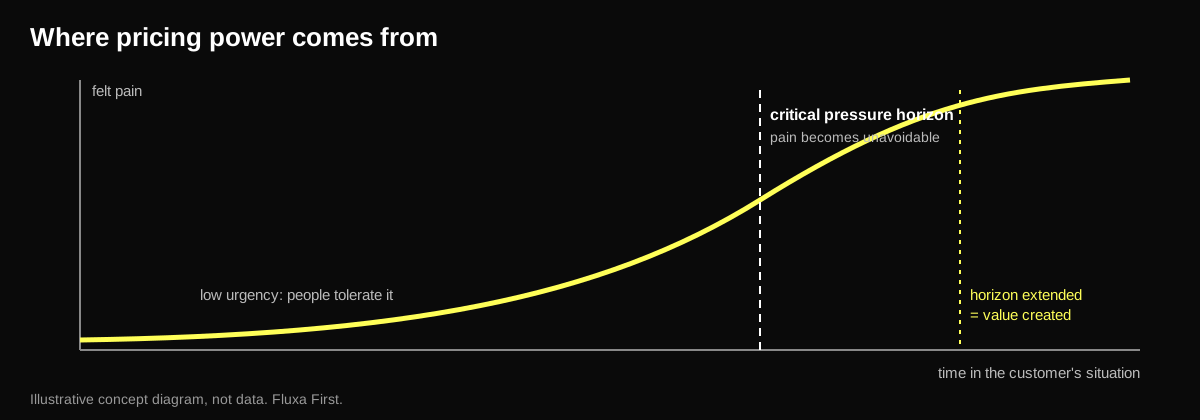
- The critical pressure horizon is the moment a problem becomes unavoidable; extending it is where value is created.
- Founders who qualify the problem first avoid falling in love with a solution nobody needs.
The strongest pricing power in hard tech rarely comes from a better spec sheet. It comes from solving a problem customers feel compelled to solve, quickly, with few good alternatives. That is why our studio qualifies the problem long before anyone sketches a product, and why we teach the same discipline in our builder curriculum.
Why do founders fall for solutions first?
Engineers and operators are trained to solve things. Give a capable team a vague problem and they will be designing hardware within an hour. We call the resulting failure mode the founder’s trap: judging an idea by how exciting the technology is, how novel the features are or how much the team enjoys building it.
Customers judge differently. They ask whether it removes pain, reduces risk, saves time or makes money. If the answer is weak, the elegance of the solution does not matter.
So we split every idea into two parts: a problem space and a solution space. One well-defined problem can support many possible solutions. We qualify the problem first, then make the solutions compete.
What makes a problem worth solving?
We look for four sources of pricing power, all of which sit in the problem rather than the product:
| Source | The question we ask |
|---|---|
| High pain | What does doing nothing cost, in money, time, risk or exposure? |
| High urgency | How soon must it be solved, and is there a deadline or trigger? |
| Few alternatives | What do people do today, and how bad is it? |
| Clear return | Does the value created far exceed what we would charge? |
Pain creates demand. Urgency decides whether that demand turns into a purchase order. Plenty of people agree a problem exists and never act on it, because nothing forces the issue this quarter. A shipyard losing schedule days every week to a welding inspection backlog has urgency. A firm that would like nicer dashboards does not.
What is the critical pressure horizon?
Every problem has a moment when it stops being tolerable. Before that moment, people work around it. After it, they act, and they will pay. We call that moment the critical pressure horizon.
In our builder program, every team worked one deliberately unglamorous sample problem: many small recreational boats have no onboard restroom, and trips often run several hours. The biology is predictable, so the moment of crisis is predictable too. That is exactly what made it a good teaching case. Teams could measure when the pressure hit, who felt it, and what a solution would have to do to push the horizon back or remove it. Nobody had a pet solution to defend, so everyone had to start from facts.
The same logic applies to serious industrial problems. A satellite operator’s horizon might be the date a spacecraft runs out of propellant. A utility’s might be the week a failed transformer leaves a substation dark. A port’s might be the hour a crane outage starts backing up vessels. Each has a measurable point when pain becomes unavoidable, and a measurable value for moving it.
How we use this in the studio
When a problem comes into our studio, from a founder, an industry partner or our own research, we work it in a fixed order:
- Write the problem statement with facts. Numbers, sources and the people who feel the pain, with no product mentioned.
- Find the horizon. When does the problem become unavoidable, and how often does that happen?
- Score pain and urgency. We compare problems against each other on the same scorecard, so they compete for our time.
- Only then open the solution space. Teams generate several solution ideas and make each one earn its way through feasibility, unit economics and customer acceptance.
The order matters. A team that qualifies the problem first can change solutions without losing its footing. A team that started with a solution has to defend it.
What it means for founders
If you are raising for a hard-tech company, lead with the problem and its horizon, not the product. Investors and customers both respond to a clearly stated, fact-based problem with a visible moment of crisis. Show who feels it, how often, and what it costs. Then show why your approach moves that moment, and by how much.
What it means for investors
Ask founders to separate the problem from the solution in their pitch. If they cannot describe the pain and urgency without describing their product, the problem may not be qualified yet. That is not a reason to pass, but it is a reason to expect a pivot.
We build companies this way because it produces businesses with real pricing power, and real pricing power is what makes a company durable. Learn more about Fluxa First or browse all topics.
Frequently asked questions
What is the critical pressure horizon?
It is the point in a customer’s situation when a problem stops being tolerable and must be dealt with. Before it, people put up with the issue. After it, they act and will pay. A product that pushes that point further out, or removes it, creates value customers can measure.
Why qualify the problem before the solution?
Because the solution is the part founders love and customers do not care about. If the problem lacks pain and urgency, no clever solution will create pricing power. Qualifying the problem first lets a team compare many solution ideas against a problem that is already proven worth solving.