
Match the money to the milestones: phased capital plans for hard tech
Key takeaways
- A hard-tech company needs four linked plans - a phased product roadmap, a phased go-to-market plan, a phased capital plan and a three-to-five-year pro forma.
- Products move through three phases - prototype, small batch and mass production - each with different goals, costs and risks.
- A typical venture fund expects exits within about ten years, while an aggressive deep-tech timeline can need that long just to reach scale.
- Raise for the phase you are in, tie each raise to evidence, and choose the type of money that fits the phase.
Most hard-tech companies that run out of money do not fail because the technology did not work. They fail because the money and the milestones were out of sync. They raised too much for the wrong phase, or too little to reach the next proof point, or they took money from investors whose clock did not match the product.
In our studio, we fix that by building the capital plan from the product roadmap, not the other way around.
What plans does a hard-tech founder actually need?
Investors do not expect certainty. They do expect a believable model of how the business reaches positive cash flow and eventually returns capital. At minimum, we ask founders to write down four linked plans:
- A phased product roadmap: what you will build, and when.
- A phased go-to-market plan: how you will find, sell to and serve customers at each stage.
- A phased capital plan: how much money you need, when, and what each tranche will accomplish.
- A three-to-five-year pro forma: revenue, expenses, working capital and cash flow over time.
None of them need to be perfect. They need to exist and agree with one another. The product roadmap comes first, because everything else depends on it.
What are the phases of a hardware product?
A product is not just the thing you build. It is the way you solve the same problem for customers over and over, dependably. That reliability is what a business is built on, and it develops in stages.
| Phase | Goal | What it should prove | Typical money |
|---|---|---|---|
| 1. Prototype | Show the solution can be built and works | Feasibility, real unit cost at small scale | Founder, grants, non-dilutive programs, early equity |
| 2. Small batch | Produce consistently and start selling | Repeatable production, paying customers, early margins | Customer prepayments, paid pilots, strategic and revenue-linked capital |
| 3. Mass production | Scale volume and profitability | Unit economics at volume | Equipment and working-capital debt, growth equity |
The most common mistake is skipping ahead. Founders try to build a polished, feature-rich product from day one, and spend Phase 3 money on a Phase 1 question. A working first version has to exist before a better second version can.
How do you decide what goes in the first version?
We use three questions for every proposed feature in the minimum viable product:
- Is it needed to show the solution can be built at least once?
- Is it needed to solve the core problem for one target customer?
- Is it needed to get that customer to pay?
If the answer to all three is no, it waits. Every extra feature adds cost, complexity and time, and in hardware that cost shows up in tooling, certification and supply chains, not just engineering hours. During Phase 1, track every production cost carefully and write down what surprised you. Those real numbers become the foundation for Phase 2 unit economics and the most credible thing you can show an investor.
Why don’t deep-tech timelines fit venture funds?
This is the part many founders discover too late.
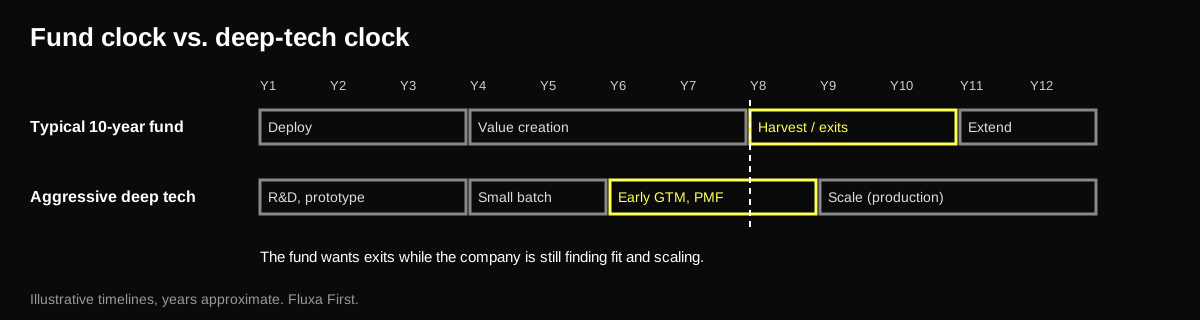
A typical venture fund deploys capital in roughly its first three years, builds value through about year seven, harvests exits in years eight to ten and sometimes extends a year or two beyond. An aggressive deep-tech timeline looks different: research and prototyping in the first few years, small-batch production by around years three to five, early go-to-market and product-market fit by around years five to eight, and scale after that.
Put those side by side and the problem is obvious. The fund wants to exit right when the company is entering its hardest, most capital-hungry phase. That mismatch is why early deep tech is hard for many investors, and why founders feel pressure to sell early or chase milestones that look good in a pitch deck instead of the ones that matter.
How we build the capital plan
We start from the roadmap and work backward. For each phase, we define the evidence that would change how the next investor or customer sees the risk, such as a passed qualification test, a pilot with written success criteria or a first production batch at a known cost. Then we size the raise to reach that evidence with some margin, and no more.
We also let each solution justify its research spending. A team may be excited about several approaches to a problem. We compare them at the solution-space level first, pick the most promising, and only then commit serious R&D money. That progression protects founders from pouring capital into a detailed design before the market has told them anything.
Finally, we match the type of money to the phase. Grants and non-dilutive programs fit research. Customer prepayments and strategic partners fit small-batch production. Revenue-linked capital fits a company that has started selling. Debt fits equipment and working capital once cash flow is visible. Growth equity fits scale.
Our view
A capital plan is a product decision. When the money is tied to milestones, every raise buys evidence, every investor knows what they are funding and founders keep more of their company. That is how we build alongside founders at Fluxa First, and it is why we pair studio support with capital designed for the long timelines of aerospace, maritime, energy, autonomy and advanced manufacturing.
More on how we build is collected under topics.
This post is general commentary, not investment, legal or tax advice.