
What venture Form D filings say about who is raising, and how founders should read them
Key takeaways
- In a snapshot of its listings through October 22, 2026, DryPowder counted 201 venture fund Form D filings for October 1 to 22; the 120 that stated a size totaled $9.77 billion in fundraising targets, not capital raised, with a median of $20 million.
- The ten largest stated offerings add up to about half of that total, so fund formation is a barbell of many small funds and a few large ones.
- A Form D shows a fund’s stated offering and how much it has sold, and some filings are amendments, so read the details before treating it as fresh money.
- Founders should match their round to a fund’s size and stage, and target funds early in their deployment period.
Venture fund formation is a barbell. In the first three weeks of October 2026, many small funds filed with the SEC and a handful of very large ones did too, with comparatively few in between. For hard-tech founders deciding whom to pitch, that shape matters as much as the headline dollar totals.
What do October’s Form D filings show?
When a venture fund raises money under the usual private-offering exemption, it files a short notice called a Form D with the SEC. DryPowder, which tracks these filings from SEC EDGAR, counted 201 venture and angel fund filings dated October 1 to October 22, 2026, in a snapshot of its listings through October 22, after excluding single-deal vehicles such as SPVs. DryPowder revises its counts as late filings arrive and updates its page hourly, so the live page may now show somewhat different numbers.
Of those 201, 120 stated an offering size. Together their stated offering sizes, which are fundraising targets rather than money raised, totaled $9.77 billion, with a median of just $20 million.
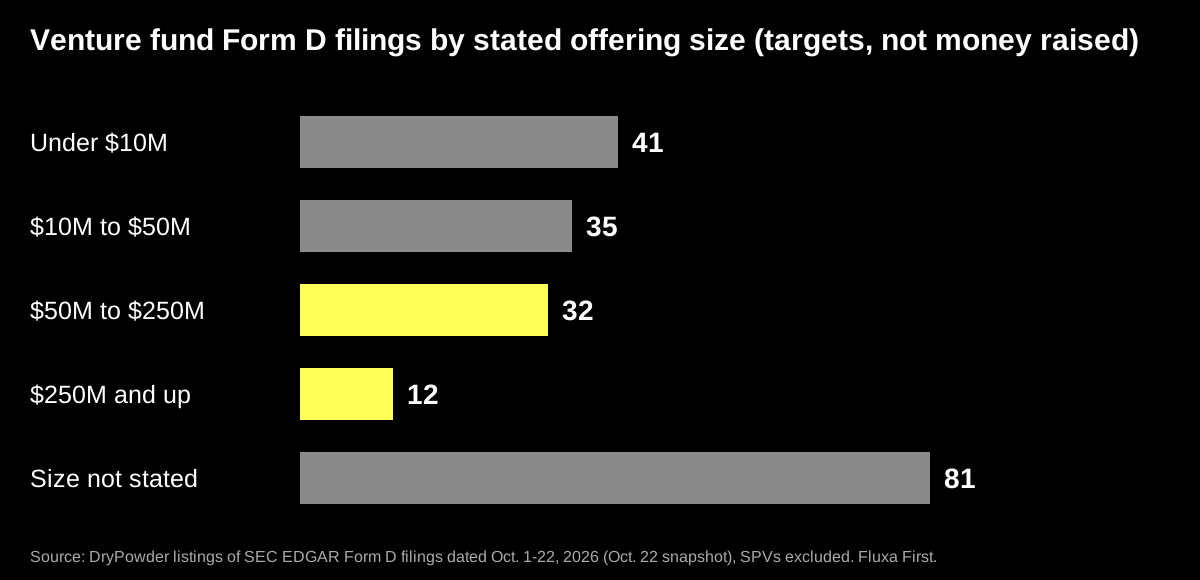
By size, 41 funds stated less than $10 million, 35 stated $10 million to $50 million, 32 stated $50 million to $250 million and 12 stated $250 million or more. Another 81 left the size blank. Adding up the ten largest stated offerings on DryPowder’s list gives about $5.35 billion, a little over half of the month’s stated total. In other words, about 8% of the funds that stated a size (10 of 120) account for half the dollars.
How should you read a Form D?
A Form D is useful, but it is easy to misread. Two numbers matter: the stated offering amount and the amount sold so far. Some filings are also amendments to earlier raises rather than new funds. A few October examples from EDGAR show the range:
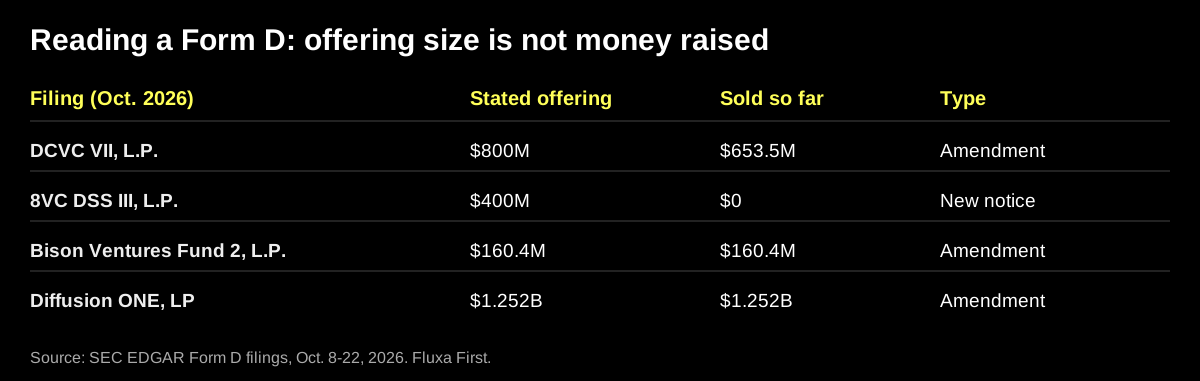
- DCVC VII, L.P. filed an amendment on October 8 showing an $800 million offering with about $653.5 million sold.
- 8VC DSS III, L.P. filed a new notice on October 22 for a $400 million offering with nothing sold yet.
- Bison Ventures Fund 2, L.P. filed an amendment showing $160.4 million offered and fully sold.
- Diffusion ONE, LP filed an amendment on October 9 showing a $1.252 billion offering, fully sold.
So a big number on a tracker can mean a fund that is fully raised, one that has barely started, or an update to a raise from months ago. DryPowder itself notes that a filing is a signal, not a guarantee that a fund is writing checks.
What does the barbell mean for founders?
Match the round to the fund. A $20 million fund, the median this month, typically writes small checks and rarely leads a large round. A hard-tech company raising a $15 million round needs a lead whose fund is big enough to own a meaningful share and still reserve money for follow-ons. Pitching the wrong size of fund wastes months.
Target funds early in deployment. A new notice with little sold often means a manager is just starting to invest. A fully sold fund raised two years ago may have little room for new companies. The filing date and amount sold help you sort the two.
Expect the middle to be thin. With most dollars in a few large funds and most funds small, companies that need $5 million to $20 million to reach their next technical milestone can fall into a gap. That is common in hard tech, where a prototype or first production line costs more than software but the company is too early for growth funds.
Build a capital stack, not just a round. Non-dilutive programs, customer prepayments, strategic partners and equipment financing can fill part of that gap. We wrote about this in our look at blended hard-tech financing with orders, strategics and debt.
How we see it
The Form D data is a snapshot of part of one month, not a trend line, and stated offerings are fundraising targets, not money raised. Still, it fits a pattern we see across venture: capital concentrates in a small number of very large funds while a long tail of small funds competes for the same early deals. We have also written about how that concentration shows up in LP distributions and emerging managers.
Our response is to be a different kind of partner. As a venture studio, we build alongside founders from problem selection through first customers, and we back durable companies with capital designed around hard-tech timelines rather than a single fund’s clock. For founders, the practical lesson is to research every investor’s fund size, stage and deployment window before the first meeting. Public filings make that easier than ever, as long as you read past the headline number.
This article is general information, not investment or legal advice.
Frequently asked questions
What is a Form D?
A Form D is a short notice filed with the SEC by companies and funds raising money under a Regulation D exemption. For venture funds it lists the stated offering amount, how much has been sold so far and related details. It is a notice, not a prospectus, and it does not say how a fund will invest.
Does a Form D mean a fund is investing now?
Not necessarily. A new filing often means a fund has started raising or has had its first close, which is usually when it begins writing checks. An amendment may just update an older raise. Check the amount sold, the fund’s thesis and its recent deals.