
Hard-tech rounds now come with orders, strategics and debt
Key takeaways
- Recent hard-tech rounds mix venture equity with strategic investors, customer orders and term debt.
- Peak Energy’s $108 million Series B was led by GM Ventures and is tied to more than $1 billion in existing customer orders, per the company.
- Reliable Robotics added $115 million to its Series D, made up of $90 million in equity and $25 million in bank debt, per TechCrunch.
- Founders should design the capital stack around milestones and use dilutive equity where nothing else fits.
The most interesting thing about this week’s hard-tech financings is not the size of the checks. It is what came with them. Customer orders, strategic investors and bank debt are now showing up beside venture equity, and that tells founders a lot about how to build a capital plan for a physical-world company.
What did this week’s rounds look like?
Peak Energy builds passively cooled sodium-ion storage systems for the grid. On Oct. 21 it announced a $108 million oversubscribed Series B led by General Motors Ventures, with participation from Maverick Silicon, Infinite Capital, Eclipse, Xora Innovation and LG Technology Ventures. The company says the money will scale domestic manufacturing, fulfill more than $1 billion in existing customer orders and bring its product to data centers. Earlier this year Peak announced a partnership with GM to develop sodium-ion cells and unveiled a 4 GWh factory in Sacramento that it expects to start production in Q1 2027.
Reliable Robotics develops autonomous flight systems that can be installed on existing aircraft. Per TechCrunch, it added $115 million to its Series D: $90 million in equity led by Nimble Partners and $25 million in debt from Silicon Valley Bank. The Series D now totals $275 million, the company has raised $380 million to date and its valuation passed $1 billion. Its CEO told TechCrunch he expects FAA certification of its first product, which handles takeoff and landing with a pilot on board, in 18 to 24 months.
| Peak Energy | Reliable Robotics | |
|---|---|---|
| Sector | Grid energy storage | Autonomous aviation |
| Lead | GM Ventures (strategic) | Nimble Partners |
| Structure | $108M Series B equity | $90M equity + $25M bank debt |
| Evidence cited | $1B+ customer orders, factory site | Certification progress, operating cargo airline |
Why are strategics and debt showing up now?
Strategics bring more than money. A strategic lead like GM Ventures can bring manufacturing know-how, supply chain access and a path to scale that a financial investor cannot. For a company that has to build a factory, that help can matter as much as the cash. The trade-off is real: founders need to watch for terms that limit who else they can sell to.
Orders make capital cheaper. A company that can point to signed customer commitments is a different risk than one that is still searching for buyers. Orders do not guarantee revenue, since contracts have milestones and conditions, but they turn a technology bet into a delivery bet. Investors price those two risks very differently.
Debt fits assets and milestones. Reliable’s $25 million term loan sits next to $90 million of equity. Debt costs less dilution than equity, but it adds fixed obligations, so it suits companies with clear milestones, real assets or predictable cash flow. Taking on debt too early, before revenue is visible, can turn a delay into a crisis.
What should founders take from this?
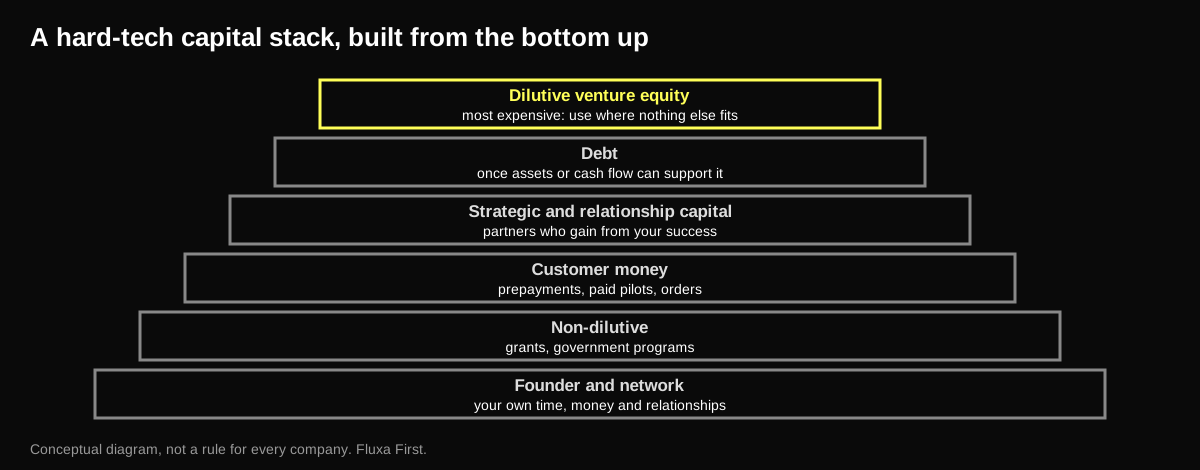
We teach founders to think about the capital stack from the bottom up. Start with what you and your network can bring, then non-dilutive sources such as grants and government programs, then customer money such as prepayments and paid pilots, then strategic and relationship capital, then debt once you have assets or revenue to support it. Dilutive venture equity is powerful, but it is the most expensive layer, so we use it where nothing else fits.
That order is not a rule for every company. It is a habit of asking, for each milestone, what the cheapest appropriate money is. Three questions help:
- What evidence will this money buy? Tie each raise to a milestone that changes how the next investor sees the risk, such as a certification step, a production run or a signed order.
- Who else benefits if we hit it? Customers and strategic partners who gain from your success are often the best early investors, as long as the terms keep your options open.
- What fixed obligations can we carry? Only take debt that your assets or cash flow can support even if the schedule slips.
Our view
Hard-tech companies are capital intensive, and the old model of raising ever-larger equity rounds until an IPO does not fit most of them. We think the healthier pattern is the one visible this week: a blended stack in which customers, strategic partners, lenders and equity investors each fund the part of the risk they understand best.
That is also how we work at Fluxa First. As a venture studio we build alongside founders from the problem stage, and we pair studio support with capital designed to match a company’s milestones and revenue, rather than forcing every company onto the same path. You can read more of our financing posts under topics.
This post is general commentary, not investment advice. Company figures are as reported in the linked announcements and coverage.