
The IPO window is open for proof, not promise

Key takeaways
- US IPO proceeds are high this year, but a handful of mega deals did most of the work and postponements climbed through Q3.
- Renaissance Capital counted 30 US listings in Q3 2026 raising $32.8 billion, or $6.2 billion without one giant offering.
- Public investors are paying for operating proof (revenue, margins, contracted demand) and pushing back on valuations built on narrative.
- Hard-tech companies should plan several liquidity paths instead of betting everything on one IPO date.
The IPO market is open, but only for companies that can show their work. That is the clearest read of the past quarter, and it matters a great deal for hard-tech founders and the investors who back them.
What happened to the IPO market in Q3?
On the surface, 2026 looks strong. CNBC, citing Renaissance Capital data, reported about $146.9 billion in US IPO proceeds across 110 deals so far this year, excluding SPACs. But a few mega offerings, including SpaceX, SK Hynix and Cerebras, account for much of that total, and deal count was down about 30% from the same point last year.
The third quarter showed the strain. Renaissance Capital’s Q3 review counted 30 listings raising $32.8 billion, but SK hynix’s $26.5 billion US offering drove most of that. Without it, proceeds were $6.2 billion. Renaissance pointed to concerns about AI spending, a 19-year high in bond yields and resumed rate hikes as the reasons the fall pickup stalled.
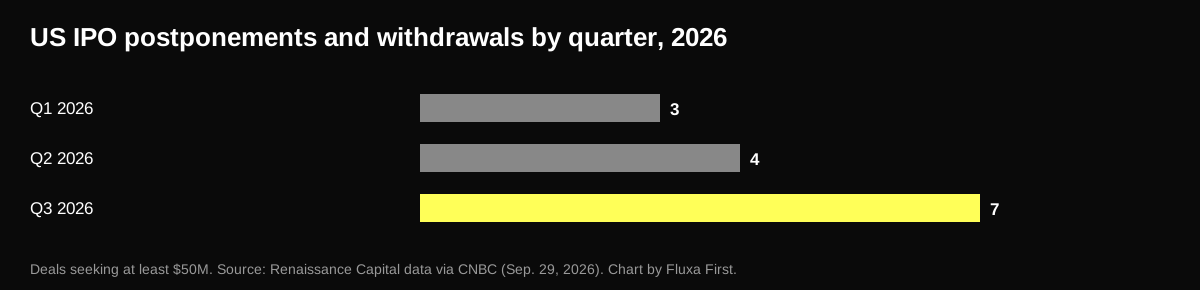
Postponements tell the same story. Per the same CNBC report, seven companies aiming to raise at least $50 million postponed or pulled IPOs in Q3, up from four in Q2 and three in Q1. Oura delayed its offering, and nuclear component maker Holtec withdrew.
Why are public investors pushing back?
Two cases from the past month show the pattern.
SB Energy, the SoftBank-backed developer that pivoted from renewables to AI data centers, delayed a planned $5 billion IPO after investors indicated interest below its targeted $50 billion valuation, according to IFR. That happened even though Nvidia had committed $3 billion in total, including a $1.5 billion prepayment for shares. A strong anchor investor did not close the gap between the story and what public buyers would pay.
Oura faced a different objection. Analysts quoted by CNBC tied its delay partly to a concentrated product line, the kind of risk public investors have been burned by before.
The common thread is simple. Public investors are paying for evidence: revenue, margins, contracted demand and a business that does not depend on a single product or customer. They are discounting valuations that rest on what a company might become.
What does this mean for hard-tech founders?
Hard-tech companies tend to have long build cycles and lumpy revenue. That makes them more exposed to a narrow window, not less. We think three things follow.
1. Build for proof early. The companies that list well in this market show operating results, not just technical milestones. For a hardware or industrial company that means paying customers, repeatable production and gross margins that improve with volume. Start tracking and reporting those numbers years before you need them.
2. Plan several liquidity paths. An IPO is one exit. Strategic acquisitions, secondary sales and refinancing are others. A company that a strategic buyer would want to own, and that could carry some debt on its cash flow, has options when the public window narrows.
3. Do not let your cap table depend on one date. If every investor on your cap table needs an IPO by a certain year to make their fund math work, you will feel pressure to list into a bad market or sell early. Choose investors whose returns do not hinge on a single event.
| Liquidity path | What it needs | Window risk |
|---|---|---|
| IPO | Scale, predictable revenue, public-market story | High: depends on rates and sentiment |
| Strategic acquisition | A product or capability a larger company needs | Medium: depends on buyer budgets |
| Secondary sale | Investor demand for the position | Medium: often at a discount |
| Cash returns from operations | Revenue and margin | Low: driven by the business itself |
How we think about it at Fluxa First
We build and back durable companies in aerospace, maritime, autonomy, energy and advanced manufacturing. Many of them will be worth owning for a long time before any IPO. That is why we favor studio-aligned capital that can share in a company’s revenue as it grows, alongside traditional equity. Structures like that put cash back in investors’ hands from operations, which means a narrow IPO window is an inconvenience instead of a crisis.
A capital markets lawyer quoted by CNBC noted that private capital is now deep enough that companies do not have to go public if they cannot get the value they want. We agree, and we would add one point. The best protection against a closed window is a business that makes money. Build that, and the window becomes a choice.
You can find more of our financing and market posts under topics.
This post is general commentary, not investment advice. Figures are from the cited reports as of their publication dates.
Frequently asked questions
Is the IPO market open for hard-tech companies?
Partly. Companies with real revenue and clear demand can still list, but investors have pushed back on high valuations and story-driven deals. Several large offerings were postponed in late Q3 2026 as bond yields rose. Founders should treat the IPO as one option and build a business that can also be acquired, refinanced or return cash.
Why are IPOs being postponed in 2026?
Analysts point to a mix of rising bond yields, renewed rate hikes and doubts about AI infrastructure spending, plus company-specific issues such as concentrated product lines or valuation gaps. Deep private capital also lets companies wait rather than accept a lower public price.