
Strategic buyers are the quiet exit for hard tech
Key takeaways
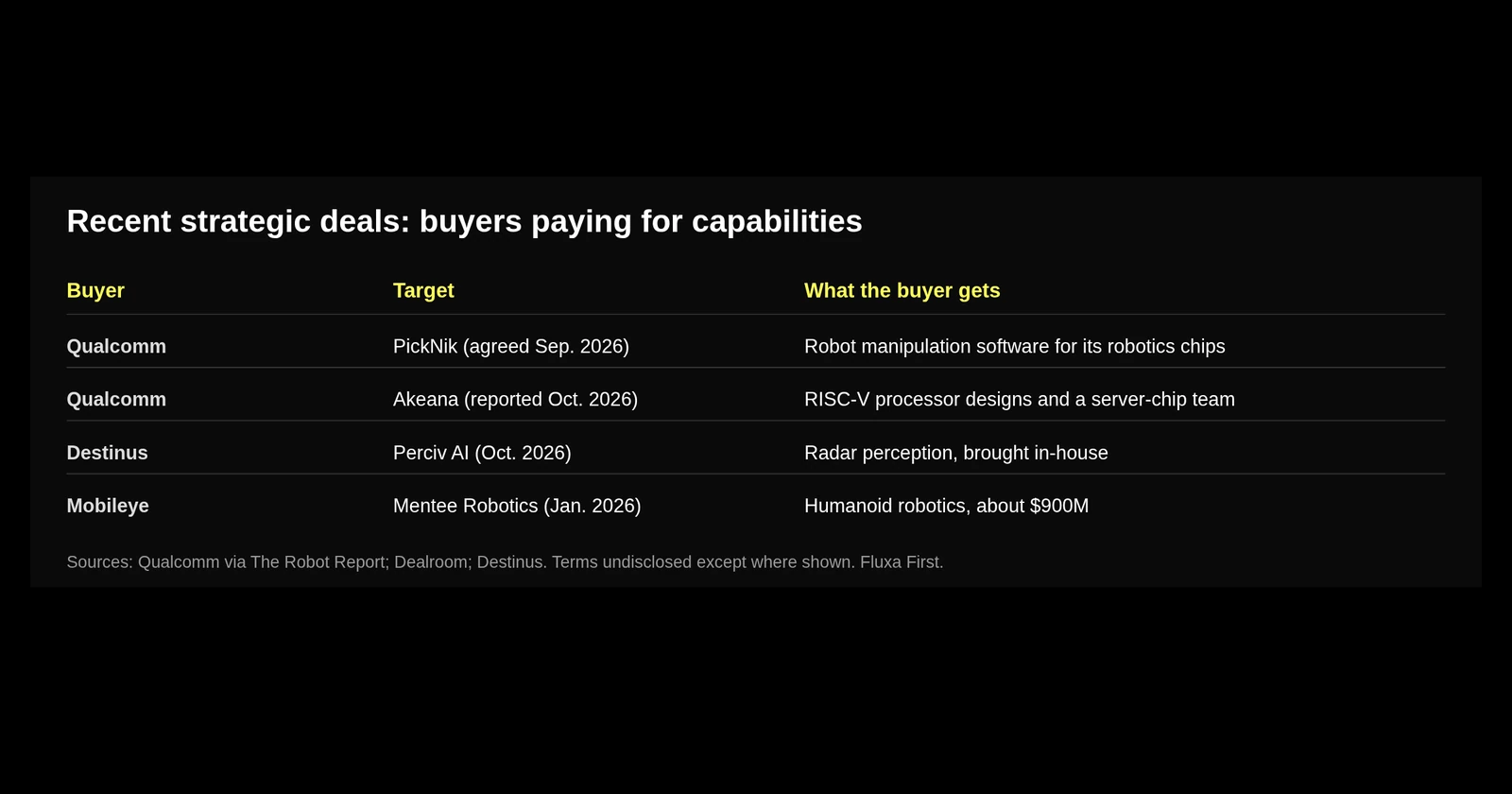
- While IPO headlines go to a few giant listings, strategic buyers keep acquiring hard-tech startups for specific capabilities such as robot software, chip designs and radar perception.
- Recent examples include Qualcomm agreeing to buy PickNik, Qualcomm acquiring Akeana and Destinus acquiring Perciv AI, all with undisclosed terms.
- Buyers pay for a capability that fills a gap in their own system, a team that can ship it, and time saved.
- Founders should build companies that are worth owning on their own and valuable to a strategic, and keep cap tables that make a sensible sale possible.
The IPO window gets the headlines, but for most hard-tech companies the more likely exit is a strategic buyer. The past few weeks made that plain. Large companies kept buying startups for very specific capabilities, quietly and mostly without disclosing prices. We think founders and investors in aerospace, autonomy, energy and advanced manufacturing should plan for that path on purpose.
What did strategic buyers buy this fall?
Three deals stand out because they show what buyers are paying for.
Qualcomm and PickNik. In September, Qualcomm agreed to acquire PickNik, the Boulder company behind MoveIt, a widely used open-source framework for robot manipulation. Qualcomm said MoveIt will stay open source and that it plans to integrate PickNik’s software with its Dragonwing robotics chips. The price was not disclosed. Qualcomm bought open-source hardware company Arduino in October 2025, and this deal extends the same strategy: own the software developers already use, so they build on your silicon.
Qualcomm and Akeana. Weeks later, Qualcomm acquired Akeana, a RISC-V processor design startup founded in 2021 by engineers who had built server processors at Marvell, according to Dealroom and Korea’s Electronic Times. Akeana’s founder confirmed the deal publicly; Qualcomm has not issued its own release. Akeana had raised more than $100 million in 2024. Terms were undisclosed, and its founder joined Qualcomm as a vice president of engineering.
Destinus and Perciv AI. On October 21, Dutch defense company Destinus completed its acquisition of Perciv AI, a Delft startup that builds neural-network models for radar detection and tracking, including navigation when GNSS is unavailable. Perciv becomes Destinus’s radar perception center, with its founders staying on to lead it. Destinus said owning the technology gives it control over a critical part of its systems. Financial terms were not disclosed.
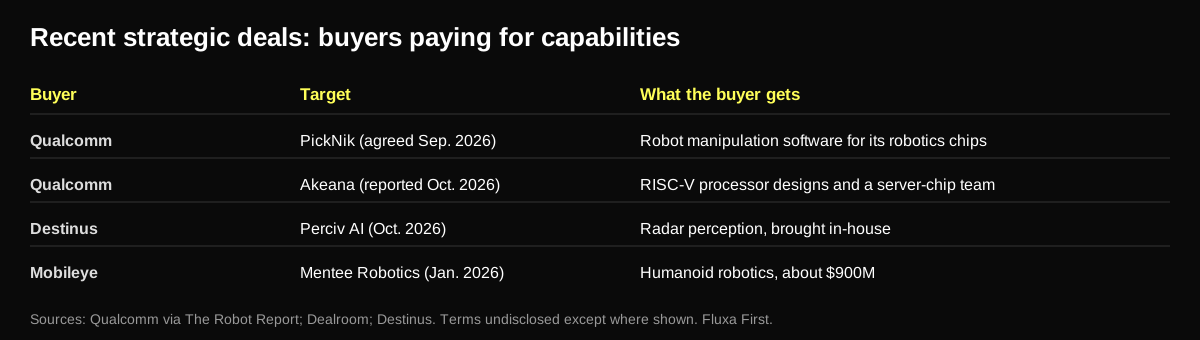
These are not isolated. The Robot Report noted that Mobileye bought Mentee Robotics for $900 million in January and that Bear Robotics bought Kinisi Robotics in June.
Why are strategics buying now?
We see three reasons, and none of them depend on the IPO calendar.
Capability gaps are urgent. Physical AI, edge computing and autonomous systems all need hard pieces that take years to build: motion planning, custom processors, sensor perception. A buyer that needs those pieces in its next product cycle cannot wait for an internal team to catch up.
Control of critical technology. Destinus framed its purchase in terms of control. In defense and industrial markets, depending on an outside supplier for a core subsystem is a risk. Buying the supplier removes it.
Valuations have reset. Forge reported in September that acquisitions are increasingly happening at prices well below peak-era rounds. Its two prominent examples were software companies Airtable and Miro, sold at discounts of 88% and 92% to their last private valuations. Forge counted 497 private companies that last raised in 2021 or early 2022, and among the 112 that traded on its platform the median price sat 61% below the last round. Those are mostly software cases, but the lesson carries over: buyers with cash can now acquire capabilities at prices that make sense to them.
What does this mean for hard-tech founders?
Build something a larger company cannot do without. The common thread in these deals is a capability that sits inside someone else’s system. A radar perception stack, a manipulation framework, a processor core. If your company owns a hard technical layer that a prime, an OEM or a chipmaker depends on, you have a natural buyer even when public markets are closed.
Partnerships often come first. Perciv’s founders said publicly that a year of working with Destinus showed the value of connecting their research to Destinus’s systems. Many acquisitions start as supply or co-development deals. That is a reason to choose partners carefully and protect your position while you work together, which we cover in our post on early go-to-market partners.
Keep the cap table sale-ready. A strategic sale at a fair but unspectacular price only works if the preference stack lets common holders and employees come out well. Stacked liquidation preferences from expensive rounds can turn a good outcome into a bad one for the team. Raise what you need, at terms that keep a sensible sale possible.
Show the buyer how you fit. Acquirers pay for integration speed. Document your interfaces, keep IP ownership clean, and have customers who would welcome a larger owner.
| What a strategic pays for | How a founder builds it |
|---|---|
| A capability that fills a gap | Own one hard technical layer deeply |
| A team that can keep shipping | Retain key engineers; spread knowledge |
| Time to market | Working product with real customers |
| Lower supply risk | Reliable delivery and documentation |
How we think about it at Fluxa First
We build and back companies that are worth owning for a long time, whether or not anyone ever buys them. That is the best position to sell from. A company with revenue and margins can wait for the right buyer instead of taking the first one.
It is also why we think capital that can return cash as a company grows deserves a place next to traditional equity. When investors receive cash along the way, a $100 million or $300 million strategic sale can be an excellent result for everyone instead of a disappointment measured against a unicorn target. Venture math that needs every company to become enormous pushes founders to turn down good acquisitions. We would rather build companies where a strategic sale is a choice made from strength.
The IPO window will keep opening and closing, as we wrote in our look at hard-tech IPOs. Strategic buyers will keep shopping regardless. Build for them, without depending on them.
This post is general commentary, not investment advice. Deal details are from the linked announcements and reports as of their publication dates.
Frequently asked questions
Is M&A a realistic exit for hard-tech startups?
Yes. Even with the IPO window narrow for most companies, large technology and defense companies kept buying startups in 2026 that give them a capability they need, from robotics software to radar perception. A company that solves a hard technical problem a larger player depends on is a natural acquisition target.
What do strategic acquirers look for in a hard-tech startup?
Usually a capability that plugs a gap in their product or supply chain, an engineering team that can keep developing it, and time to market they could not match internally. Customer traction, clean IP ownership and a manageable cap table make a deal easier to close.