
Q3 2026 venture market: record dollars, thin distributions
Key takeaways
- US venture deal value reached a record $515.8 billion through Q3 2026, but AI companies took 82.7% of it.
- Q3 alone fell to $98.4 billion while deal count stayed near a record, so the headline was driven by a few giant rounds.
- Only 18 companies went public in Q3 and fundraising concentrated in large, established firms.
- For hard-tech founders outside AI, the money exists but is not flowing their way by default; plan for revenue and patient capital.
US venture capital set a dollar record through the first three quarters of 2026, yet most founders we talk to do not feel a boom. Both things are true. The record is real, but it is concentrated in a small number of very large AI rounds, while exits and new fund formation tell a much tighter story. For hard-tech companies in aerospace, maritime, energy and advanced manufacturing, that gap matters more than the headline.
What did the Q3 2026 venture numbers show?
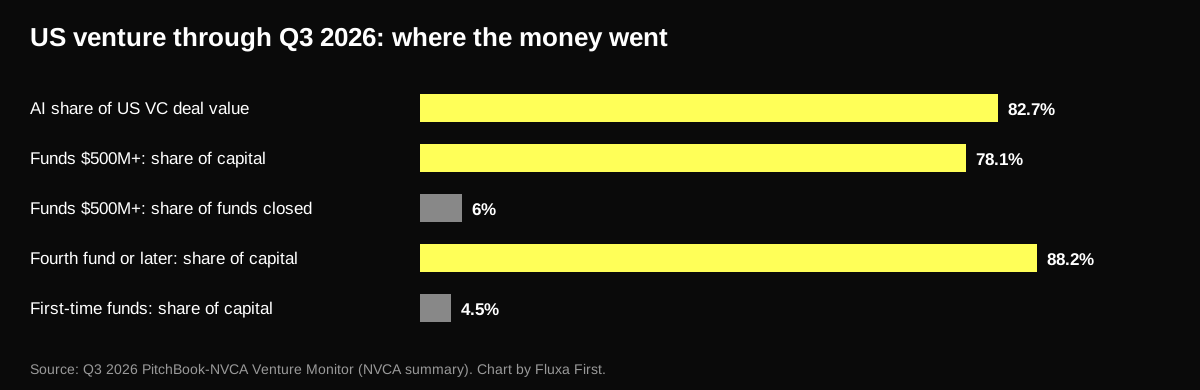
According to the Q3 2026 PitchBook-NVCA Venture Monitor, US deal value reached $515.8 billion through September, roughly 44% above the full-year record set in 2021. AI companies accounted for 82.7% of that value, the highest share in the dataset.
The quarter itself looked different. Q3 deal value dropped to $98.4 billion, down about 40% from Q2, even though an estimated 5,012 deals closed, one of the busiest quarters on record by count. In plain terms: lots of companies raised money, but the giant checks that inflated the first half of the year were not repeated. Venture-growth deal value fell from $196.9 billion in Q1 to $29.7 billion in Q3, per the full report.
Why does concentration matter more than the total?
A record total built on a few frontier labs says little about the median company. Three signals in the report point to a narrow market:
| Signal (US, through Q3 2026) | Figure |
|---|---|
| AI share of deal value | 82.7% |
| Capital raised by funds of $500M or more | 78.1% of dollars, 6.0% of funds |
| Capital raised by firms on fund four or later | 88.2% |
| Capital raised by first-time funds | about 4.5% |
| Companies that went public in Q3 | 18 |
| Active unicorns | 992, worth a combined $5.7 trillion |
Large, established managers are raising most of the money, and they are deploying it into the categories their LPs already expect. That leaves a real gap for companies whose path to value runs through hardware qualification, government contracts or industrial customers rather than a fast software growth curve.
Are exits recovering?
Selectively. SpaceX completed the largest IPO on record this year, and J.P. Morgan’s venture update projected a strong year for IPO proceeds. But the Q3 window was quiet: 18 listings, most of them in healthcare, with no AI IPO, and two of the most anticipated listings pushed back. Several well-known software companies sold at deep discounts to their prior private valuations. A backlog of nearly a thousand unicorns is still waiting for a way out.
We read this as a market where marks are rising faster than cash is coming back. That is a structural issue, not a quarterly blip, and it shapes how every fund and founder should plan.
What it means for hard-tech founders
Plan for revenue earlier than you think you need it. When exits are thin, investors lean on near-term evidence. A paying pilot with a shipyard, an airline maintenance shop or a utility is worth more in this market than another deck slide about total addressable market.
Do not assume the next round will price your progress fairly. Deal count is healthy, but the capital pools are concentrated. Map your capital stack before you need it: grants, customer prepayments, strategic partners and non-dilutive programs can carry a hardware company through milestones that generalist funds discount.
Pick investors whose time horizon matches your build cycle. A ten-year fund that is already worried about distributions will push for a fast exit. Hard-tech companies often need longer, and they need partners who say so up front.
What it means for investors
For LPs and angels, the lesson is that diversification across vintage and strategy matters more when the market is this concentrated. Record dollars into one sector raise the odds that the next downturn is correlated across a lot of portfolios at once. Durable businesses that generate cash in sectors tied to national priorities, such as energy, ports, launch infrastructure and domestic manufacturing, offer a different return path than another bet on the same few model labs.
Our view
We build and back companies in sectors where the work is physical, the customers are serious and the need is not going away: aerospace, maritime, autonomy, energy and advanced manufacturing. In a market like this one, we think the advantage goes to companies that can show real customers and real revenue, and to investors who are paid as the business performs rather than only when a distant exit arrives. The record headline is not our market. The durable middle is, and it is under-served.
Read more about how Fluxa First works or browse all topics.
This post is general commentary from Fluxa First, not investment advice. Figures are from the cited public reports as of October 2026.