
Why LPs keep re-upping with incumbents, and what new managers can do
Key takeaways
- Venture fund marks are rising, but cash returned to LPs (DPI) is still thin for most recent vintages.
- When distributions stall, LPs cut new relationships first and re-up with managers who have returned cash before.
- Established firms took 88.2% of US VC fundraising through Q3 2026, and first-time funds about 4.5%.
- New managers win by offering something different, such as specialist sector access, operating help or earlier cash back.
Limited partners are not short of interest in venture. They are short of cash coming back from it. That single fact explains most of what is happening in fundraising this year, including why the biggest firms keep getting bigger and why new managers face the hardest market in a decade.
Why are LP distributions so low?
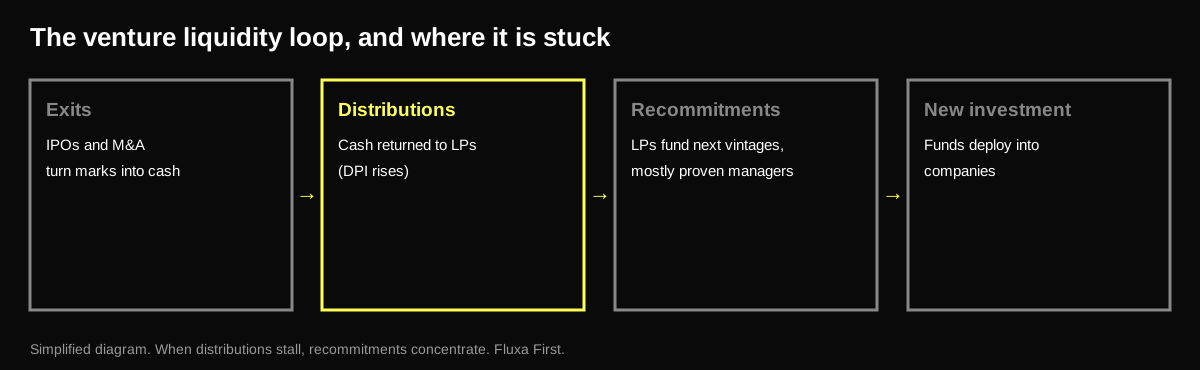
Venture works as a loop. Companies exit, funds distribute cash, LPs recommit some of that cash to new funds, and the new funds invest. When exits slow, the loop stalls at the distribution step.
Carta’s Q1 2026 fund performance report shows the split clearly. Median TVPI, which counts paper value, has been climbing for nearly every recent vintage. But median DPI for the 2019 and 2020 vintages is still barely above zero, and fewer than half of those funds have returned any capital at all. Even among the 2017 and 2018 vintages, fewer than one in five funds has returned 1x.
Paper gains do not pay pension obligations or endowment budgets. Cash does.
How does that push money to incumbents?
When an LP has less cash coming in, it makes fewer new commitments, and the first cuts usually fall on new relationships. Underwriting an unproven manager costs time and carries career risk. Re-upping with a firm that has returned cash before is the easy decision.
The data shows exactly that. Per the Q3 2026 PitchBook-NVCA Venture Monitor, established firms captured 88.2% of US venture capital raised through Q3, the highest share in PitchBook’s dataset, and one large firm alone closed more than a fifth of all US venture fundraising this year. First-time funds captured about 4.5%, and their count is on pace for a ten-year low.
Are secondaries the answer?
They are part of it. Secondary sales let LPs and funds sell positions before an exit. William Blair’s 2026 secondary market report describes record volume in 2025, with GP-led deals around $110 billion and secondary funds raising a record $95 billion. But secondaries usually trade at a discount, and trading volume is concentrated in a small set of famous names. They move liquidity around; they do not create it.
What it means for emerging managers
We think new managers should stop trying to look like a smaller version of a large firm. In this market, LPs back difference, not imitation. The strategies that still raise share a few traits:
| What LPs reward now | Why |
|---|---|
| Deep sector specialization | Access and judgment a generalist cannot copy |
| Operating capability | Help that measurably improves company outcomes |
| Earlier cash returns | Distributions that do not wait for an IPO |
| Clear alignment | Fees and carry tied to realized results |
A venture studio fits several of these at once. We build companies with founders from the problem stage, we stay close to operations, and we focus on durable businesses in sectors where customers pay real money: aerospace, maritime, autonomy, energy and advanced manufacturing. That is a different risk and return profile than a portfolio of software bets waiting on the same exit window.
What it means for founders
Founders feel this cycle second-hand. A fund that is anxious about distributions may push for an early sale, resist a long hardware build or hold back reserves. Before you take a check, ask your investor where they are in their own fundraising cycle and how they plan to return cash. A good partner will answer plainly.
It also helps to raise from investors whose returns are tied to how your business performs, not only to a distant exit. Structures that share in revenue or cash flow, alongside traditional equity, can align everyone around building a business that lasts. We have written more about how different instruments compare in our financing explainers, and you can find them under topics.
Our view
The liquidity drought is not a temporary inconvenience. It is a signal that the classic venture model, which depends on a few giant exits to pay for everything else, is under strain. We expect more capital to move toward managers who can show cash returns from durable companies, and toward models where investors and founders build together. That is the bet we are making at Fluxa First.
This post is general commentary, not investment advice. Figures are from the cited reports as of their publication dates.
Frequently asked questions
What is DPI in venture capital?
DPI, or distributions to paid-in capital, is the cash a fund has returned to its LPs divided by the money they paid in. A DPI of 1.0 means LPs got their money back. Unlike TVPI, it counts only realized cash, not paper valuations, which is why LPs watch it closely when exits are slow.
Why are first-time venture funds struggling to raise in 2026?
LPs are receiving little cash from older funds, so they have less to recycle and less appetite for diligence on new managers. They concentrate commitments with firms that have track records of distributions. Specialist managers with clear differentiation still raise, but generic new funds face a high bar.