
USMCA in limbo: what annual reviews and metals tariffs mean for builders
Key takeaways
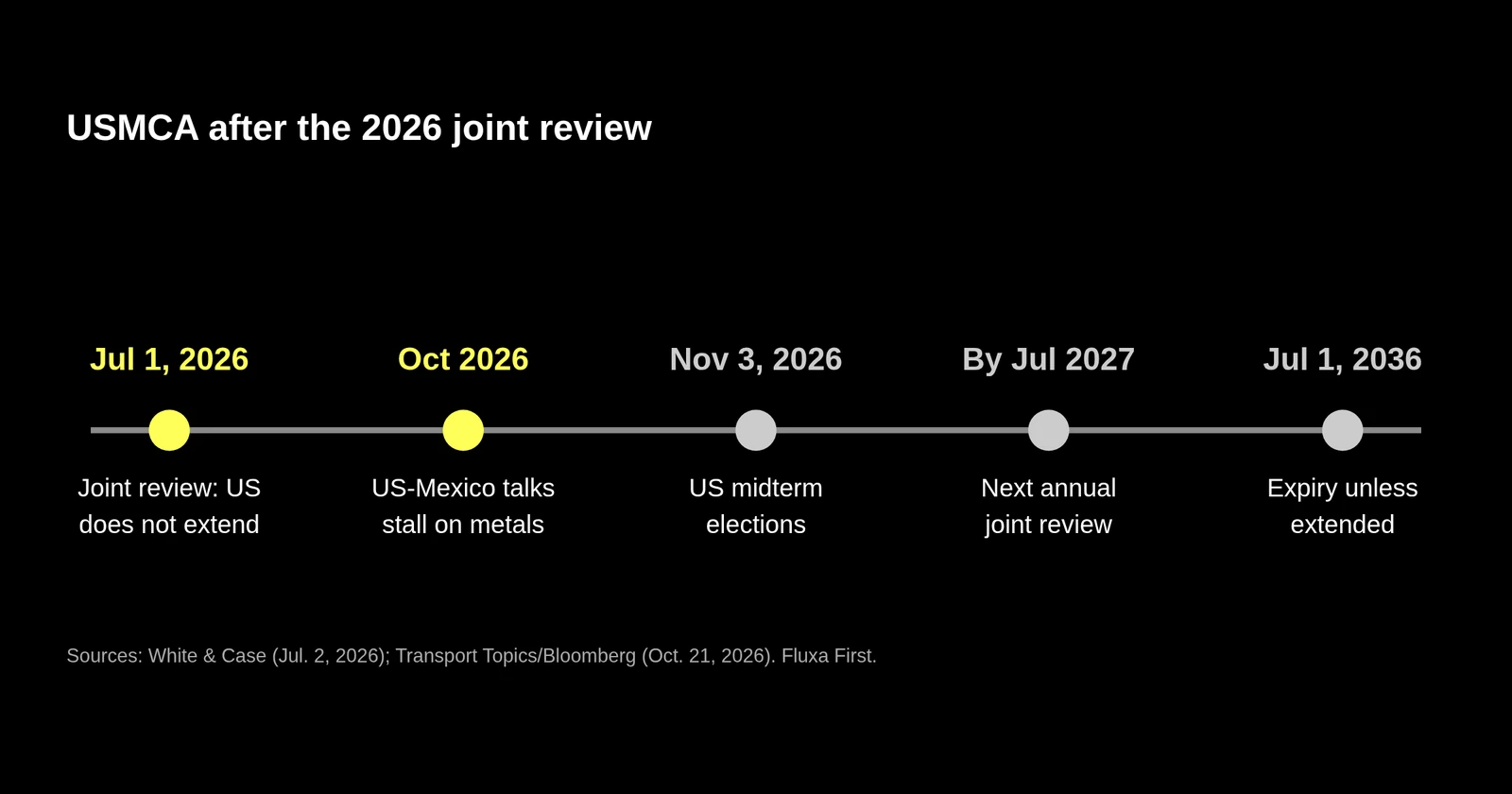
- At the July 1, 2026 joint review, the United States did not confirm a 16-year extension of USMCA, which triggers annual reviews until the parties extend it or it expires on July 1, 2036.
- The agreement remains fully in force, and an extension can still be agreed at any time by the three heads of government in writing.
- US-Mexico talks stalled in October over Section 232 tariffs, including 50% on steel and aluminum, and major progress may wait until after the November 3 midterm elections.
- For hard-tech builders, trade terms are now a recurring variable, so supply chains, contracts and pricing should be designed for policy change.
North America’s trade framework has entered a new phase. The United States-Mexico-Canada Agreement (USMCA) is still fully in force, but it is no longer on autopilot. After the July 2026 joint review, its future is decided one year at a time, and the latest round of US-Mexico talks has stalled over tariffs on metals. For companies that build physical products with North American supply chains, trade policy has become a recurring planning variable rather than a background condition.
What happened at the July 2026 joint review?
USMCA requires the three countries to hold a joint review on the sixth anniversary of the agreement. At that review on July 1, 2026, according to a White & Case analysis, the United States declined to confirm that it wanted to extend the agreement for another 16 years, saying it would not renew USMCA in its current form. Mexico and Canada both supported an extension.
That decision did not end the agreement. Tariff preferences, rules of origin, investment protections and dispute settlement all remain in place. But it triggered a different process: the parties must now hold a joint review every year until they agree to extend the agreement or it expires on July 1, 2036. An extension can still happen at any time if the three heads of government confirm it in writing.
The United States has negotiated with Mexico and Canada separately. White & Case reported two US-Mexico rounds, in May and June, with a third scheduled for the week of July 20. Topics included automotive rules of origin, steel and aluminum, and economic security. Canada had not yet begun text-based talks at the time.
Why have the Mexico talks stalled?
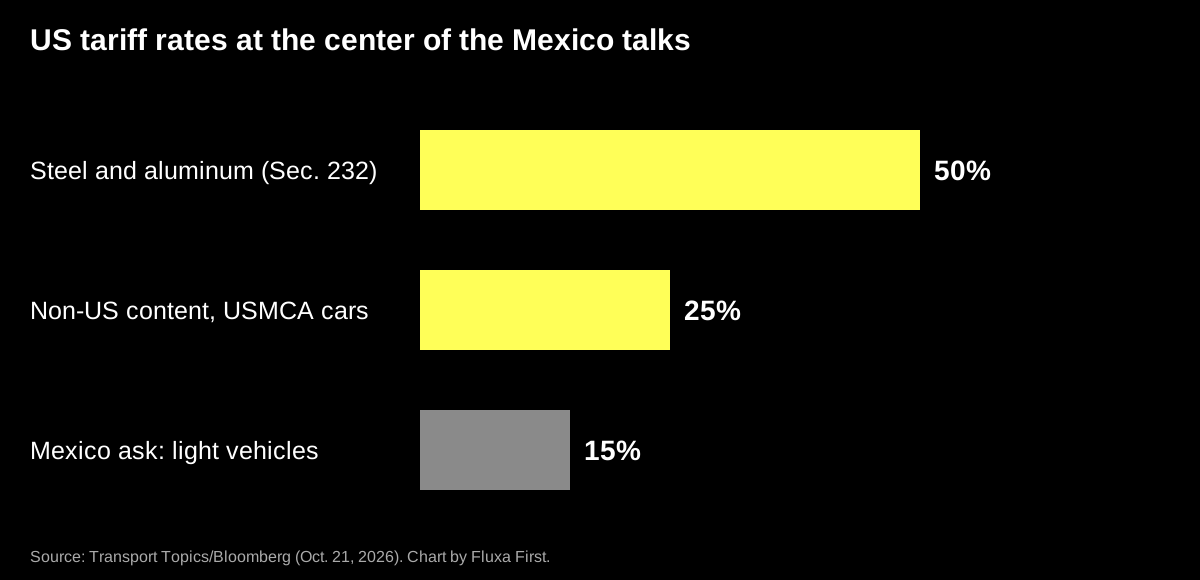
On October 21, Transport Topics, reporting Bloomberg News, said US and Mexican negotiators had reached an impasse over tariffs on steel and aluminum. The central issue is Section 232 duties, which include a 50% tariff on steel and aluminum and a 25% tariff on non-US content in USMCA-compliant cars. Mexico has sought relief on metals and on derivative products made from them, and a cut in light-vehicle tariffs to 15% from 25%.
According to the report, people familiar with the talks expect major progress to wait until after the November 3 midterm elections, though leaders in both countries said negotiations were advancing. US talks with Canada broke down in August over similar disputes on sector tariffs. More than 80% of Mexico’s exports go to the United States, and the report said business leaders have been stalling investment decisions while terms are unsettled.
What does this mean for hard-tech supply chains?
Most of the debate is about cars and metals, but the effects reach any company that buys machined parts, castings, wire harnesses, electronics assemblies or raw metal from across the border. Three changes stand out.
Uncertainty now has a calendar. With annual reviews, every year brings a new decision point. Investments in North American capacity, from a supplier’s new line to your own plant, will be priced with that risk in mind.
Metals costs are policy-driven. A 50% tariff on steel and aluminum, plus duties on derivative products, raises the cost of imported metal in the bill of materials for drones, vessels, energy equipment and industrial machines that use it.
Rules of origin still matter. Because the agreement remains in force, products that meet USMCA rules of origin keep their preferences, although Section 232 duties apply separately and, as the car tariff shows, can still reach USMCA-compliant products. Knowing where every major component comes from is now a competitive skill, not a compliance chore.
How should builders plan?
We think the right response is to design for change rather than bet on an outcome:
- Model several tariff scenarios in your unit economics, including the current rates and plausible changes, and know which components drive most of your exposure.
- Qualify a second source for critical metal parts, ideally one in the United States and one elsewhere in North America.
- Write tariff terms into contracts with suppliers and customers so that sudden changes are shared rather than absorbed by a small company.
- Track origin data for every major component so you can prove USMCA eligibility quickly.
- Watch the calendar: the post-election period, the next annual review and any written extension.
This builds on themes we covered in the reshoring workforce constraint and our look at castings and forgings in the industrial base.
How we see it
We are not taking sides in the negotiation. Reasonable people disagree about how to balance market access, domestic industry and leverage with partners. Our point is narrower: for companies building hardware in North America, trade terms are now a variable that will move again, probably more than once before 2036.
That favors builders who keep production flexible, know their supply chains in detail and invest in domestic capability where it makes economic sense. A resilient American industrial base depends on durable companies that can keep shipping whatever the tariff schedule says this year.
This article is general information, not legal or trade compliance advice.
Frequently asked questions
Did USMCA expire in 2026?
No. The agreement remains in force with its tariff preferences, rules of origin and dispute settlement intact. What did not happen at the July 1, 2026 joint review was a decision to extend it for another 16 years. Instead, the three countries now hold annual reviews, and the agreement runs to July 1, 2036 unless extended.
What are Section 232 tariffs?
Section 232 of the Trade Expansion Act of 1962 lets the US impose tariffs on imports judged to affect national security. Current Section 232 duties include a 50% tariff on steel and aluminum and, as reported by Transport Topics, a 25% tariff on non-US content in USMCA-compliant cars.