
Managed trade with China: what the Board of Trade and the 30-for-30 deal mean for hardware companies
Key takeaways
- After the September 2026 Washington summit, the US and China agreed to cut tariffs on about $30 billion of each other’s non-sensitive goods, with roughly 90% of listed products moving to most-favored-nation rates once domestic procedures are complete.
- The lists cover consumer goods on the US side and farm, timber and seafood products on the Chinese side; semiconductors, EVs, batteries, rare earths, aircraft, steel and pharmaceuticals are excluded.
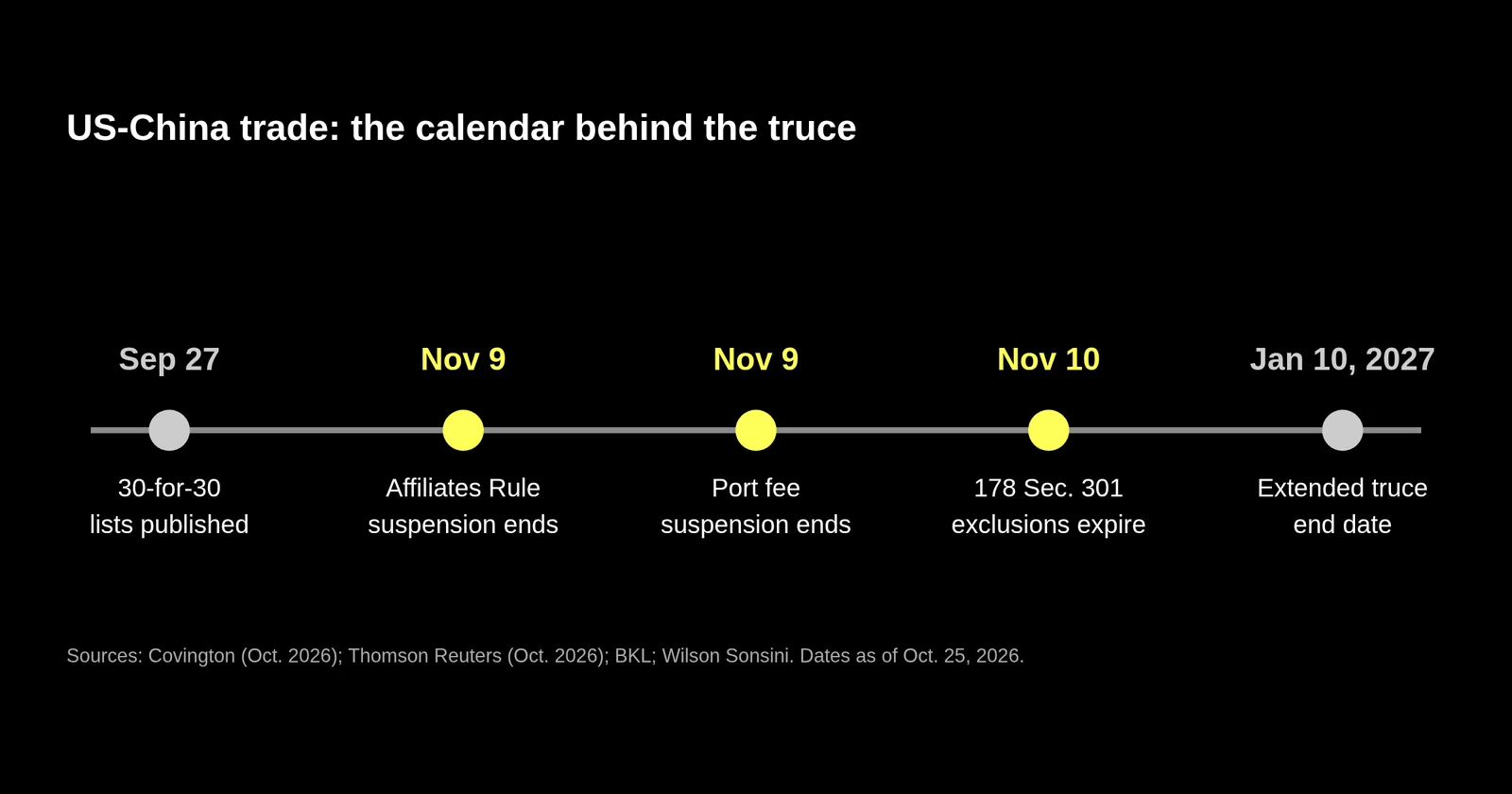
- The broader truce was extended to January 10, 2027, but several separate measures, including the BIS Affiliates Rule suspension and 178 Section 301 exclusions, are set to lapse on November 9 and 10 unless extended; USTR has proposed, but not finalized, extending the separate port fee suspension through January 9, 2027.
- We read this as managed trade in low-risk goods alongside continued controls on strategic sectors, and advise hard-tech companies to plan against legal deadlines rather than headlines.
The United States and China have built a new channel for managing trade in everyday goods while keeping strategic sectors walled off. After a Washington summit in late September, the two governments agreed to cut tariffs on about $30 billion of each other’s non-sensitive goods and extended their broader truce to January 10, 2027. For hard-tech companies, the headline matters less than the fine print: strategic products are excluded, and several important deadlines arrive in November, well before the truce ends.
What did the two sides agree?
The White House announced details of the US-China Board of Trade on September 27, following the September 24-25 meeting between the two presidents, according to Covington. The Board is a government-to-government mechanism for managing trade in non-sensitive goods, first announced at a Beijing summit in May. Its first output is the 30-for-30 framework: two lists of products, roughly $30 billion of trade on each side, that will be eligible for tariff relief.
China’s Ministry of Commerce says tariffs on about 90% of listed products will fall to most-favored-nation rates, and that both sides will implement the cuts at the same time after completing their domestic procedures. US officials cautioned that the lists do not bring immediate cuts, and Covington notes that changing Section 301 tariffs requires a notice-and-comment process that can take months.
Wilson Sonsini summarizes the summit’s three trade outcomes: the Board of Trade and Board of Investment, the 30-for-30 framework and a two-month extension of the Busan truce, from November 10, 2026 to January 10, 2027. The firm also notes that national security controls on both sides remain firmly in place.
What is in the lists, and what is not?
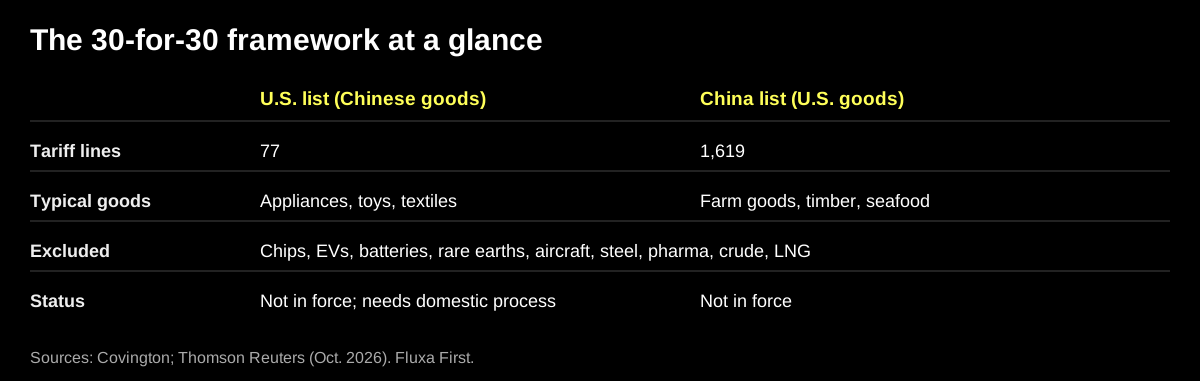
According to a Thomson Reuters analysis, the US list covers 77 tariff lines, mostly household textiles, small appliances, juvenile products and toys. China’s list covers 1,619 lines, weighted toward agriculture, timber and fish. The $30 billion figure is trade value based on 2024 flows, not a purchase commitment or an estimate of tariff savings. Both sides excluded the sectors that matter most for industrial competition: semiconductors, EVs, batteries, rare earths, aircraft, steel, pharmaceuticals, crude oil and liquefied natural gas. Even inside covered categories, exclusions reach below the tariff line. A toy qualifies, for example, unless it has built-in wireless or network connections.
Why do the November dates matter?
The political calendar says January 10. The legal calendar is earlier.
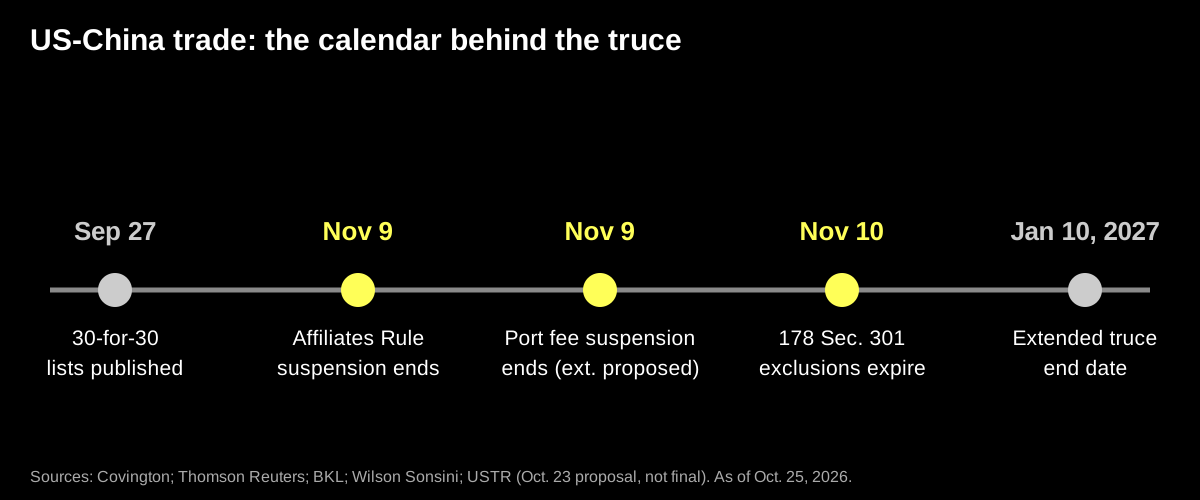
Thomson Reuters notes that three US measures lapse on November 9 and 10 unless extended: the suspension of the Commerce Department’s BIS Affiliates Rule, which would extend export restrictions to entities owned 50% or more by listed parties; the suspension of Section 301 port fees on maritime and shipbuilding; and 178 remaining Section 301 exclusions for Chinese products. A BKL legal update adds that while an official has said the Affiliates Rule suspension will be extended, the truce itself does not legally do so; Commerce must amend the rule. As of October 30, USTR has proposed, but not finalized, extending the port fee suspension through January 9, 2027; its comment period closed that day. We have not seen a published extension of the Affiliates Rule suspension or the 178 exclusions.
What does this mean for hard-tech companies?
Strategic sectors stay contested. Both governments chose to relieve tariffs on goods neither sees as a security risk. Chips, batteries, critical minerals, aircraft and steel are outside the deal, and export controls continue. Companies in those supply chains should not read this as a thaw.
Plan against the Federal Register. Supply chain and compliance teams should track the legal instruments, not press releases. Model costs under both the current tariff stack and the possible relief, and screen parts at the tariff-line level.
Know your affiliates. If the Affiliates Rule returns, suppliers and customers owned by listed entities could fall under export restrictions overnight. Founders selling or sourcing internationally should understand who owns their counterparties.
Treat stability as temporary. Since 2025, US-China trade has moved through cycles of escalation and reprieve. New institutions such as the Board of Trade may bring more predictability for consumer goods. Hard-tech companies should still build supply chains that can absorb a reversal, which is why we keep arguing for qualified domestic and allied manufacturing capacity and diversified sources for rare earths and other critical inputs.
How we see it
We see the Board of Trade as a sensible way to lower friction in goods that carry little strategic risk, while both countries keep competing hard in the technologies that shape industrial and military power. That split is likely to last. For the companies we build and back, the practical response is the same in calm periods and tense ones: know where every critical part comes from, keep a second source and design for the rules that are actually in force.
This article is general information, not legal or trade compliance advice.
Frequently asked questions
What is the US-China 30-for-30 framework?
It is a reciprocal arrangement under the new US-China Board of Trade to reduce tariffs on about $30 billion of each country’s imports from the other, limited to goods both sides consider non-sensitive. China’s commerce ministry says tariffs on about 90% of listed products will drop to most-favored-nation levels. The relief takes effect only after each side completes its domestic legal procedures.
Does the US-China trade truce cover semiconductors or critical minerals?
No. According to law firm and trade analyses of the published lists, strategic sectors such as semiconductors, EVs, batteries, rare earths, aircraft, steel and pharmaceuticals are excluded from the 30-for-30 tariff relief. National security export controls on both sides remain in place.