
Critical minerals: from frameworks to groundbreakings, and price floors next
Key takeaways
- One year after the US-Australia Critical Minerals Framework, more than A$5 billion in support has been announced and major gallium and rare earth projects are under construction.
- The projects now being built are expected to supply roughly 10% of global gallium and nearly 5% of rare earths demand, per the US Embassy in Australia as reported by Metal Tech News.
- USTR is designing a binding plurilateral critical minerals agreement built around mineral-specific price floors adjusted at the border; no text has been released.
- Price floors could make non-Chinese processing financeable, but timelines are long and the details are still open.
The policy conversation about critical minerals is changing in two ways. Commitments are turning into construction, and the tools are shifting from one-off deals toward market design, especially price floors. Both matter for anyone building companies that depend on gallium, rare earths, scandium or the other materials behind advanced electronics, magnets and aerospace alloys.
What has the US-Australia framework delivered in a year?
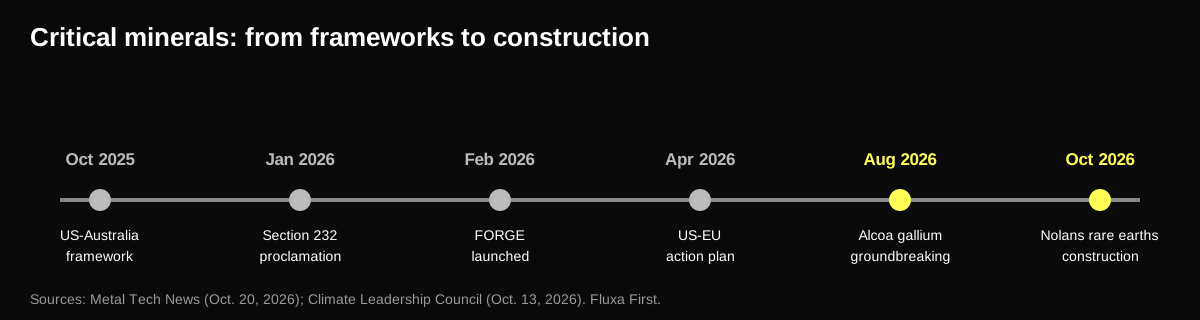
The United States and Australia signed their Critical Minerals Framework on Oct. 20, 2025. A first-anniversary review by Metal Tech News reports that the two countries have since announced more than A$5 billion (about US$3.5 billion) in support for Australian critical minerals projects. According to the US Embassy in Australia, US-backed projects now in construction are expected to eventually supply roughly 10% of global gallium and nearly 5% of rare earths demand.
Two projects stand out:
- Gallium in Western Australia. Alcoa broke ground in August on a gallium recovery facility at its Wagerup alumina refinery, designed to produce 100 metric tons a year, about 10% of global supply. It is a trilateral effort with Japan, including Japanese trading company Sojitz, and the Pentagon announced an estimated $174 million equity investment.
- Rare earths in the Northern Territory. Arafura Rare Earths began construction of its Nolans mine-to-oxide project on Oct. 8. It is expected to meet 4% to 5% of global rare earths demand and is backed by A$1.2 billion in Australian government support, plus export credit agencies from several allied countries.
Not every number is final. The review notes that many of the US financing figures, such as export credit letters of interest and a conditional $400 million commitment for a scandium project, are preliminary and subject to conditions.
Why are price floors the next step?
Building a mine or refinery outside China is only half the problem. The other half is surviving the price. When a dominant supplier can flood the market, new producers elsewhere struggle to finance projects because lenders cannot count on stable revenue.
That is what the proposed Agreement on Trade in Critical Minerals is meant to address. According to a Climate Leadership Council explainer current as of late September, it is a USTR-led plan for a binding agreement among like-minded trading partners. It follows a Jan. 14, 2026 Section 232 proclamation on processed critical minerals and builds on action plans with Mexico, Japan and the EU. USTR’s most recent public description points to phased-in, mineral-specific price floors adjusted at the border, plus common standards across partners. Cost benchmarks for gallium, germanium, tungsten, antimony and NdPr are expected to inform negotiations.
Important caveats remain. No agreement text has been released. Which minerals, which partners and which commitments will be binding are all open questions, and a binding agreement would need congressional action to implement.
What would price floors change?
If they work as described, price floors would change the investment math for processing and refining outside China:
| Without a floor | With a floor |
|---|---|
| Revenue swings with a dominant producer’s pricing | A minimum price that partners defend at the border |
| Projects struggle to secure debt | Lenders can underwrite a revenue baseline |
| Buyers default to the cheapest source | Common standards reward traceable supply |
They also carry risks. Floors can raise input costs for manufacturers, invite disputes among partners about who qualifies and create pressure for exceptions. The design details, not the headline, will decide whether they help.
What does this mean for founders and investors?
We see three kinds of opportunity, all on long timelines:
- Processing and separation. The hard bottleneck is refining, separation and metal-making, not only mining. New process technologies that lower cost or waste could benefit directly from a price floor.
- Recovery and recycling. Alcoa’s gallium project recovers metal from an existing industrial stream. The same logic applies to scrap, tailings and end-of-life products.
- Traceability and substitution. Common standards will need tools that prove where material came from. And materials science that reduces dependence on scarce elements remains valuable whatever happens to policy.
Our view
We think allied supply chains are the realistic path to security for most critical minerals. No single country can do it alone, and the US-Australia work shows that coordinated financing can move projects from announcement to construction. Price floors could be the missing piece that makes these projects bankable, but founders should build businesses that work across a range of policy outcomes rather than betting on one. At Fluxa First we look for companies that turn these supply chain shifts into durable revenue.
More of our geopolitics coverage is under topics.
This post is general analysis, not investment or policy advice. Figures are as reported in the linked sources.