
Reshoring runs on people: the workforce gap behind American manufacturing

Key takeaways
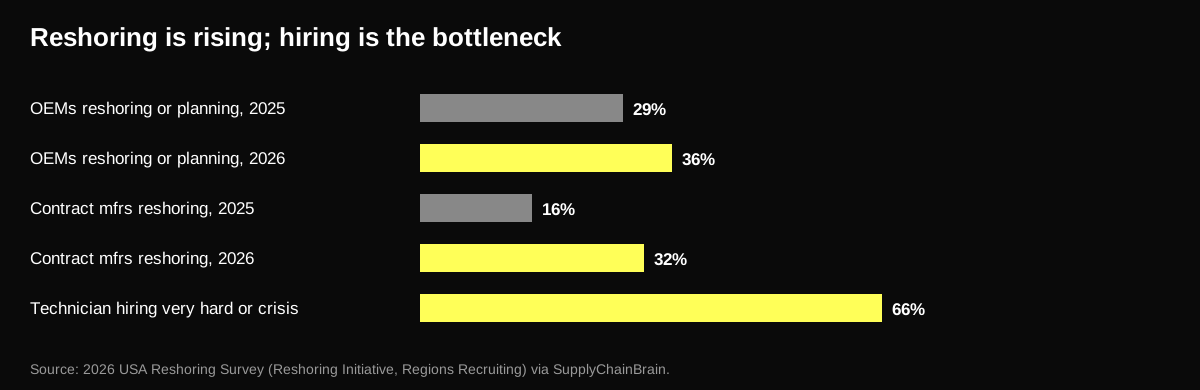
- In a 2026 survey, 36% of US OEMs and 32% of contract manufacturers said they had reshored or were reshoring, up from 29% and 16% a year earlier.
- 66% of respondents called hiring technicians such as welders and machinists very difficult or at crisis levels.
- Manufacturers ranked an adequate labor supply above tariffs, tax cuts and deregulation as the incentive that matters most.
- A separate report projects about 1.7 million skilled-trade openings a year through 2035; tools that multiply skilled workers are a large market.
Reshoring is no longer a talking point. More American manufacturers are bringing production home, and the reasons are practical: shorter lead times, more reliable delivery and less exposure to geopolitical shocks. But the same data that shows momentum also shows the brake. The binding constraint on American manufacturing is not capital or policy. It is people.
Is reshoring actually happening?
Yes, and faster than a year ago. The 2026 USA Reshoring Survey from the Reshoring Initiative and Regions Recruiting polled 249 manufacturers, and as SupplyChainBrain reported, 36% of original equipment manufacturers said they had reshored some production or were actively doing so, up from 29% in 2025. Among contract manufacturers the share doubled, from 16% to 32%. More than half of contract manufacturers said geopolitical risk was pushing their customers toward domestic suppliers, up from about a quarter the year before.
The motivations are operational, not just political. Large majorities of OEMs cited faster speed to market, better on-time delivery and logistics savings.
What is holding it back?
Two things: uncertainty and labor.
Shifting trade policy makes long-term plant investment harder to commit to, because manufacturers can plan around known costs but struggle with a moving target. That is a real issue, and it argues for policy stability regardless of which direction policy takes.
Labor is the bigger one. Two-thirds of respondents described hiring technicians, including welders, machinists and electrical and chemical engineers, as very difficult or at crisis levels, and 60% said the same about maintenance and repair technicians. When asked what would bring more production back, manufacturers ranked an adequate supply of skilled labor above tariffs, tax cuts, deregulation and a weaker dollar. Contract manufacturers also reported that recent immigration enforcement is making recruiting harder.
How big is the skilled-trades gap?
Large and structural. A report from Jobs for the Future and the Burning Glass Institute, covered by Fortune, projects about 1.7 million skilled-trade job openings every year through 2035. Nearly a quarter of skilled-trade workers are 55 or older and only about 11% are under 25. The same reporting notes that fewer than half of people who start an apprenticeship or community college workforce program finish it.
The demand comes from overlapping national priorities: data centers, defense production, shipbuilding, energy projects and housing all need the same electricians, welders and machinists. Those shortages compound.
Can automation fill the gap?
Partly. Between 20% and 30% of surveyed manufacturers believe AI and automation could close the cost gap with offshore production by 2040, while others doubt it would be enough on its own. Automation changes the job mix; it does not remove the need for skilled people to install, program, maintain and repair the machines. In our view the winning pattern is augmentation: tools that let each skilled worker do more, learn faster and make fewer errors.
Where are the openings for founders?
| Gap | What to build |
|---|---|
| Training throughput | Simulation, augmented work instructions and competency tracking that shorten time to proficiency |
| Program completion | Support and scheduling tools that keep apprentices and students from dropping out |
| Skilled-worker leverage | Collaborative robots, welding automation and inspection systems that multiply each technician |
| Knowledge capture | Systems that record the know-how of retiring workers before it walks out the door |
| Total cost modeling | Software that helps manufacturers compare onshore and offshore sourcing on full cost, not unit price |
That last row is underrated. According to the survey’s authors, only about 30% of OEMs use a total cost of ownership method when comparing sourcing options. Many companies would reshore more if they did the full math, including freight, duty, inventory carrying cost and the value of being close to customers and engineers.
What it means for founders
If you are building advanced manufacturing or industrial software, your customer’s biggest pain is probably hiring, not machine cost. Lead with how your product makes the existing team more productive and how fast a new hire can use it. Manufacturers say community colleges and trade schools are their main recruiting channels, so partnerships there can double as distribution.
What it means for investors
Workforce technology for the trades has historically been under-funded compared with white-collar software. The demand is now clear, budgets are real and the customers are durable. Companies that sell into several national priorities at once, such as shipyards, energy projects and defense suppliers, have more than one market to grow into.
Our view
American sovereignty depends on the ability to make things at home, and making things depends on people who know how. Capital and policy can build a plant; only trained workers can run it. We want to back founders who build the tools, training and systems that let American industry grow its workforce as fast as its ambitions. Learn more about Fluxa First or browse all topics.