
Foundries before fleets: castings, forgings and the hidden industrial base

Key takeaways
- US submarine construction depends on a small number of suppliers, many of them sole sources, for castings, forgings, hull steel, sonar ceramics, magnets and coatings, per a US Naval Institute Proceedings analysis.
- The Navy has directed more than $2.6 billion to supplier development since 2018, but the analysis argues spending has not been tied to clear outcome metrics.
- Fairbanks Morse Defense broke ground on a $60 million propulsor facility in Mississippi, backed by $27 million from the Navy and $22 million from Australia under AUKUS.
- The opportunity for builders is in measurable throughput - yield, inspection, process control and qualification speed.
When people talk about American industrial strength, they usually picture finished products: ships, aircraft, reactors. But the pace of all of them is often set much further down the chain, by a handful of foundries, forges, mills and specialty material shops. If one of them misses a pour or fails an inspection, the delay ripples all the way to the final product. Nowhere is that clearer right now than in submarines.
Where does the submarine supply chain break?
An October analysis in US Naval Institute Proceedings argues that submarine construction relies on a few sole-source suppliers with little margin for error. It identifies four material families where failures could cascade:
| Material family | Why it is fragile |
|---|---|
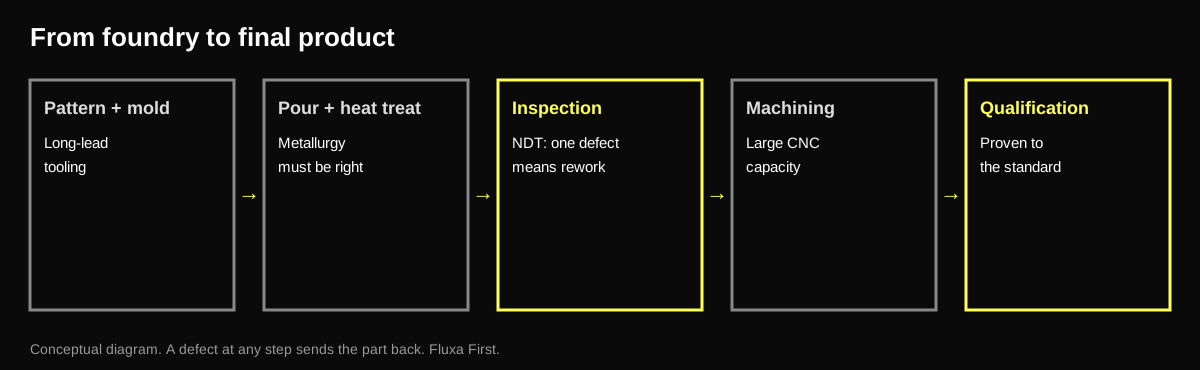
| Propulsor castings and forgings | Thin supplier bench; long steps from pattern to pour to machining; one defect means months of rework |
| Hull steel and plate | A handful of mills and furnaces can make the required sizes and grades |
| Sonar ceramics and magnets | Few producers worldwide; most magnet supply runs through China |
| Anechoic coatings | Any change to an adhesive formula can trigger lengthy requalification |
The authors add cross-cutting pressures: an estimated need for roughly 100,000 additional skilled workers over the next decade across submarine programs, new rules starting in 2027 that bar Chinese-origin magnets anywhere in the supply chain and overlapping demand from two submarine classes plus planned sales to Australia.
Has the money worked?
Money has not been the only issue. The Proceedings piece notes that the Navy has directed more than $2.6 billion to supplier development since 2018, and that Congress appropriated $3.3 billion for the submarine industrial base in April 2024. But citing GAO, the authors argue the Navy has not defined clear metrics showing whether that spending increased throughput, reduced cost or shortened schedules.
Their prescription is practical: qualify second sources for critical parts, buy tooling and alloy stock early to smooth queues and track measures such as first-pass yield, inspection reject rates and waivers per lot. In other words, manage the industrial base like a production system, not a grant program.
What is being built?
One example broke ground this week. Fairbanks Morse Defense started construction on a $60 million facility in Pascagoula, Mississippi, to make propulsors, propellers and other components for Virginia-class submarines and other ships, per Inside Defense. The Navy is contributing $27 million through BlueForge Alliance, and another $22 million comes from Australia’s contributions to the US submarine industrial base under AUKUS.
The details are telling. The 38,000-square-foot expansion adds two five-axis CNC machines for parts weighing up to 100 metric tons and a bay for a future 3D sand printer. It is expected online in early 2028. The company acquired Bird-Johnson in 2025, which Inside Defense describes as the only privately owned US foundry certified for large-scale Navy propeller manufacturing.
That last fact sums up the problem. A single certified private foundry for a critical class of parts is not a supply chain. It is a single point of failure.
Why does this matter beyond submarines?
Castings and forgings are not a naval niche. The same kinds of large, precise metal parts go into power generation, grid equipment, aircraft engines, rocket engines, mining equipment and heavy industry. The shortage of skilled foundry and forge workers, the aging equipment and the slow qualification processes affect all of them. Fixing the base for submarines strengthens it for energy and aerospace too.
Where can builders help?
We see opportunities in technology that raises throughput at existing and new shops, rather than only adding capacity:
- Digital and additive tooling: 3D sand printing of molds and cores to cut pattern lead times.
- Process monitoring: sensors and software that catch pour and heat-treatment problems before a part is finished.
- Inspection automation: faster, more consistent nondestructive testing to reduce rework and inspection backlogs.
- Qualification data: tools that make it faster to prove a new supplier or process meets the standard.
- Workforce tools: training and guidance systems that help new workers reach qualified skill levels sooner.
Each of these can be measured in the terms the Proceedings authors ask for: yield, reject rates, cycle time.
Our view
America cannot build fleets, reactors or rockets faster than its foundries can pour and its inspectors can approve. We think the companies that make the hidden industrial base more productive, and prove it with numbers, are among the most important and durable businesses in hard tech. They are unglamorous, and they are exactly what American industrial strength is made of. At Fluxa First, that is where we want to build.
More of our American sovereignty coverage is under topics.
Figures are as reported in the linked sources. This post is general analysis, not investment advice.