
Rare earths and the calendar: Nov. 10, Jan. 1 and the long middle

Key takeaways
- China refines most strategic minerals and makes about 94% of permanent magnets, per the IEA, and has used export licensing as leverage.
- A suspension of China’s rule covering foreign goods with 0.1% Chinese rare earth content was due to lapse Nov. 10; whether it is extended remains uncertain.
- From Jan. 1, 2027, a Pentagon sourcing ban on certain metals from adversary nations reaches back to the mine, and a July executive order sharply narrows waivers.
- Processing, not mining, is the long-term bottleneck, and it is where founders and investors can help most.
Rare earths have moved from a niche commodity topic to a scheduling problem for anyone building motors, sensors, aircraft, ships or munitions. Two dates matter in the near term, and a much longer stretch matters after that. Here is a measured read on where things stand and what hard-tech companies should do about it.
Why do rare earth export controls matter so much?
Because the supply chain is concentrated. The International Energy Agency estimates that China is the top refiner for 19 of 20 key strategic minerals, with an average share around 70%, and holds about 94% of global permanent magnet production, as cited by RFE/RL. Permanent magnets sit inside electric motors, actuators, guidance systems and wind turbines. Hard-tech hardware of almost every kind touches them.
Beijing has used export licensing to apply pressure, and reporting suggests it has calibrated that pressure toward defense supply chains while trying to avoid broad disruption of consumer industries. Chinese customs data showed rare earth magnet exports to the US in August down about a fifth from July. The pressure is not limited to the US: the Financial Times reported that Japan has warned it is months from running out of yttrium.
What happens on Nov. 10?
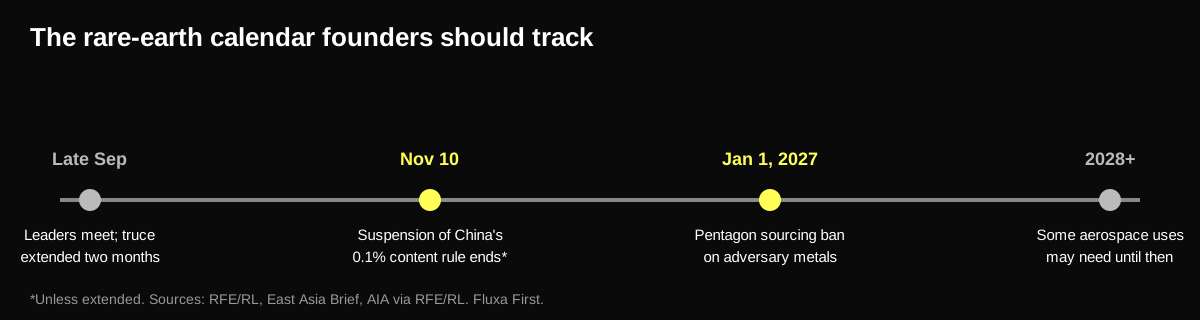
China’s rules include an extraterritorial provision: foreign-made goods containing 0.1% or more Chinese-origin rare earth content by value can require Chinese export approval. Enforcement of that provision was suspended for a year after trade talks, and the suspension was scheduled to expire on November 10, per Bloomberg.
At their late-September meeting, the US and Chinese leaders agreed to extend the broader trade truce by two months, to Jan. 10, 2027, but the extension did not resolve minerals access, per RFE/RL. Beijing has not published a legal notice moving the Nov. 10 expiry of the suspension, so on paper the 0.1% rule could resume on Nov. 11 unless China acts, per Technology.org. The April 2025 licensing regime for seven heavy rare earths, including dysprosium, terbium and yttrium, was never suspended. Companies should plan for both outcomes rather than bet on one.
What happens on Jan. 1, 2027?
On the US side, defense procurement law bars the Pentagon from buying rare earth magnets, tungsten, tantalum and molybdenum from China, Russia, North Korea and Iran, and from Jan. 1, 2027 that ban reaches back through the supply chain to mining and refining. A July executive order also narrows waivers to cases where compliant material is truly unavailable, not merely costlier. The Aerospace Industries Association has said some members expect to comply on time for certain applications, while others may need until 2028 or later because compliant aerospace-grade material is scarce.
The result is a pincer: one side may restrict supply, the other forbids using it in defense work, and the compliant supply in between is still thin.
What is the US doing about it?
A lot, and it will take time. According to VOA, Washington launched a mineral reserve initiative aimed at a 60-day emergency supply of materials such as gallium and cobalt, took an equity stake in a domestic rare earth producer in 2025 with a long-term offtake and price floor, and has sharply increased non-equity investment in rare earth and magnet projects. The White House has also reported more than 160 mineral deals since January 2025, including projects with partners in Central Asia.
Most analysts quoted in these reports expect a midstream supply chain independent of China to take five to ten years or more. Processing, the chemistry and metallurgy that turns ore into separated oxides, metals and alloys, is the hardest part, because the know-how and the commercial-scale plants mostly sit in one country.
What should hard-tech founders do now?
| Action | Why |
|---|---|
| Map your bill of materials to the element level | Many teams do not know which subsystems contain covered materials |
| Ask suppliers for origin documentation now | Defense customers will ask you before Jan. 1 |
| Qualify a second source, even at higher cost | A slower, compliant source beats a cheaper, blocked one |
| Design for reduced or substitute materials | Magnet-light motors and alternative alloys lower exposure |
| Track the Nov. 10 outcome | It affects products you assemble outside China too |
Where are the opportunities?
The gaps are mostly in the middle of the chain: separation and refining processes that are cleaner and cheaper at smaller scale, magnet manufacturing, recycling of magnets from scrap and end-of-life products, and materials science that reduces how much rare earth content a design needs. These are deeptech businesses with long build cycles and real customers waiting, which is the profile we look for.
Our view
We do not think the answer is panic or a promise of instant self-sufficiency. The realistic path is steady: build processing capacity at home and with allies, design products that need less of the scarce material, and give founders patient capital matched to multi-year milestones. Supply chain resilience is a core part of American sovereignty, and it is built one plant and one qualified supplier at a time. Learn more about Fluxa First or browse all topics.
This post is general analysis, not legal or compliance advice. Check current rules with qualified counsel.