
Tooling is the hidden chokepoint in American manufacturing
Key takeaways
- A new Center for Automotive Research report says North America cannot launch, redesign or refresh vehicles at scale without Chinese tooling, based on industry interviews.
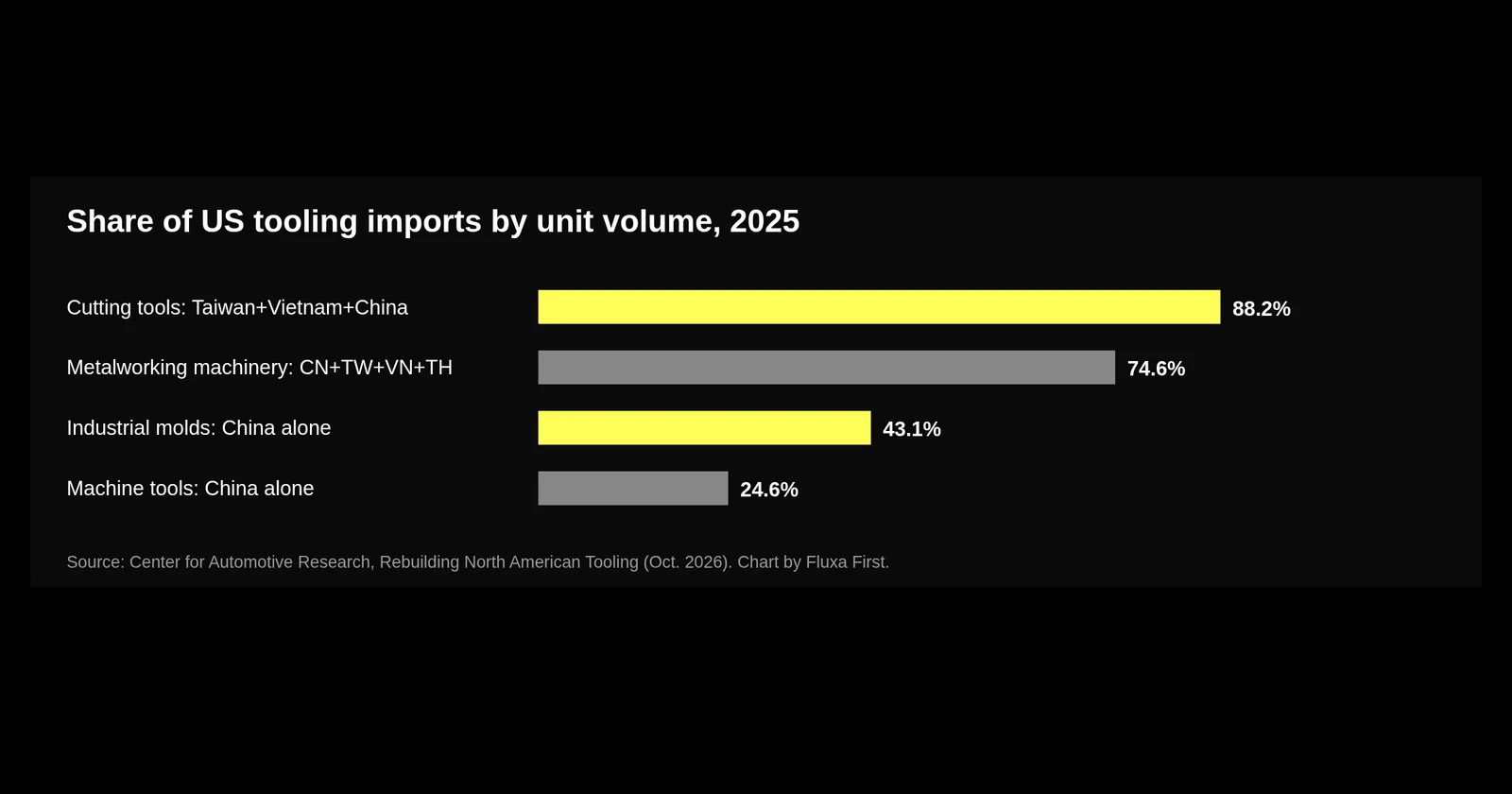
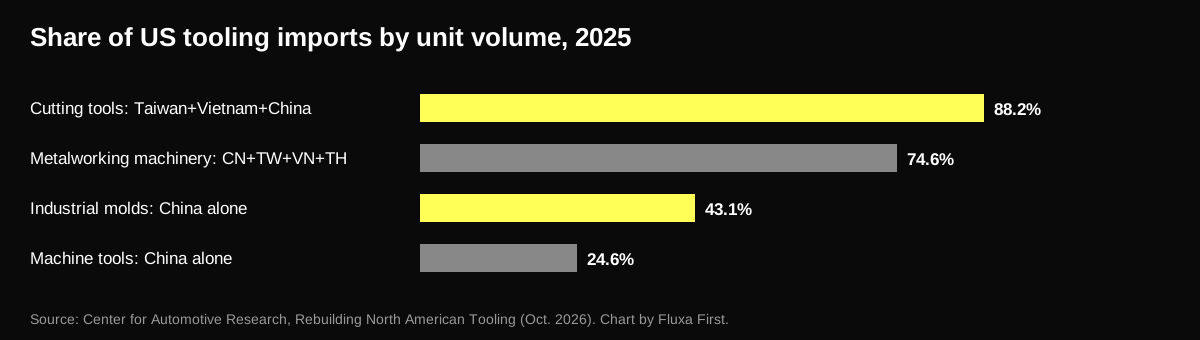
- In 2025, Taiwan, Vietnam and China supplied 88.2% of US cutting tool and accessory imports by unit volume, and China alone supplied 43.1% of industrial mold units.
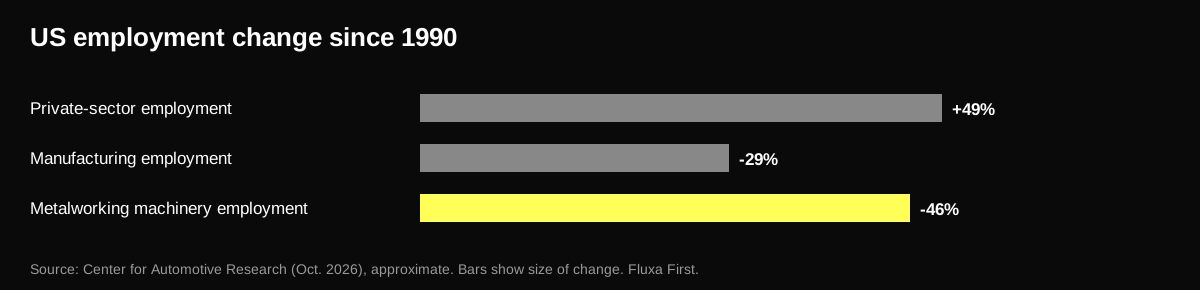
- {‘US tooling has shrunk for decades’: ‘metalworking machinery employment is down about 46% since 1990 and tool-and-die workers are aging.’}
- The core problem is economic, not only technical; payment terms, capital access and workforce must be fixed together, which creates openings for new kinds of tooling companies.
Ask what limits American manufacturing and you will hear about chips, rare earths and skilled labor. Rarely about tooling. Yet without dies, molds and fixtures, no factory can launch a new product, and a new report argues that North America now depends on Asian, largely Chinese-linked, suppliers for much of that tooling. For anyone building hard-tech companies in the US, that is a supply chain risk worth understanding.
What did the report find?
The Center for Automotive Research’s October 2026 study, Rebuilding North American Tooling, is based on trade data and interviews with toolmakers and industry leaders. Its headline finding, drawn from those interviews, is that North America cannot launch, redesign or refresh vehicles at scale without Chinese tooling, which makes tooling a strategic chokepoint for both auto production and national security.
The trade numbers for 2025 show how concentrated supply has become:
- Taiwan, Vietnam and China supplied a combined 88.2% of US cutting tool and accessory imports by unit volume.
- China alone supplied 43.1% of US industrial mold import units, more than double second-ranked Canada, though only 15.4% by dollar value.
- For machine tools, China’s share was 24.6% of units and 4.6% of value.
- China, Taiwan, Vietnam and Thailand together supplied 74.6% of measured US metalworking machinery import units.
Tariffs moved the trade routes more than the dependence. The report notes that after Section 301 tariffs in 2018, imports from China declined while those from Taiwan, Vietnam and Thailand rose sharply. Vietnam’s share of US metalworking machinery import units went from 0.3% in 2019 to 25.2% in 2025. Interviewees said that growth would not have been possible without Chinese tooling firms expanding across the region.
How did US tooling shrink?
The domestic side has been eroding for decades. According to the report, since 1990 US private-sector employment rose about 49% while metalworking machinery employment fell about 46%. Tooling establishments fell 15% from 2014 to 2025. Inflation-adjusted output in 2025 was 33% below its 1997 peak. Tool-and-die workers declined 23% from 2009 to 2025, and their average age rose from 49 to 54.
Why is this an economic problem, not only a technical one?
The most useful part of the report is its diagnosis. Many North American tool shops are small private firms with annual revenue around $5 million and limited access to affordable capital. They pay for steel, engineering, labor and equipment long before they are paid for the finished tool. Chinese competitors, the report says, receive most of their payment before shipment and benefit from subsidies, including low-rate or interest-free loans. Add customer-specific specifications and uncertain program volumes, and US shops have little reason to invest.
China is also pushing in the opposite direction. Beijing has made high-end machine tools and their core components, such as spindles, lead screws and guide rails, a stated industrial priority, including in a 2025 national standards plan from its industry ministry.
The report calls for an industry-government task force to map critical tools and backup capacity, reform payment and sourcing terms, and commit work, capital and training to regional suppliers. Shop owners told CAR that rebuilding competitiveness could take more than a decade, while demand from defense, AI data centers and utilities competes for the same workers and equipment.
Why should hard-tech founders care?
Tooling is not only an auto issue. Every company that makes physical products, whether drones, satellites, marine systems, batteries or grid equipment, needs dies, molds, fixtures and cutting tools to move from prototype to production. If your tooling comes from a supply chain that can be disrupted by tariffs, export controls or a long ocean shipment, your production schedule carries that risk.
| Risk for a hardware startup | What to do |
|---|---|
| Long lead times on imported molds and dies | Qualify a domestic or allied backup shop early |
| Tooling tied to a single overseas vendor | Own your tooling designs and data |
| Engineering changes that need new tools | Design for tooling flexibility and reuse |
| Tariff or export-control shocks | Model tooling costs under several trade scenarios |
Where are the opportunities?
Because the problem is economic, the solutions are partly about business models. We see room for companies that:
- Change payment terms, for example by financing tooling for customers or structuring milestone payments so small shops are not acting as banks.
- Digitize tooling, cutting engineering hours with better design software, simulation and digital work instructions.
- Use new processes, such as additive manufacturing for molds, inserts and fixtures, where it shortens lead times.
- Consolidate fragmented shops into larger, better-capitalized regional platforms that can invest in equipment and training.
- Train the next workforce, since the people who know how to build and maintain tools are retiring.
How we see it at Fluxa First
We build and back companies across advanced manufacturing and the broader industrial base, and this report describes exactly the kind of problem we like: unglamorous, essential and solvable by builders who understand both the technology and the economics. A tooling platform with steady customers, sound payment terms and a trained workforce is a durable business, not a moonshot.
It also connects to themes we have written about before, including the reshoring workforce constraint and qualified manufacturing capacity. Reshoring production without reshoring the tools that make production possible leaves a gap. Closing it is how American manufacturing becomes resilient rather than just relocated.
Frequently asked questions
What is tooling in manufacturing?
Tooling is the dies, molds, fixtures, jigs, gauges, cutting tools and related equipment that let factories make parts to precise specifications at scale. Every new or redesigned product needs new tools. The Center for Automotive Research estimates a new vehicle needs more than 2,100 different tools to launch.
Why is US tooling dependent on China?
The CAR report points to decades of decline in North American tool shops, uncompetitive payment terms that force small shops to finance work before they are paid, skilled labor shortages, and Chinese competitors with subsidized financing, scale and integrated supply chains. Trade data also shows imports shifting to Vietnam and Taiwan, which interviewees link to the expansion of Chinese tooling firms in the region.