
Square footage is easy. Qualified capacity is the real bottleneck.
Key takeaways
- Several US manufacturing expansions were announced this month, from additive manufacturing to defense production to school buses.
- For aerospace, defense and semiconductor equipment, the hard part is qualified capacity - certifications, process control and security compliance - not floor space.
- Manufacturing engineering, the work of turning designs into assembly steps, is a hidden bottleneck as products change faster.
- Founders should design for qualification from day one and look at tools that compress engineering time.
Every week brings another announcement of a new American factory. That is good news. But for the industries we care most about, such as aerospace, defense, energy equipment and semiconductor tools, square footage is not the constraint. The constraint is qualified capacity: production that customers are allowed to buy from, because it is certified, controlled and secure. And behind that sits a quieter bottleneck, the engineering time it takes to turn a new design into a working line.
What was announced this month?
| Company | Announcement | Scale |
|---|---|---|
| 3D Systems | Industrial Technology Center, Littleton, Colo. | About 50,000 sq ft added |
| Corvid Technologies | Campus expansion, Mooresville, N.C. | $95M, 400,000 sq ft facility, 423 jobs |
| Blue Bird | New bus plant, Fort Valley, Ga. | About $300M, 1M sq ft, 375 jobs |
| Arda Industries | Manufacturing engineering software, out of stealth | $160M Series A, $232M raised in total |
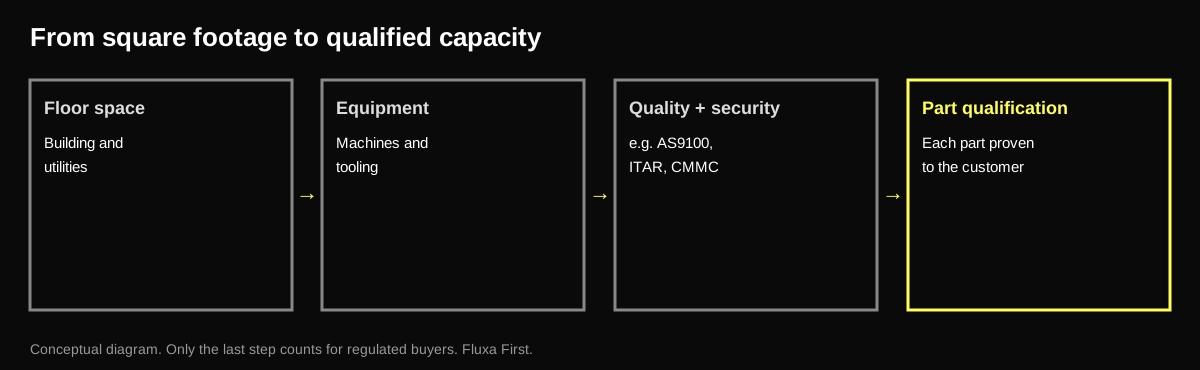
3D Systems opened a new center in Littleton, Colorado on Oct. 21 to help aerospace, defense and semiconductor equipment makers develop, qualify and produce 3D-printed parts. The headline is not the 50,000 square feet. It is the list of credentials the site holds: AS9100D aerospace quality certification, ITAR registration, Joint Certification Program registration and CMMC Level 2 compliance for handling controlled unclassified information.
Corvid Technologies, an employee-owned defense contractor, plans to invest $95 million and add 423 jobs, including a new 400,000-square-foot manufacturing facility for vehicle launch systems, according to North Carolina’s commerce department. The state lists the average salary for the new roles at $81,550.
Blue Bird will convert a former motorhome plant in Fort Valley, Georgia into a 1-million-square-foot facility building school buses across diesel, gasoline, propane and electric powertrains, with construction expected to start in Q1 2027, according to the governor’s office.
Arda Industries launched with $232 million in total funding for software that turns product design files into assembly plans and work instructions and updates them as designs change. The company says its first customer, Anduril, cut basic work instruction creation from about 10 hours to 15 minutes. It is starting in defense and the data center supply chain, including makers of transformers and electrical equipment.
Why is qualified capacity the bottleneck?
A buyer of flight hardware or defense components cannot simply pick the cheapest machine shop. The supplier needs a quality system the customer trusts, export control registration for sensitive work, cybersecurity compliance for controlled data and a qualified process for each specific part. Getting there takes months or years, and each new part can require its own qualification.
That is why a 50,000-square-foot addition with the right certifications can matter more to aerospace and defense supply chains than a much larger building without them. It is also why so many hard-tech startups stall between prototype and production: they find that the parts they need are made by a handful of qualified suppliers with full order books.
Why does manufacturing engineering matter so much?
The second bottleneck is people. Every time a product changes, someone has to work out the assembly order, write the instructions and adjust the stations. Arda’s announcement makes the case that conventional automation for a single station can take months to program, while products like drones, robots and data center equipment now change constantly. Manufacturing engineers are scarce in the US, so that work becomes a limit on how fast factories can adapt.
For American industry this is a strategic issue. Countries that can retool quickly for each product generation win fast-moving hardware categories. If the US wants to build drones, robots and electronics at scale, it needs to change factory processes at something closer to the speed of design.
What does this mean for founders?
Design for qualification from the start. If your customer is in aerospace, defense or energy, build your quality system, documentation and security practices into the company early. Retrofitting them later is slow and expensive.
Treat suppliers as a strategic choice. Map which qualified suppliers your product depends on and how full their order books are. A second source qualified early can save a year.
Look for tools that compress engineering time. Software for work instructions, inspection, process control and digital qualification can raise the output of scarce engineers. These are good businesses in their own right.
Our view
We are encouraged by the wave of new American factories. But we think the next phase of reshoring will be decided less by ribbon cuttings and more by certifications, process discipline and engineering speed. Companies that make qualified capacity easier to create, faster to change and simpler to prove are building the real infrastructure of American industrial strength. Those are the companies we look for at Fluxa First.
More of our industrial coverage is under topics.
Figures are as stated in the linked announcements. This post is general commentary, not investment advice.