
Sodium-ion grid storage moves toward American factories
Key takeaways
- On October 21, 2026, Peak Energy closed a $108 million Series B led by GM Ventures to scale US manufacturing of passively cooled sodium-ion grid storage and fill more than $1 billion in customer orders.
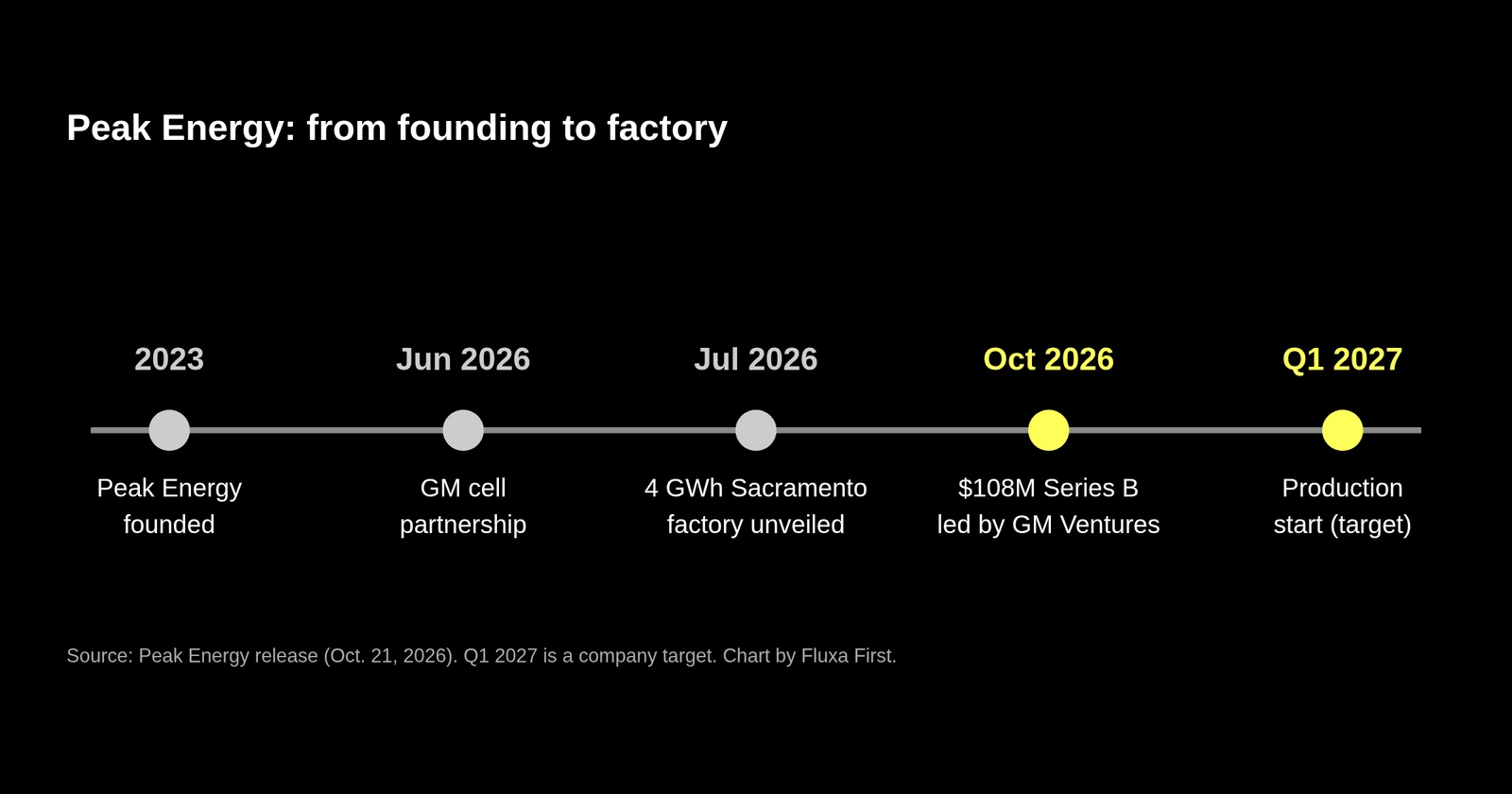
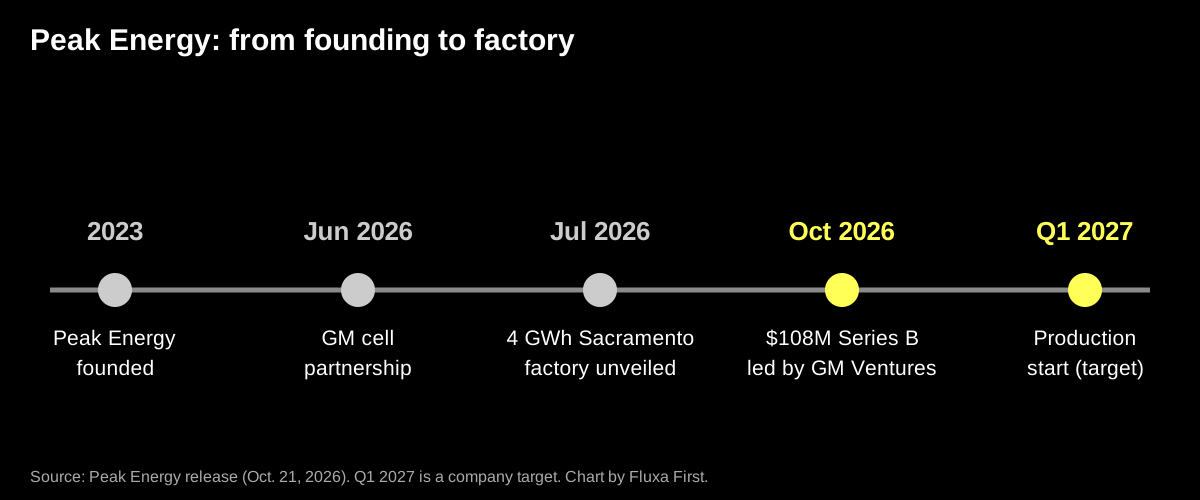
- Peak plans to start production at a 4 GWh factory in Sacramento in the first quarter of 2027 and is launching a product for data centers, where access to power has become a key constraint.
- Battery makers are also converting US lines to lithium iron phosphate for storage, such as Samsung SDI’s StarPlus Energy plant. We see chemistry choice as a supply chain decision as much as a technical one.
Grid storage is becoming as important to the power system as generation, and the question of where the batteries are made is becoming a sovereignty question. This week a sodium-ion startup raised a large round led by General Motors’ venture arm to build its first factory in California. We think chemistry choice is turning into supply chain strategy.
What did Peak Energy announce?
On October 21, Peak Energy announced an oversubscribed $108 million Series B led by GM Ventures, with Maverick Silicon, Infinite Capital, Eclipse, Xora Innovation and LG Technology Ventures participating. The company makes passively cooled sodium-ion storage systems for the grid.
Peak says the money will help it scale domestic manufacturing, deliver more than $1 billion in existing customer orders and launch a product for data centers, where access to power has become a primary limit on growth. Its commercial agreements include deals with Jupiter Power, RWE and Energy Vault. In June the company announced a partnership with General Motors to develop next-generation storage cells, drawing on GM’s US cell industrialization experience. In July it unveiled a 4 GWh factory in Sacramento, which it says will start production in the first quarter of 2027.
The company claims its simpler, passively cooled design can cut the cost of stored energy by up to 20% compared with conventional systems, with no planned maintenance and no water use. Those are company claims, and the factory has not started production yet. What stands out to us is who wrote the check: an automaker’s venture arm, backed by a company that knows exactly how hard it is to industrialize battery cells.
How does this fit the wider battery build-out?
Peak is not alone in building American storage capacity, and not everyone is betting on the same chemistry. Samsung SDI’s joint venture with Stellantis, StarPlus Energy, is converting a nickel-cobalt-aluminum line to make larger lithium iron phosphate cells for energy storage, its third such line in the US, according to The Elec, as relayed by Voltgrid News, an AI-assisted outlet. Equipment orders for that line came in October.
Two things are happening at once. Demand for storage is rising quickly, driven partly by data centers. And manufacturers are choosing chemistries with an eye on where the materials come from and how simple the system is to run.
Why chemistry is a supply chain decision
Every battery chemistry carries its own supply chain: the minerals, the refining, the cathode and anode materials, the electrolyte and the factory equipment. When one chemistry dominates and its inputs are concentrated in a few countries, buyers inherit that concentration. A chemistry built on abundant materials does not remove every dependency, since equipment, processing know-how and components still matter, but it changes which ones matter most.
For American energy independence, we think the right goal is not one winning chemistry. It is several chemistries made at home, so utilities, developers and data centers have more than one way to buy storage, and a disruption in one supply chain does not stall the grid. We made a similar argument about heavy electrical equipment in our post on the power transformer shortage.
What should founders and investors take from this?
- Strategic investors signal industrial intent. When the venture arm of a company that builds cells at scale leads a round, it brings manufacturing knowledge, not just money. Founders scaling hard tech should look for investors who can help them industrialize.
- Orders before factories. Peak raised against more than $1 billion in stated commitments. Order books do not remove risk, but they change the conversation with capital providers, including lenders.
- Simplicity is a product feature. Removing cooling and maintenance is a cost story as much as a technical one. Buyers of infrastructure pay for lower lifetime cost and fewer failure points.
- Factory start is the real test. The step from pilot lines to a full plant is where many battery companies have struggled. We wrote about qualified manufacturing capacity as the bottleneck in hard tech, and it applies here.
How we see it
We back durable companies in energy and advanced manufacturing, and grid storage is a clear case where technology, manufacturing and national resilience line up. The winners will be the teams that turn a good cell into a reliable, bankable product made at scale in the United States. That is a manufacturing challenge first, and it is where we think much of the value in the energy transition will be created.
Company figures and plans are as stated in the linked announcements and are forward-looking. This post is general commentary, not investment advice.
Frequently asked questions
What is sodium-ion grid storage?
It is stationary battery storage built on sodium-ion cells instead of lithium-ion. Sodium is abundant and widely available, and sodium-ion cells are generally less energy-dense than lithium-ion ones, which matters less for grid storage where weight and size are less critical than cost, safety and life. Peak Energy’s systems are also passively cooled, meaning they do not use active cooling equipment.
Why does battery chemistry matter for energy independence?
Each chemistry depends on a different set of minerals, processing steps and equipment suppliers. A chemistry built on abundant, domestically available materials can reduce exposure to concentrated foreign supply chains. Having several chemistries made at home also gives utilities and data centers more than one way to buy storage.