
Distributed shipbuilding: why the Navy wants more small yards
Key takeaways
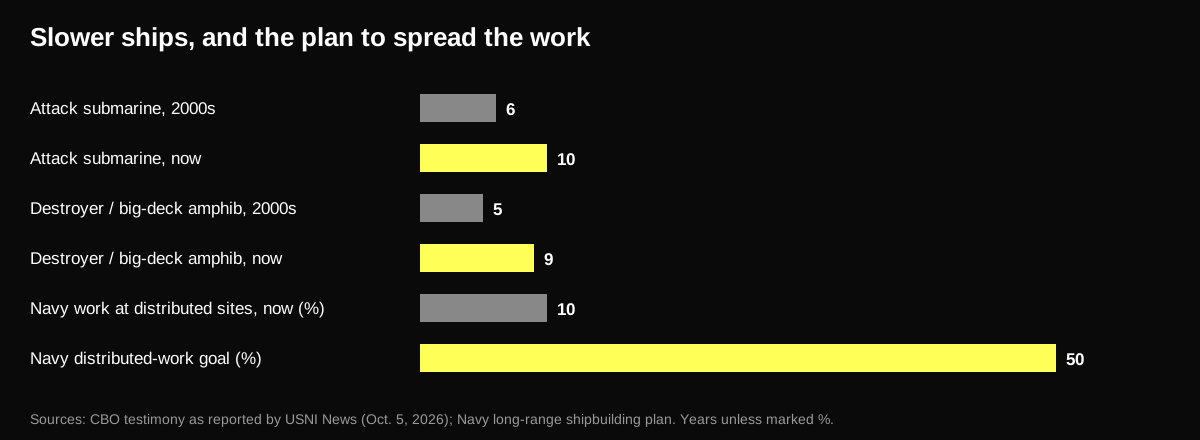
- The Navy’s long-range plan aims to move distributed shipbuilding from about 10% of work to 50%.
- {‘Build times have stretched’: ‘about ten years for an attack submarine and nine for a destroyer, per CBO testimony.’}
- October brought a new private submarine-component yard plan in Maryland and approval for a second destroyer at Bath Iron Works, pending funding.
- The biggest openings for founders are in module quality, digital design handoff, workforce tools and yard-to-yard logistics.
The US Navy is changing how it builds ships. Instead of asking a handful of large yards to do almost everything, it wants a federated network of smaller yards and suppliers building modules that are then shipped to final assembly. The goal in the Navy’s long-range plan is to raise the share of work done at distributed sites from roughly 10% today to 50%. October made clear this is no longer just a plan.
Why is the Navy moving to distributed shipbuilding?
Because the current model is too slow and too short of people. As USNI News reported, Congressional Budget Office testimony in April put attack submarine construction at about ten years, up from six in the 2000s, and destroyers and big-deck amphibious ships at about nine, up from five.
The workforce is the core constraint. The same reporting notes that the American shipbuilding workforce has shrunk sharply since the late 1970s, and that Gulf Coast yards compete for the same pool of welders and fitters. One major yard has more floor space than workers to fill it. The logic of distribution is simple: put the work where the workers already are, instead of hoping they relocate.
This is not new. Modular construction was refined in postwar Japan and Sweden, and US submarine programs have split hull sections between yards for decades. What is new is the scale the Navy wants and the number of smaller yards it hopes to bring in, including commercial yards that grew up serving offshore oil and gas.
What changed this month?
Several concrete moves landed in the first half of October:
- A new private yard for submarine components. On October 6, Maryland announced a $3.7 billion private investment by Anduril Industries in a two million square foot shipyard at Sparrows Point near Baltimore, expected to create more than 3,100 permanent jobs, per the Maryland Department of Commerce. Anduril also received a Navy contract worth up to $2.9 billion to build Virginia-class components, as CNBC reported. Operations are slated to start in 2030.
- A second destroyer for Bath Iron Works. The Pentagon determined the Maine yard has the capacity to build a second Arleigh Burke-class destroyer in fiscal 2027, reversing its budget request, though Congress still has to fund it, per Roll Call.
- Module work spreading along the Gulf. Smaller yards in Alabama, Florida and Texas are building submarine and destroyer modules, and a Navy-funded module facility in Mobile is targeting about one million labor hours a year by 2027, per USNI News.
What are the risks?
Distribution trades one bottleneck for another. Modules built in different places must fit together exactly. Australia’s experience splitting destroyer work across several yards in the late 2000s led to misfit blocks and delays, and in the US, late bow and stern sections contributed to a delivery slip on a ballistic missile submarine. The federated model works only if design data, tolerances, inspection and logistics are tightly managed across companies that have never worked together.
That is a hard-tech problem, and hard-tech problems are where we spend our time.
Where are the openings for founders?
We see four areas where startups can make distributed shipbuilding work better:
| Gap | What a startup could build |
|---|---|
| Module fit and quality | Metrology, scanning and inspection that catch dimensional errors at the supplier yard, before barging |
| Digital design handoff | Tools that turn a prime’s model-based design into clear, version-controlled work packages for smaller yards |
| Workforce productivity | Training, augmented work instructions and welding automation that make each skilled worker go further |
| Yard-to-yard logistics | Scheduling, tracking and transport planning for oversized modules across a regional network |
Many of these products also sell into commercial shipbuilding, offshore energy and heavy construction, which gives a founder more than one customer base. That dual-market path is what makes a company durable instead of dependent on a single program.
What it means for investors
Shipbuilding is a long-cycle market with lumpy budgets, and a contract announcement is not revenue. Investors should look for companies whose products improve throughput at yards that already have work, rather than businesses that only make sense if a specific new program is funded. The workforce constraint will last for years. Tools that multiply skilled labor will be valuable regardless of which ships get built.
Our view
Maritime capacity is part of national capacity. A country that cannot build and repair ships quickly cannot sustain trade, energy or security at sea. We think the shift to distributed shipbuilding will open the market to a new generation of suppliers, and we want to help founders build the quality, data and workforce tools that make the network work. Read more about Fluxa First or browse all topics.