
Geothermal is moving from pilot to build program
Key takeaways
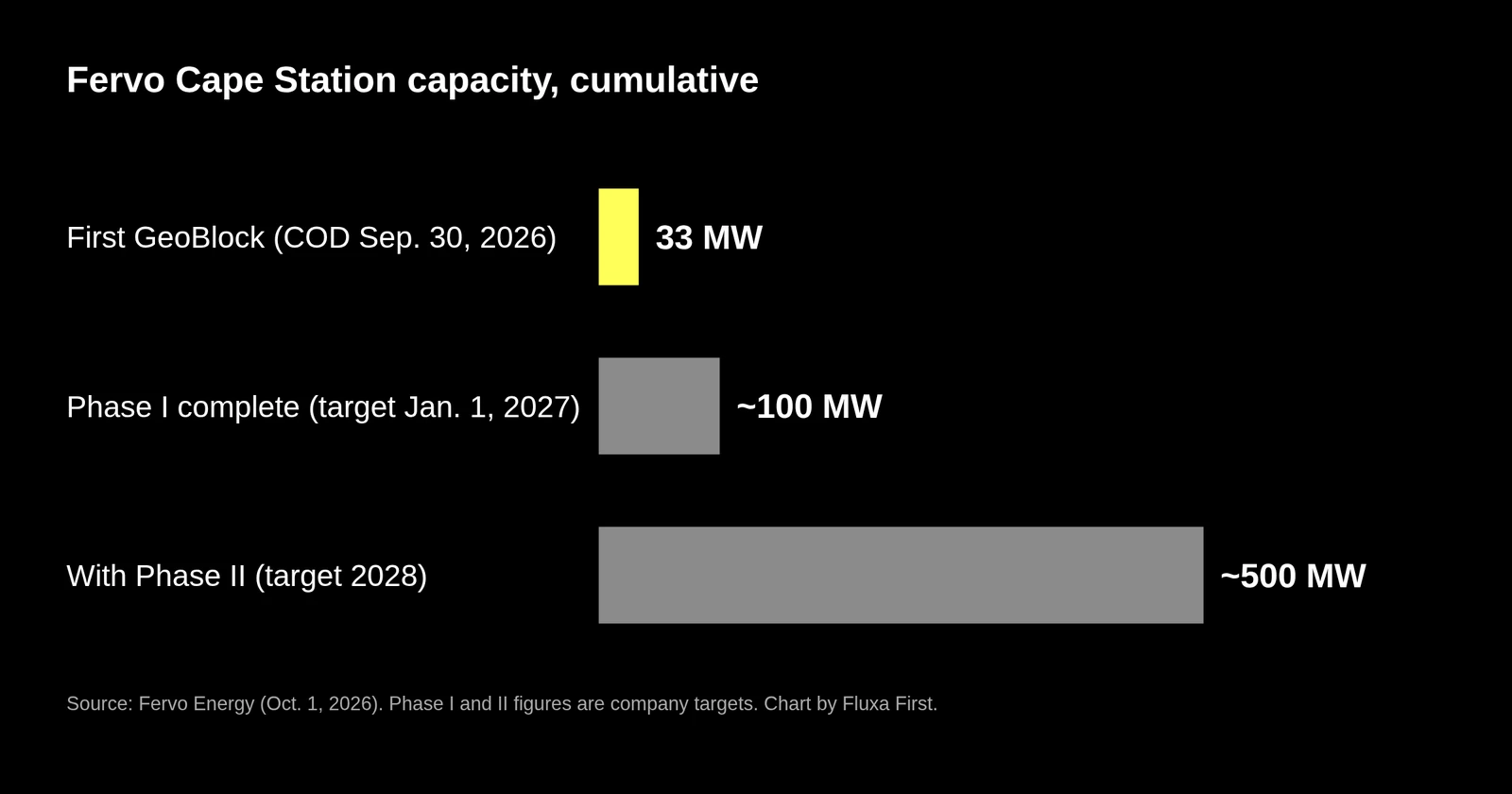
- Fervo Energy’s first 33 MW GeoBlock at Cape Station, Utah, reached commercial operation on September 30, 2026, after 23 months of construction, and is earning revenue under a power purchase agreement.
- Fervo targets about 100 MW by January 1, 2027 and another 400 MW in 2028, and says it has more than 1 GW of binding power contracts across its portfolio.
- On October 22, Endurance Energy reported what it calls the first end-to-end subsea geothermal test, drilling a seafloor well and generating net-positive power for 8.7 seconds.
- Geothermal is becoming a repeatable product, which is what turns a promising technology into a durable energy business.
Geothermal power has spent decades as the clean energy source that was always promising and rarely built at scale outside a few regions. That is changing. In October, one company brought a next-generation geothermal plant into commercial operation ahead of schedule, and another reported what it calls the first end-to-end test of geothermal power from the deep ocean floor. Together they show geothermal moving from science project toward repeatable build program, and that shift is what matters for founders and investors.
What did Fervo just prove?
On October 1, Fervo Energy announced that the first power plant at its Cape Station project in Beaver County, Utah, had reached commercial operation. The first GeoBlock synchronized to the grid on September 24 and declared commercial operation on September 30, one day ahead of its contract date. It produced 33 MW of net power, meeting the threshold in its power purchase agreement, and is now earning revenue.
Fervo says it is the first greenfield enhanced geothermal development in the world to reach contractual commercial operation. It built and commissioned the first GeoBlock in 23 months and believes future GeoBlocks can be built in 18.
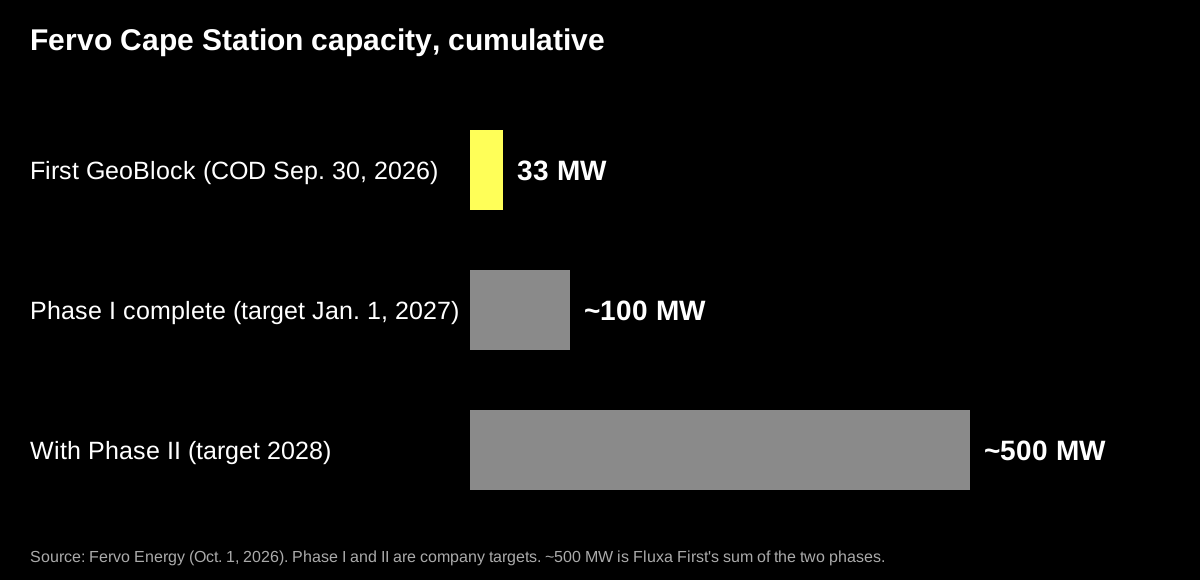
The plan from here is a build-out. Phase I is about 100 MW across three 33 MW GeoBlocks, and Fervo expects the remaining two to reach commercial operation by January 1, 2027. A further 400 MW is under construction with a target of 2028. The roughly 500 MW total is our own sum of the two phases, not a Fervo figure. The company says it has more than 1 GW of binding power purchase agreements across its portfolio and points to demand from AI hyperscalers and utilities.
What did Endurance test on the seafloor?
Three weeks later, Endurance Energy reported what it calls the first end-to-end demonstration of subsea geothermal power. In September, its Adélie test plant was deployed at Axial Seamount, an active underwater volcano about 300 miles off the Oregon coast, nearly a mile deep.
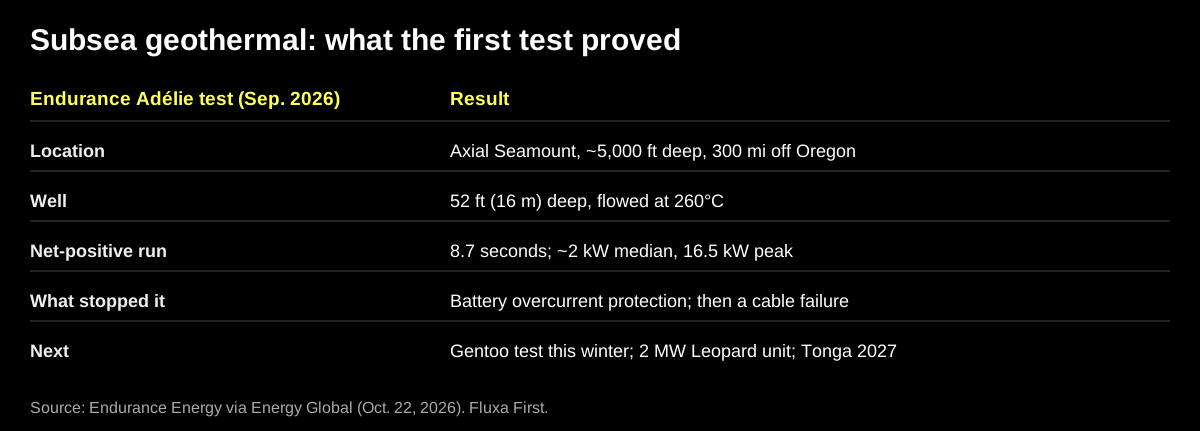
The team drilled and completed a 52-foot well on the seafloor that flowed at 260°C, landed a 3-tonne power plant, and controlled it in real time from Seattle over a National Science Foundation seafloor fiber network. Connected to a nearby natural vent, the plant generated more electricity than it used for 8.7 seconds, with a median of about 2 kW net and a peak of 16.5 kW.
Endurance was also candid about what did not work. The new well delivered hot fluid but was too restrictive to run the plant. The net-positive run ended when battery overcurrent protection tripped, and a cable failure ended the dive. Next, it plans an upgraded test called Gentoo this winter, deeper wells with a drill that can reach about 260 feet, and a 2 MW commercial unit called Leopard. Its first commercial project, in Tonga, targets first power in 2027 for a grid that runs largely on imported diesel.
Why do these milestones matter?
Firm power is scarce. Grid operators, data center builders and manufacturers want electricity that runs around the clock regardless of weather. Geothermal can provide it from domestic heat, with no fuel to import. That makes it an energy independence story as much as a clean energy one.
Repeatability is the product. The most important word in Fervo’s announcement is GeoBlock. A standard block that gets faster and cheaper each time is how a power technology becomes an industry. The 23-month first build and the 18-month goal for the next ones are the metrics to watch, alongside drilling costs and well performance.
Honest test data compounds. Endurance published its failures along with its successes. That is how hard-tech companies should report early tests: as evidence about what works, what does not and what comes next. An 8.7-second run is a small number, but a first proof of the full chain from well to wire is a genuine milestone, and the lessons on mineral buildup, well flow and remote operation are what make the next system better.
Beachhead markets matter. Starting subsea geothermal on an island grid that runs largely on imported diesel is a smart choice. Customers there feel high fuel costs and supply risk directly, which makes them more willing to try something new.
What should founders take from this?
Geothermal’s revival draws on skills from oil and gas: drilling, reservoir engineering, subsea operations and well completion. American industry has deep experience in all of them. The opportunity for new companies is not only in power plants, but in the supply chain around them: drilling tools that survive high temperatures, sensors and monitoring, heat exchangers, power conversion, and software that cuts the time from site selection to first power.
The bigger constraint is often not technology but delivery: permits, transmission connections and equipment lead times. We wrote about one of those bottlenecks in our look at the power transformer shortage, and about another firm power source in our advanced nuclear roundup.
How we see it
Reliable, domestic power underpins manufacturing, computing and defense. Our view is that the winners in geothermal will be the companies that treat each project as a product they can repeat, report progress honestly and finance the build-out with capital matched to long project timelines. October’s milestones suggest geothermal is starting to look like that kind of business.
Frequently asked questions
What is enhanced geothermal?
Enhanced geothermal systems create or expand fractures in hot rock deep underground, then circulate fluid through them to bring heat to the surface for power. They aim to make geothermal possible in many more places than conventional geothermal, which depends on natural reservoirs of hot water or steam.
What is subsea geothermal power?
Subsea geothermal power taps heat beneath the ocean floor, for example near underwater volcanoes or hydrothermal vents, using equipment placed on the seafloor and connected to shore. Endurance Energy’s September 2026 test was an early demonstration, not a commercial plant.