
Advanced nuclear in October 2026: permits, fuel and Army microreactors
Key takeaways
- TVA received the first US construction permit for a BWRX-300 small modular reactor, only the second advanced reactor construction permit ever issued.
- The Army picked five microreactor vendors for five bases, with up to $2.2 billion in milestone-based funding and a September 2028 target for a first reactor.
- DOE opened up to $50 million for silicon carbide fuel cladding, and a HALEU supply contract was announced.
- {‘The constraint is shifting from permission to execution’: ‘fuel, components, construction and skilled labor.’}
For years, advanced nuclear in the United States was mostly paper: designs, applications and announcements. This fall, more of it moved onto real sites with real money and real deadlines. That shift changes where the risk sits, and it opens a different set of opportunities for founders who build the parts, tools and services these projects need.
What moved in advanced nuclear this fall?
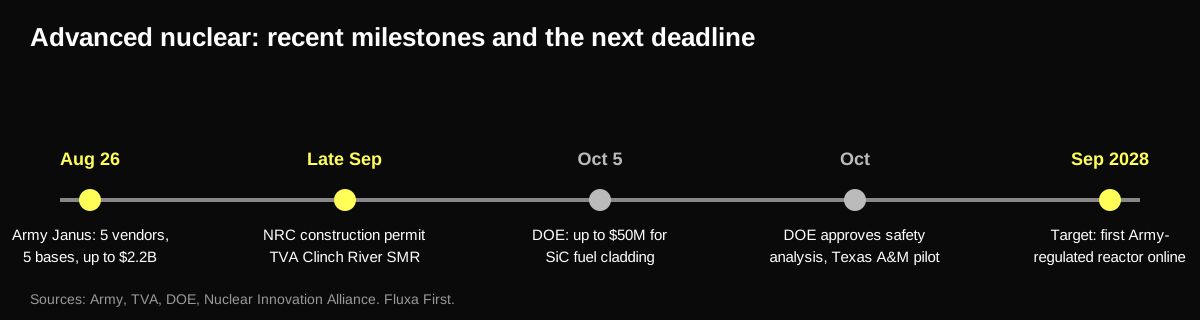
A construction permit for a small modular reactor. In late September, the Nuclear Regulatory Commission issued TVA a construction permit for Clinch River Unit 1, a GE Vernova Hitachi BWRX-300 near Oak Ridge, Tennessee. TVA said it is the first US utility permitted to build that design and that this is only the second advanced reactor construction permit ever issued in the country, per its announcement. TVA has not announced a construction date and is still negotiating cost sharing with partners, and it will need a separate operating license before loading fuel. The permit is also recorded in the Federal Register.
Army microreactors on five bases. In late August, the Army’s Janus program selected five vendors and five installations, with up to $2.2 billion across fiscal 2027 to 2031, according to the Army. The reactors will be contractor-owned and operated, payments are released only when technical milestones are met, and the Army expects private capital to bring the total to more than 20 microreactors. The target is a first Army-regulated reactor operating on a base by September 2028.
Fuel and materials. On October 5, DOE’s Office of Nuclear Energy offered up to $50 million over three years to fabricate full-length silicon carbide clad fuel rods for irradiation testing, with applications due December 7, per DOE. The Nuclear Innovation Alliance’s October tracker update also notes a contract to supply high-assay low-enriched uranium (HALEU) before 2030 and DOE approval of a pilot reactor safety analysis at Texas A&M’s RELLIS campus.
Why does this matter beyond the reactor vendors?
The Janus structure is worth studying even if you never build a reactor. The government is paying for outcomes, not effort: money arrives when a technical milestone is demonstrated, and vendors put their own capital at risk. That is the same discipline we apply in our studio, where capital is released against evidence. It rewards companies that can define their milestones clearly and hit them.
It also tells you who the customer is. Military bases want power that does not depend on a fragile external grid. Data centers and industrial sites want the same thing for different reasons. Demand for firm, local power is broad, and it is not tied to a single program.
Where is the bottleneck now?
As permits and awards arrive, the hard questions become physical:
| Constraint | Why it matters |
|---|---|
| Fuel supply | Many advanced designs need HALEU, and domestic enrichment capacity is still being built |
| Qualified components | Nuclear-grade valves, pressure vessels, instrumentation and forgings have long lead times |
| Construction execution | First-of-a-kind builds carry schedule and cost risk that later units should not |
| Skilled labor | Welders, pipefitters, reactor operators and QA inspectors are in short supply nationally |
| Materials testing | New fuels and claddings need irradiation data before licensing |
Each row is a business opportunity. Startups that shorten qualification for components, improve inspection, train and certify workers faster, or provide testing services can sell to many reactor developers at once, rather than betting on one design winning.
What it means for founders
If you are building in energy, look one layer below the headline. The reactor developers are well funded relative to most of their suppliers. The companies that make the supply chain work, from sensors and digital twins to specialized fabrication, will be needed by all of them. Pick a constraint from the table above, find a customer who feels it this year, and build around a milestone they will pay for.
What it means for investors
Nuclear timelines are long and first units are expensive. Investors should favor companies with revenue from the existing fleet, the largest light-water reactor fleet in the world, while they position for new builds. That path generates cash now and keeps options open if a particular new design slips.
Our view
Energy independence is part of American sovereignty. Firm, domestic power underpins manufacturing, computing and defense, and advanced nuclear is one of the few options that can deliver it at scale. We are optimistic, and we also think execution is now the story. The founders who help these projects get built on time will build durable companies. Learn more about Fluxa First or browse all topics.