
The transformer chokepoint: why grid equipment now sets the pace of American industry
Key takeaways
- Average lead times are about 128 weeks for power transformers and 144 weeks for generator step-up units, versus under a year before the pandemic.
- Roughly 80% of large power transformers used in the US are imported, and there is a single domestic producer of the core steel they need.
- Federal action includes a Defense Production Act determination for grid equipment and a DOE program of up to $375 million.
- New factories take one to three years, so the shortage will outlast the policy response; standardization, refurbishment and new power electronics are where startups fit.
America wants to build: factories, data centers, shipyards, reactors and mines. Every one of those needs to connect to the grid, and almost every grid connection needs a transformer. Right now, that single piece of equipment is setting the schedule for a large share of the country’s industrial ambitions.
How bad is the transformer shortage?
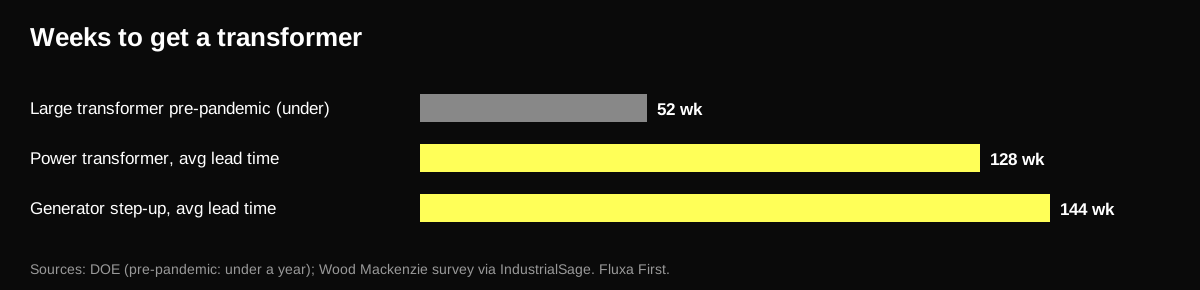
According to a Q2 2025 Wood Mackenzie survey cited by IndustrialSage, standard power transformers average about 128 weeks from order to delivery, and generator step-up transformers, which connect power plants to the grid, average about 144 weeks. DOE has noted that before the pandemic a large unit could be ordered with a lead time of less than a year.
The Department of Energy’s Office of Electricity describes the same picture from the policy side: after almost twenty years of flat demand, US electricity load has grown close to 3% a year since 2023, critical grid equipment faces lead times of two years or more, and some transformers have seen prices rise four to nine times over five years.
Why is this a sovereignty problem?
Three facts make it strategic rather than merely inconvenient:
- Import dependence. Roughly 80% of large power transformers used in the US are imported.
- A single material source. Transformer cores need grain-oriented electrical steel, and there is only one domestic producer of it.
- Customization. Many units are built to bespoke specifications, which slows production and makes spares hard to share between utilities.
In April, a presidential determination under Section 303 of the Defense Production Act declared transformers, substations, breakers, power electronics and electrical core steel essential to national defense. The reasoning cited limited domestic capacity, long procurement timelines and reliance on imports. A country that cannot energize a new plant for two or three years cannot reshore manufacturing on the timeline its policy promises.
What is being done?
DOE plans a supply chain program worth up to $375 million focused on three things: more refurbishment and reuse of existing equipment, standard configurations that let factories produce at scale, and next-generation power electronics such as solid-state transformers. The department’s stated goals are modest and honest: cut imports and lead times by up to 10% and utility equipment spending by as much as 25%.
Industry is also adding capacity, with roughly $2 billion directed at North American transformer production and new output expected around 2028. But DOE’s own estimate is that a new transformer factory takes one to three years to build. Policy moves faster than steel.
Where can startups help?
| Opportunity | What it looks like |
|---|---|
| Standardization | Software and engineering services that help utilities converge on common designs and share spares |
| Refurbishment and life extension | Diagnostics, monitoring and rebuild services that keep existing units in service longer |
| Power electronics | Solid-state and hybrid transformers, and grid-edge devices that reduce the need for conventional units |
| Materials and manufacturing | Alternative core materials, automated winding and faster factory processes |
| Procurement intelligence | Tools that help developers reserve slots and plan equipment years before construction |
Several of these businesses can earn revenue quickly from utilities and industrial developers who are already feeling the pain. That is the combination we look for: high pain, high urgency and few alternatives.
What it means for founders building physical things
If your company will build a facility, put grid equipment on your critical path today. Industry practice is shifting so that procurement planning starts before final project approval, not after. Talk to your utility early about interconnection timing, consider modular or temporary power for early phases, and treat delivery slots as a strategic asset.
What it means for investors
Data center and industrial demand will not ease soon, and the supply response is measured in years. Companies that shorten the wait, extend the life of what is installed or replace parts of the conventional design have a durable market. Look for teams with utility customers and a clear path through qualification, since grid buyers are conservative for good reasons.
Our view
Sovereignty is not only about defense hardware. It is about whether a nation can power its own growth. We see grid equipment as part of the industrial base, as essential as shipyards and launch pads, and we want to help founders build the companies that close this gap. Learn more about Fluxa First or browse all topics.
Frequently asked questions
Why are power transformer lead times so long?
Demand from data centers, electrification, new generation and grid replacement arrived at the same time, while manufacturing capacity grew slowly. Much of the supply is imported, designs are highly customized, and the specialized electrical steel inside comes from very few sources. The result is waits of two years or more for many units.
Is the transformer shortage a national security issue?
The federal government treats it as one. An April 2026 presidential determination under the Defense Production Act found grid equipment, including transformers and electrical core steel, essential to national defense, citing foreign dependence and long lead times. A country that cannot energize new factories quickly cannot reshore industry quickly.