
A new American shipyard, built with Korean know-how
Key takeaways
- On October 22, 2026, HD Hyundai and Kiewit agreed to form a joint venture, HD-Kiewit Shipbuilding, to build a new shipyard in the United States, with construction starting next year and full operations targeted for 2029.
- HD Hyundai will provide shipbuilding technology and production expertise, Kiewit engineering and construction, and the venture will look at Navy logistics ships, commercial ships and supplying blocks and modules to other US yards.
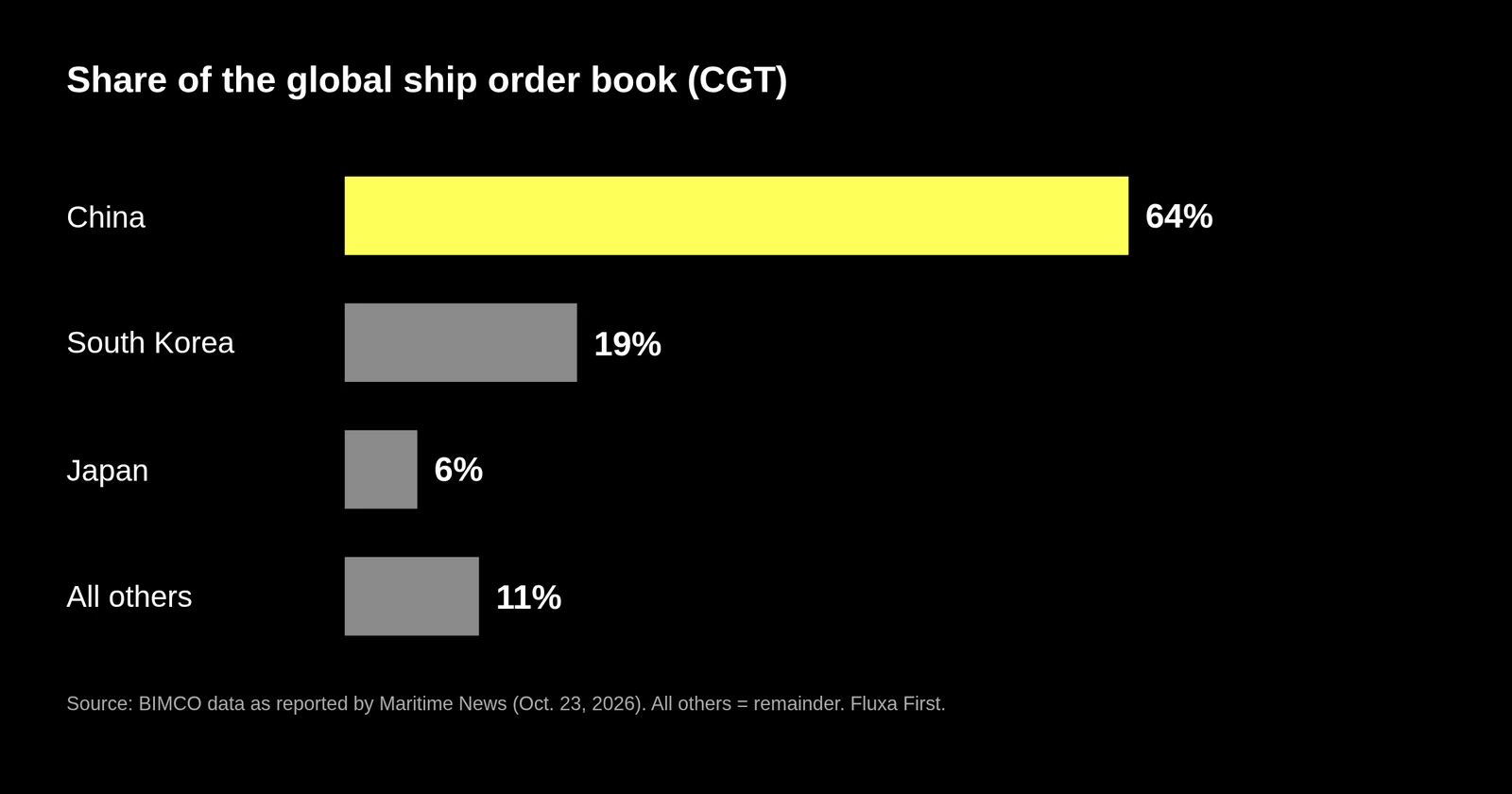
- Chinese yards held 64% of the global order book and won 74% of new contracting over the prior 12 months, according to BIMCO data reported on October 23, against 19% and 6% of the order book for South Korea and Japan.
- We see allied know-how plus American construction capacity as the fastest credible path to more US shipbuilding, and a large opening for suppliers, automation and workforce companies.
The fastest way to build ships is to learn from people who already build a lot of them. That is the logic behind a new joint venture between South Korea’s HD Hyundai and US engineering and construction firm Kiewit, announced on October 22, to build a brand-new shipyard in the United States. It comes as China’s yards hold nearly two-thirds of the world’s ship order book. For American industrial sovereignty, greenfield capacity built with allied know-how may be the most practical path to scale.
What did HD Hyundai and Kiewit announce?
According to Yonhap, the two companies signed an agreement in Houston on October 22 to form a joint venture, tentatively named HD-Kiewit Shipbuilding LLC. Construction of the shipyard is planned to begin next year, with full-scale operations targeted for 2029. HD Hyundai will bring shipbuilding technology and production expertise. Kiewit will bring engineering and construction capabilities.
HD Hyundai stressed that this is a new yard rather than an upgrade of an existing one. The venture plans to pursue Navy logistics support vessels and commercial ships, and is considering making ship blocks and modules for other US yards. The partners also plan to work together on port infrastructure. Yonhap’s report named no site or investment amount. WorkBoat, citing the partners’ announcement, reports a purpose-built yard on an existing industrial site in Ingleside, Texas, with up to 3,000 jobs at full scale. We have not seen an investment figure. One Korean outlet mentions California as a second candidate site, so the location should be treated as preliminary.
How big is the gap?
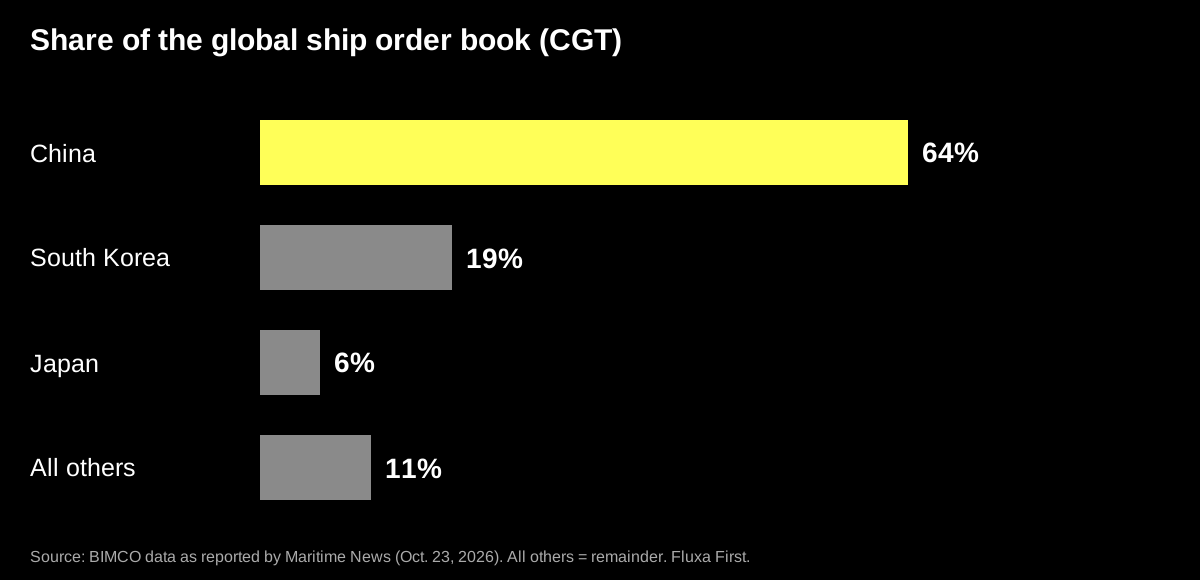
Maritime News, citing BIMCO data, reported on October 23 that the global order book reached an estimated 203.2 million compensated gross tonnes as of September 1, 2026, up from 180 million a year earlier and above the 2008 peak of 195.4 million, though still below a reported high of 210.4 million in May. Chinese yards won 74% of tonnage contracted over the previous 12 months and held 64% of the order book, against 19% for South Korea and 6% for Japan. The United States does not appear in the shares reported.
The same report noted other signs of activity in US yards, including Wildcat Defense’s agreement to acquire Fraser Industries with plans to invest $350 million in that yard. Korea’s yards remain busy at home too: HMM ordered eight 13,000-TEU container ships from HD Hyundai for about $1.42 billion in the same week.
Why does a greenfield yard matter?
We wrote earlier about the case for distributed shipbuilding across many smaller yards. A new yard designed from scratch adds something different: the chance to lay out production the way the world’s most productive builders do, rather than retrofitting facilities designed for older methods.
In our view, much of the edge of the leading Asian builders is process, not just labor cost: block construction, outfitting sections before assembly, tight scheduling and deep supplier networks. Those methods are hard to copy from a distance. Partnering with a builder that runs them every day, and pairing it with a US firm that knows how to build large infrastructure here, gives the venture a credible starting point.
The block and module idea matters too. If one yard can supply outfitted sections to others, the whole US industrial base gains capacity without every yard having to master every step.
What are the risks?
Time. Full operations are targeted for 2029, and yards often take longer than planned. Orders need to arrive in time to keep a new workforce employed.
Workforce. A new yard needs welders, pipefitters, electricians and planners in large numbers. As we wrote in the reshoring workforce constraint, people are often the binding constraint.
Demand and policy. US yards have struggled to compete on price for commercial ships. Demand will depend on Navy and government programs, domestic shipping rules and long-term policy support.
Where do founders fit?
New yards create demand far beyond the yard itself. Shipbuilding needs steel processing, castings and forgings, propulsion, power systems, piping, cable, coatings and electronics, plus planning software, welding automation and inspection. Every one of those supply chains thinned out as US commercial shipbuilding shrank. Companies that can supply qualified parts, automate the hardest manual steps or train workers faster will find customers in every new US yard, not just this one.
How we see it
Maritime capacity is a pillar of American sovereignty: it carries trade, energy and supplies for the armed forces, and it cannot be rebuilt overnight. We think the strongest path combines American capital, construction and demand with allied production know-how, which is what this venture proposes. The yard itself is years away. The supplier base around it is an opportunity now, and it is where many of the durable hard-tech companies of the next decade will be built.
Frequently asked questions
Why is the United States building new shipyards?
US commercial shipbuilding capacity is small compared with China, South Korea and Japan, and existing yards are busy with Navy work. New yards and partnerships with experienced foreign builders aim to add capacity for both commercial and government ships, rebuild skilled workforces and strengthen the domestic supply chain for ship components.
What are ship blocks and modules?
Modern ships are built in large prefabricated sections, called blocks or modules, that are outfitted with piping, wiring and equipment before being joined together. Building blocks at one yard and shipping them to another can spread work across several sites and speed up construction, which is why the HD Hyundai and Kiewit venture is considering supplying them to other US shipyards.