
The drone gap is a components gap

Key takeaways
- US defense plans now call for drones in the hundreds of thousands, but US drone production is small and the global parts supply chain is dominated by China.
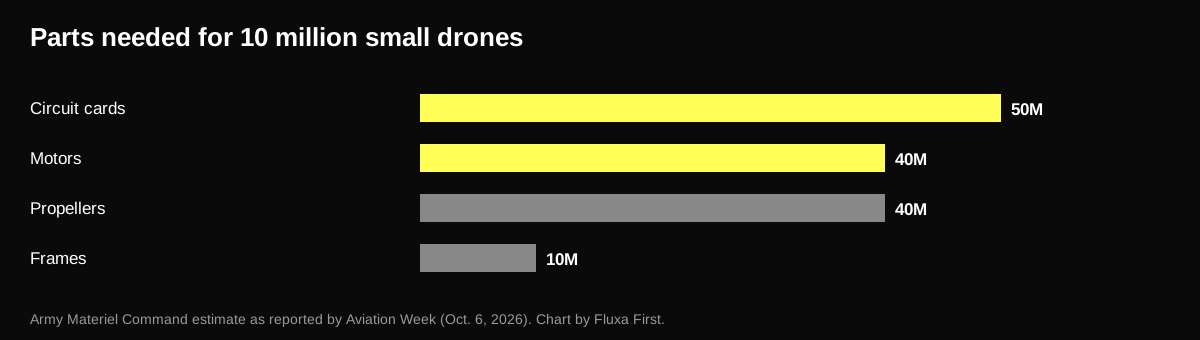
- An Army manufacturing lead estimated that 10 million drones would need about 50 million circuit cards and 40 million motors, per Aviation Week.
- The Army has retooled several depots to make motors, propellers, frames, circuit cards and battery packs, and plans to act like a contract manufacturer for startups.
- Component makers that serve both commercial and defense customers are the foundation of a sovereign drone and robotics supply chain.
Most of the conversation about American drones focuses on finished aircraft: who wins which competition and how many get bought. We think the more important question sits one level down. A drone is a bundle of motors, propellers, circuit cards, batteries, cameras and radios, and global production of those parts is dominated by China today. Until that changes, America does not have a drone industrial base. It has drone assemblers.
How big is the demand?
The numbers being discussed have grown fast. At AUSA on Oct. 14, Defense Secretary Pete Hegseth said the Pentagon is seeking roughly $50 billion in reconciliation funding to scale autonomous and robotic systems, per Military Times. That is separate from the fiscal 2027 budget request, which includes $53.6 billion for the Drone Dominance initiative across procurement, counter-drone systems, contested logistics and autonomy.
Specific programs are moving too. The Pentagon’s Drone Dominance Phase III competition plans to buy about 60,000 one-way attack drones for $450 million, according to DroneLife, at fixed prices of $5,000 and $3,000 per drone depending on mission type. Applicants must show they can build at least 8,000 drones in five months, with potential to exceed 100,000 a year, and the solicitation prefers systems sourced and made mainly in the United States.
Why is the gap in components?
An Aviation Week report from earlier this month puts the problem in plain terms. Ukraine built about 4 million small drones in 2025 and is on track for 9 million to 10 million this year. An Army Materiel Command manufacturing lead walked through what matching that scale would take: for 10 million drones, roughly 50 million circuit cards, 40 million motors, 40 million propellers and 10 million frames.
The frame is the easy part. Motors need magnets, many of which depend on Chinese rare earth supply chains. Circuit cards need components and assembly capacity. Battery packs need cells. Each of those is its own supply chain, and each is far larger than the number of drones suggests.
What is the Army doing about it?
The Pentagon has ordered about half a dozen Army depots, normally used for maintenance and overhaul, to start making drone parts, according to Aviation Week. They are being retooled for brushless motors, propellers, frames, circuit cards and battery packs. Tobyhanna Army Depot in Pennsylvania opened a motor assembly line this summer and has capacity to scale to roughly 500,000 motors a year.
The more interesting detail is the business model. The Army plans to run these depots somewhat like contract manufacturers: making parts for startups that lack equipment, renting space to companies that want to make their own components and even bidding jointly with companies on contracts. The effort is part of an $18.1 billion plan to modernize the Army’s organic industrial base of depots, arsenals and ammunition plants.
Meanwhile, the Defense Innovation Unit’s Drone Dominance program is funding private companies to build their own drones, and the Pentagon hopes three or four national champions emerge that can eventually support a commercial and defense drone industry making millions of aircraft a year.
What should a sovereign drone supply chain look like?
We think three principles matter:
| Principle | Why it matters |
|---|---|
| Build at the component level | Assembling imported parts does not remove the dependency |
| Serve commercial and defense customers | Volume from both markets lowers cost and keeps lines running |
| Design for standard interfaces | Common parts let many drone makers share suppliers |
The second point is the most important for founders. A motor, battery or flight controller that only sells to the military rides the budget cycle. One that also sells into agriculture, inspection, logistics and robotics has steadier demand and lower unit cost. The same parts that go into drones also go into the robots and autonomous systems that will run American factories, ports and farms.
Where are the opportunities?
- Motors and magnets: brushless motors at volume, ideally with magnet supply chains that do not run through China.
- Electronics: flight controllers, radios and the assembly capacity to build circuit cards in the millions.
- Power: battery packs and cell supply suited to small aircraft.
- Manufacturing technology: automation and test equipment that let small teams produce at high volume.
- Shared infrastructure: using depot capacity and government test ranges to reduce the capital a startup needs.
Our view
Drone production is becoming a test of whether America can rebuild high-volume manufacturing of small, cheap, fast-changing hardware, the very category it largely gave up decades ago. Defense demand is the spark, but the lasting industrial base will be built by component companies that also serve commercial robotics, energy and logistics. Those are durable businesses, and they are the kind we want to build at Fluxa First.
More of our American sovereignty coverage is under topics.
Figures are as reported in the linked sources. This post is general analysis, not investment advice.