
Medicine sovereignty starts with the ingredients: rebuilding US API manufacturing
Key takeaways
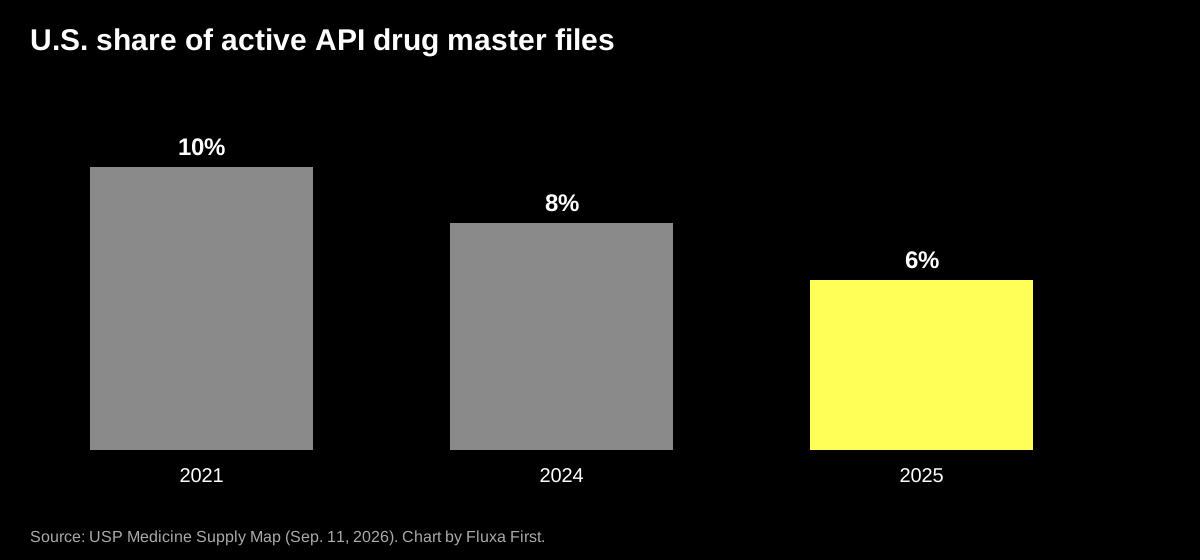
- The United States held 6% of active API drug master files for US medicines in 2025, down from 10% in 2021, while India held 49% and China 21%, according to USP’s Medicine Supply Map.
- China and India together made up 90% of new API filings in 2025, and the US just 3%.
- On October 22, 2026, Lilly broke ground on a $5 billion plant near Richmond, Virginia, its first site to make both active ingredients and finished medicines in one facility.
- We see API manufacturing as core industrial sovereignty, and an opening for companies building advanced, automated and continuous chemical and biologic production.
A country that cannot make the active ingredients in its own medicines depends on others for its health security. The United States is in that position. Data from USP’s Medicine Supply Map shows the US held just 6% of active API drug master files for US medicines in 2025, down from 10% in 2021. On October 22, one of the largest drugmakers broke ground on a plant that makes both ingredients and finished medicines in Virginia. It is a meaningful step, and a reminder of how large the gap is.
Where are the ingredients in US medicines made?
An active pharmaceutical ingredient, or API, is the substance that makes a medicine work. Before a drug can be made, the API has to be produced, often through many chemical or biological steps. Manufacturers describe those facilities and processes to the FDA in drug master files, so counting active files by location gives a picture of where registered capacity sits.
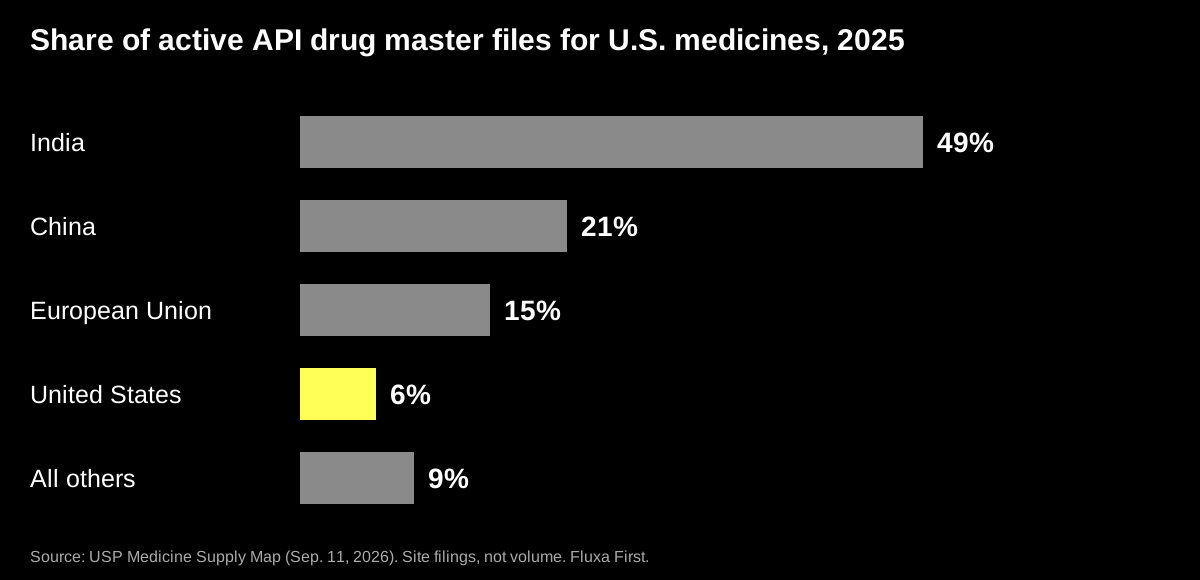
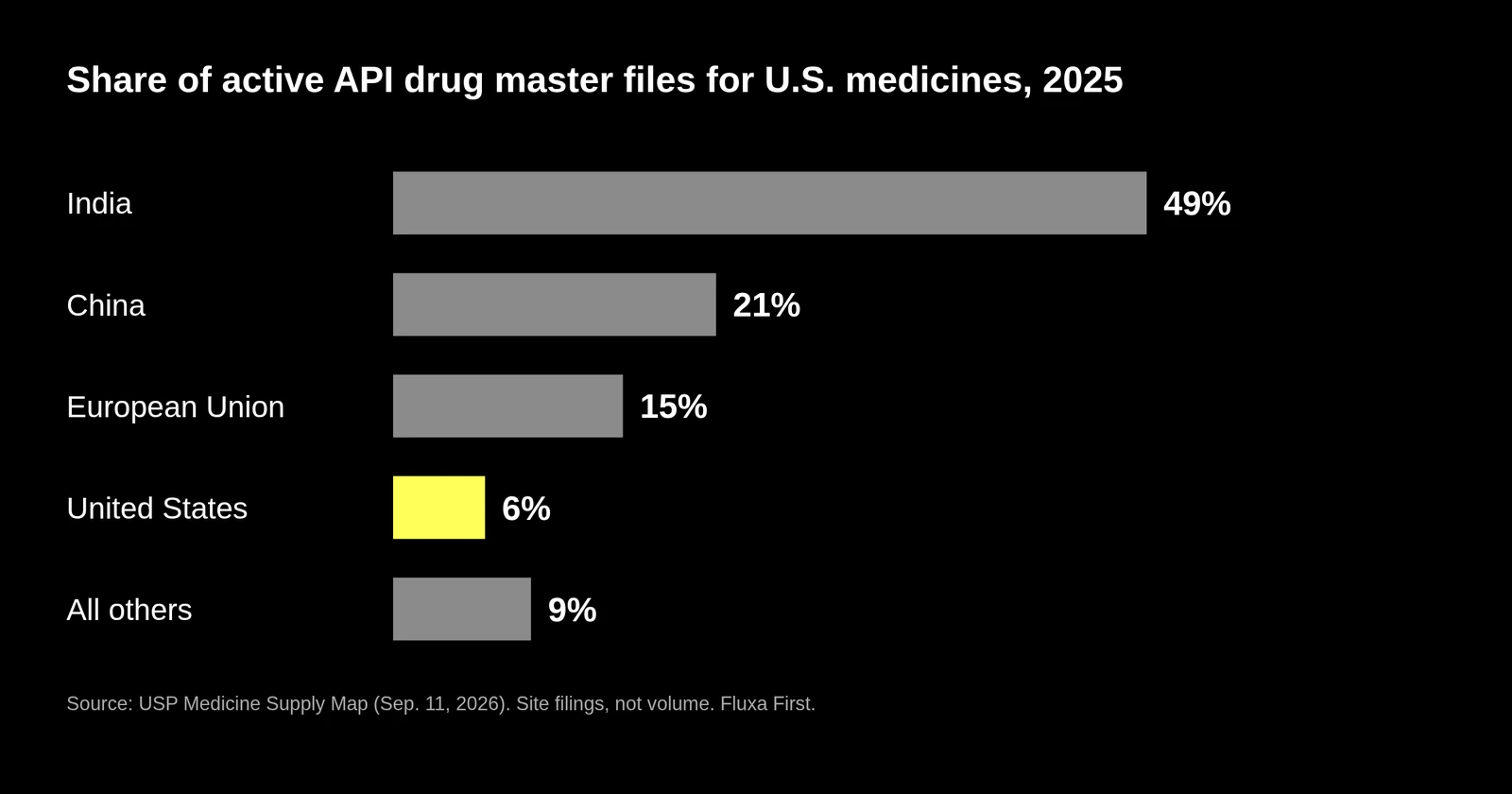
USP’s September 2026 analysis found that India holds 49% of active API files for US medicines, China 21%, the European Union 15% and the US 6%. China’s share rose from 13% in 2021 to 21% in 2025, including its largest one-year gain on record. China and India together accounted for 90% of new filings in 2025, while the US accounted for 3%. The US share of new filings has fallen from about 20% in the early 1980s.
USP is careful to note that file counts measure capacity, not volume. Its separate volume analysis found China’s share of US prescription API volume rose from 8% to 10%. Both measures point the same way. Generic medicines account for roughly 90% of US prescriptions filled, and their supply often relies on upstream API makers concentrated in a few countries.
What did Lilly announce?
On October 22, Lilly broke ground on a $5 billion plant in Goochland County, just west of Richmond, Virginia. It will be the company’s first facility to make both APIs and finished medicines in one integrated site, with dedicated API capacity for bioconjugate and large-molecule medicines. The site will make antibody-drug conjugates, targeted cancer treatments that pair antibodies with potent drugs. Lilly expects 650 permanent jobs and about 1,800 construction jobs, and has committed $40 million to a Virginia center for advanced pharmaceutical manufacturing training, including a pilot-scale training site targeted for 2028.
The Richmond site is one of 10 US manufacturing sites Lilly has announced since 2020, five of which will produce APIs, as part of a push the company puts at more than $50 billion.
Why does this matter for sovereignty?
Large, branded drugmakers are reshoring production of their newest and most valuable medicines. That is important, but most of the concentration risk sits elsewhere, in older generic medicines and their ingredients, where, in our view, margins are thin and much production moved abroad over past decades. Those are the drugs that fill most prescriptions and that tend to run short when a single plant or region is disrupted.
Medicines are part of the same industrial base question we keep returning to, alongside castings and forgings, critical minerals and the workforce to run new plants. A country needs enough domestic and allied capacity to keep essential goods flowing when trade is disrupted.
Where can new companies help?
Rebuilding API capacity on the old model, with large batch plants competing on labor cost, is hard to justify. New approaches change the math.
- Continuous and modular manufacturing. Making chemicals in continuous flow rather than large batches can shrink plants, cut waste and make smaller domestic sites viable.
- Automation and digital quality. Lilly says its Richmond site will rely on machine learning, digital systems and advanced analytics to get batches right the first time. Smaller companies can bring similar tools to contract manufacturers and generic producers.
- Key starting materials and intermediates. Many APIs depend on upstream chemicals made in only a few places. Domestic and allied capacity for those inputs is as important as the final step.
- Workforce and training. Lilly’s training commitment shows that skilled people are a bottleneck. Training platforms and operator tools are part of the solution.
How we see it
We think medicine supply is a core part of American sovereignty, alongside energy, defense and critical minerals. The US does not need to make every ingredient at home, but it does need enough domestic and allied capacity that a disruption in one region cannot cut off essential drugs. Investments like Lilly’s help at the top of the market. The bigger opportunity for builders is the less glamorous middle: the generic ingredients, intermediates and manufacturing technologies that make domestic production of everyday medicines competitive again.
Frequently asked questions
What is an active pharmaceutical ingredient?
An active pharmaceutical ingredient, or API, is the substance in a medicine that produces its therapeutic effect. Finished drugs combine the API with other ingredients and packaging. Many medicines sold in the United States are finished domestically or abroad using APIs made in other countries, which is why API sourcing is central to drug supply resilience.
What is an API drug master file?
A drug master file is a confidential submission to the FDA in which a manufacturer describes the facilities, processes and materials it uses to make a drug substance. Counting active API DMFs by location shows where registered manufacturing capacity sits. It does not measure production volume or market share.