
Five business model choices, one honest COGS: how hard-tech founders finish Phase 1
Key takeaways
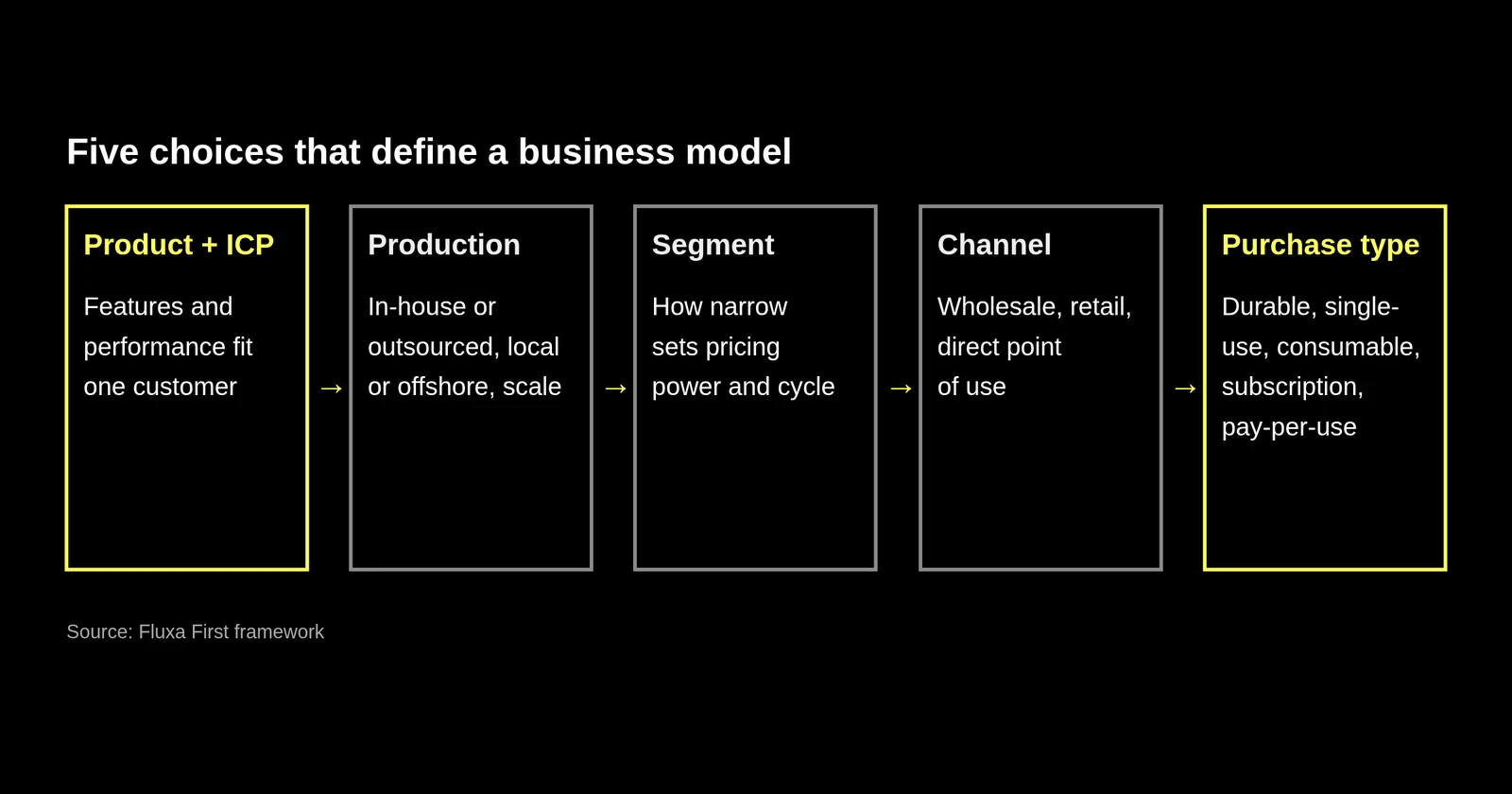
- A business model is the result of five linked choices, product design and customer, production, segmentation, distribution and purchase type, and changing one usually forces changes in the others.
- For the first phase, pick one selling category, B2G, B2B, B2B2C or B2C, one purchase type and one primary channel, and write down why.
- Build cost of goods per unit from parts, production process and direct labor, separately for prototype and small-batch phases, and keep cost of sales out of it.
- The pro forma ties product roadmap, go-to-market and capital plan together and answers when the company reaches positive cash flow and how much capital it needs to get there.
A hard-tech startup does not get to Phase 2 by building a better prototype alone. It gets there by turning the prototype into a business someone can underwrite: a coherent business model, an honest cost per unit, a pro forma that ties it together and the capital to execute. This playbook covers the first two, the choices that define the model and the cost of goods that proves it, because they are where most early plans break.
What is a business model, really?
A business model is not a pricing page. It is the result of a set of linked decisions about how a company creates, delivers and captures value. We break it into five.
- Product design and ideal customer. Features, form factor and performance have to fit the needs and limits of one specific customer profile. A sensor built for a utility substation is a different product from one built for a hobbyist, even if the core technology is the same.
- Production and supply chain. In-house or outsourced, domestic or offshore and the scale of production all set the cost structure. For hard tech this is often the biggest driver of margin.
- Market segmentation. How narrowly you define the target segment shapes pricing power, sales complexity and the competition you face.
- Distribution channel. Wholesale through distributors, direct retail, ecommerce or delivery at the point of use each carries different margins, control and speed.
- Purchase type. Durable product, single-use item, consumables, subscription, pay-per-use or a hybrid. This choice sets revenue timing, working capital needs and the shape of the customer relationship.
The choices are connected. Move from selling a durable unit to selling a monitoring subscription, and production volumes, channel, cash flow and the customer’s buying process all change with it. That is why we ask founders to make the five choices together, not one at a time.
How should founders choose for Phase 1?
Pick one of each and write down the reason. For the selling motion, choose one category to start: business-to-government, business-to-business, business-to-business-to-consumer through an OEM, or direct-to-consumer. Each has different sales cycles, price sensitivity and adoption patterns. Government buyers bring long cycles and strict compliance. Business buyers want ROI and often involve several decision-makers. OEM channels trade margin for reach. Consumers move faster but are harder to reach cheaply.
A company may eventually serve all four. In the first phase, focus on one so you can learn deeply, refine the message and prove the model clearly. A two-to-four sentence rationale for your chosen combination is a useful test. If you cannot explain why this customer, this purchase type and this channel fit together, the model is not ready.
How do you build COGS per unit?
Cost of goods sold is the direct cost of producing and delivering one unit. Build it from three parts, and build it twice: once for the prototype phase and once for the first small-batch phase.
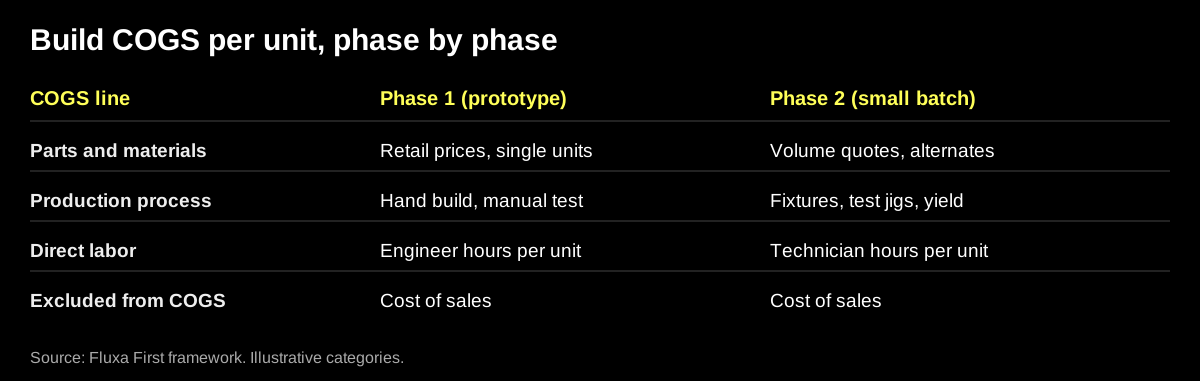
- Parts and materials. Every physical component, raw material and packaging item, plus digital costs tied to the unit, such as third-party licenses, APIs or cloud usage.
- Production process. The steps to make and deliver one unit, such as machining, assembly, testing, quality control, software deployment, installation or training, with an estimated cost for each.
- Direct labor. The hours of assembly, test, packaging and technician time each unit requires.
Leave cost of sales out. Sales commissions, marketing and customer acquisition belong in go-to-market expenses, not in COGS. Mixing them hides whether the product itself makes money.
Expect the two phases to look very different. Prototype parts are bought one at a time at retail prices, engineers build by hand and testing is manual. In small batches, volume quotes, fixtures and test jigs bring costs down, and technicians replace engineers on the line. Write down your key assumptions and your biggest uncertainties next to the numbers. A COGS estimate that labels its guesses is more credible than one that hides them.
How does this become a pro forma?
The pro forma is the financial blueprint that turns the product roadmap, go-to-market plan and capital plan into numbers over three to five years. Unit economics by phase feed it directly: revenue from price and volume, COGS from your per-unit build-up and customer acquisition cost from your go-to-market plan. Around those sit overhead, ongoing research and development and go-to-market expenses, plus a monthly or quarterly cash flow that shows when the business turns cash positive and how much capital it needs, and when.
Investors read it to answer a few questions. Do margins improve with scale? Are overhead and go-to-market costs reasonable? When does cash flow turn positive? How much capital will this take in total, including future rounds? When could they see a return? Our post on phasing capital alongside the product roadmap covers how to sequence raises against milestones, and capability milestones covers the technical side.
How we see it
Founders often treat the business model as something to figure out after the technology works. We see it the other way. The model decides which version of the technology is worth building, and an honest COGS is the first proof that a hard-tech company can become a durable business rather than an expensive project. Make the five choices on purpose, cost the unit phase by phase and let the pro forma show the path to cash. Everything investors ask afterwards builds on that.
Frequently asked questions
What should be included in COGS for a hardware startup?
Include the direct costs of producing and delivering one unit. That means parts and materials, including packaging, licenses and cloud costs tied to the unit, the production process such as assembly, testing and quality control, and direct labor per unit. Leave out cost of sales, overhead and research and development, which belong elsewhere in the pro forma.
Why should COGS be estimated separately for each phase?
Unit costs change a lot between a hand-built prototype and a small production batch. Parts get cheaper with volume, fixtures and test jigs cut process time, and labor shifts from engineers to technicians. Separate estimates show investors that margins improve with scale and make the capital plan more realistic.
What do investors look for in a startup pro forma?
They look for unit economics that improve with scale, reasonable overhead and go-to-market costs, a credible date for positive cash flow, the total capital needed to reach key milestones including future rounds, and a sense of when and how they could see a return.