
When unicorn prices meet real buyers: what the Airtable and Miro sales teach
Key takeaways
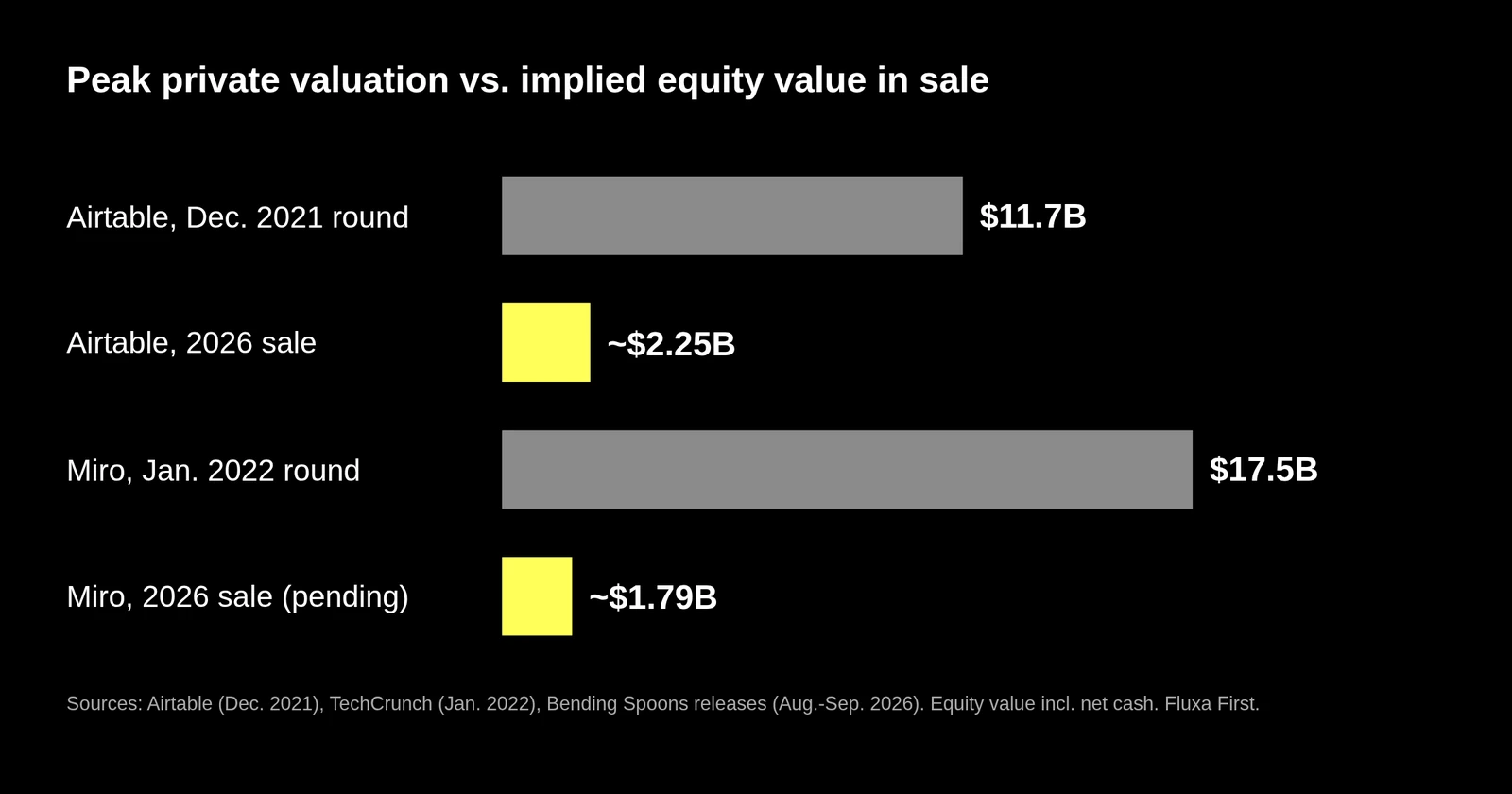
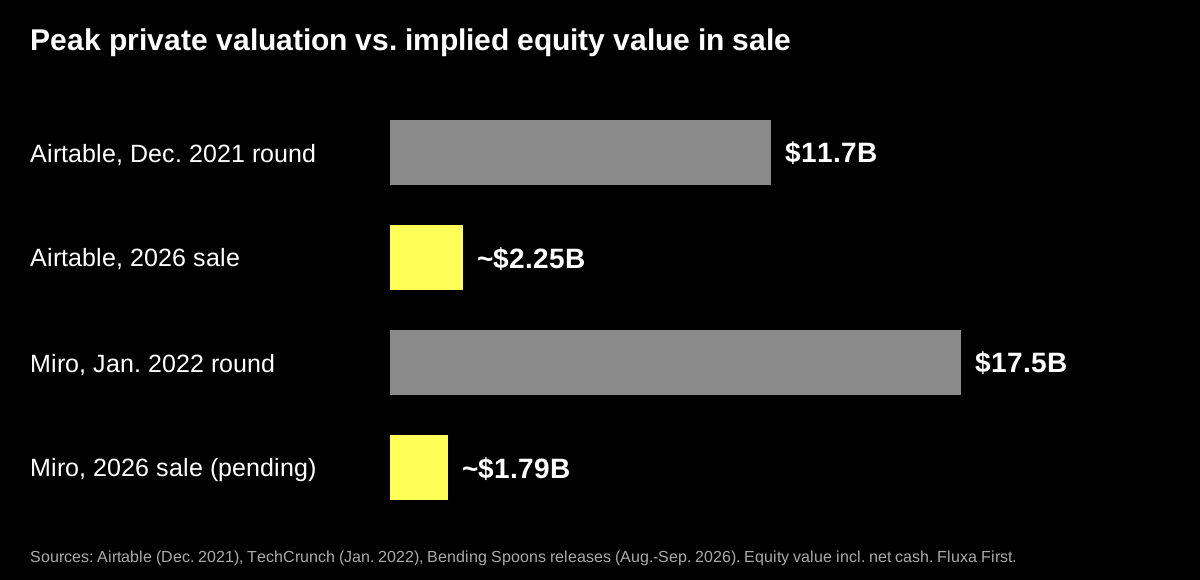
- Bending Spoons bought Airtable at a $1.285 billion enterprise value, about $2.25 billion in equity value including cash, against an $11.7 billion valuation in 2021.
- It agreed to buy Miro at a $1.355 billion enterprise value, about $1.79 billion in equity value, against a $17.5 billion valuation in 2022.
- PitchBook counts 992 active US unicorns worth a combined $5.7 trillion, with few clear paths to liquidity.
- Our view is that a round price is a forecast of a future sale, so founders should price rounds against the buyers and cash flows they can actually reach.
A private valuation is not money in the bank. It is a forecast of what someone will pay later. Two sales this fall made that plain: Airtable and Miro, two of the best known software unicorns of the 2021 boom, sold for a fraction of their peak round prices. For founders building durable hard-tech companies, the lesson is simple. Price each round against the buyers and cash flows you can actually reach, not against the hottest comparable.
What happened with Airtable and Miro?
In December 2021, Airtable announced a $735 million Series F at an $11 billion pre-money valuation, widely reported as $11.7 billion after the money came in. About three weeks later, Miro raised $400 million at a $17.5 billion valuation.
In 2026 both landed with the same buyer. Bending Spoons, which listed on Nasdaq on July 1, completed its purchase of Airtable on September 4. TechCrunch reported the all-cash price at $1.28 billion, with an implied value of about $2.25 billion once Airtable’s net cash was included, and noted that its shares had reportedly traded around a $4 billion valuation on secondary markets earlier in the year. On September 10, Bending Spoons agreed to buy Miro at a $1.355 billion enterprise value, or about $1.79 billion in equity value with net cash. That deal was still subject to closing when this was written.
Both companies are real businesses with large customer bases. That is the point. The gap is not a story about failure. It is a story about what the 2021 and early 2022 prices assumed.
How big is the unicorn overhang?
The Q3 2026 PitchBook-NVCA Venture Monitor counts 992 active US unicorns with a combined valuation of $5.7 trillion, and only 18 venture-backed IPOs in the third quarter. PitchBook, comparing enterprise values with prior valuations, describes the Airtable and Miro sales as exits at discounts of nearly 90%. Measured against equity value including cash, Airtable’s discount is closer to 80%. Many other companies priced in the same window face the same arithmetic. Some will grow into their marks. Others will choose a sale, a down round or a long wait.
We covered the broader liquidity picture in record dollars, thin distributions and the IPO side in the IPO window is open for proof, not promise. This post is about the founder decision that comes long before any of that: what price to accept.
Why does a high round price become a trap?
A round price sets expectations for everyone around the table. When the eventual sale comes in lower, several things happen at once.
- Preferences move to the front. Preferred investors usually get their money back before common holders. In a low sale, much of the proceeds can go to the most recent investors, and founders and employees may receive far less than headline numbers suggest.
- The buyer set shrinks. Few acquirers can pay tens of billions for a company. A more modest price opens the door to many more strategic buyers, and to competition among them.
- Time becomes expensive. A company that must justify a peak mark may wait years for a market that never returns, while its people and its options age.
None of this means founders should accept low prices. It means the price should come with a plausible story about who pays more later and why.
What should hard-tech founders do differently?
Hard-tech companies carry more capital needs and longer timelines than software, so the cost of a mispriced round is higher. We use four questions before any priced round.
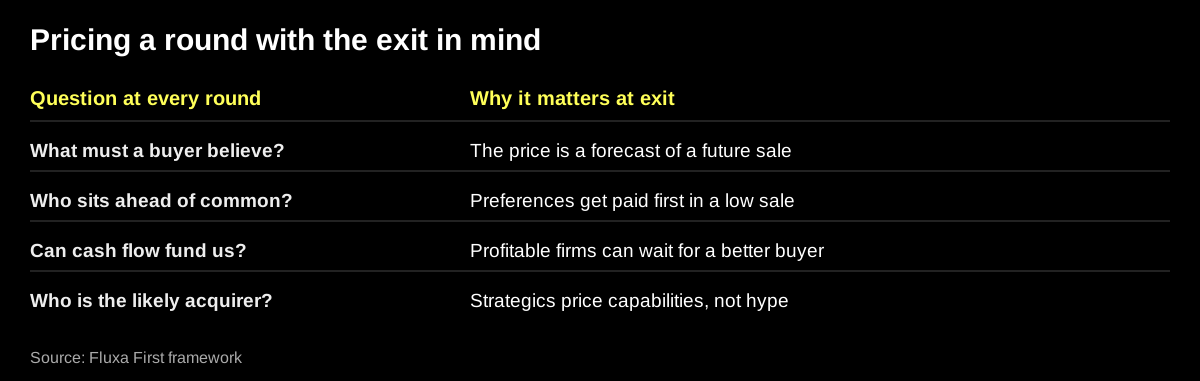
- What must a buyer believe? Write down the revenue, margin and market position a future acquirer or public investor would need to see to pay more than this round’s price. If that picture depends on a market multiple that only existed in a boom, the price is too high.
- Who sits ahead of common? Model the preference stack at several sale prices, including ones below the round price. Founders should know what their own shares and their team’s options are worth in each case.
- Can cash flow fund us? A company that reaches positive cash flow has the option to wait for the right buyer. That option is worth more than a few points of valuation.
- Who is the likely acquirer? In hard tech, the realistic buyers are often strategics who pay for capability, customers and qualified production. We wrote about that path in how we think about financing hard tech.
How we see it
We back durable companies, and durability starts with honest prices. A fair round at a sensible valuation, paired with a plan to reach revenue and cash flow, gives founders more choices later than a headline number they have to grow into. The Airtable and Miro outcomes are still real exits that returned cash. They also show how much value can disappear between a boom-era mark and a buyer’s check.
For investors, the takeaway is to underwrite exits, not marks. For founders, it is to treat valuation as one term among many, and to protect the option to sell, wait or grow on their own schedule.
This article is general information, not investment, legal or tax advice.
Frequently asked questions
Why do startups sell below their last private valuation?
A private round price reflects what a small group of investors paid for preferred shares at one moment, often in a hot market. An acquirer pays for expected cash flows and strategic value today. When growth slows or market multiples fall, the two numbers can diverge sharply, and the company may still choose a sale to give investors and employees liquidity.
What is the difference between enterprise value and equity value in an acquisition?
Enterprise value is the price for the operating business. Equity value adds the company’s net cash, or subtracts net debt, and is closer to what shareholders receive in total. In the Airtable and Miro deals, Bending Spoons reported both figures, and equity value was higher because both companies held net cash.