
Downsized IPOs: what shrinking hard-tech offerings tell founders
Key takeaways
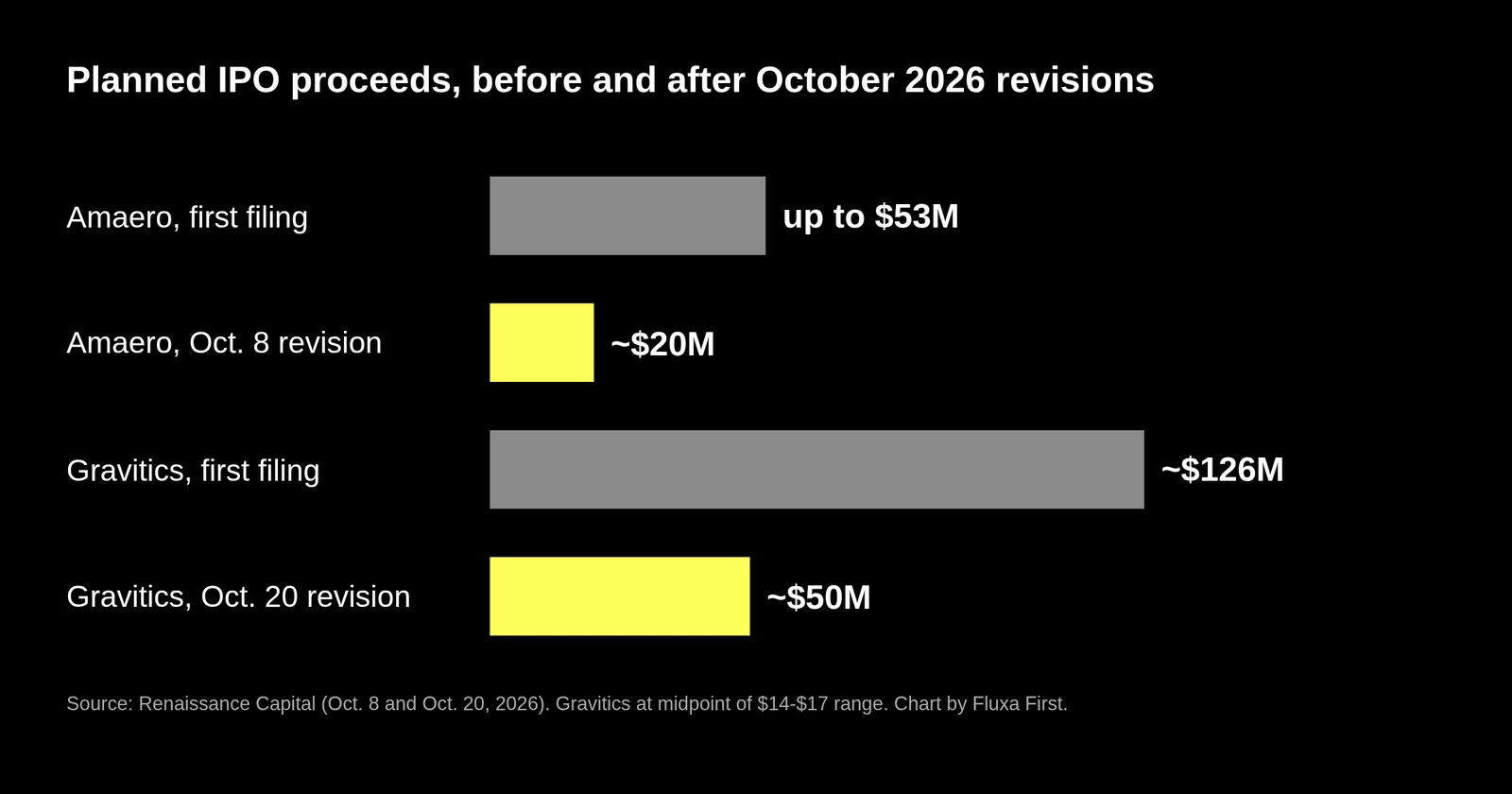
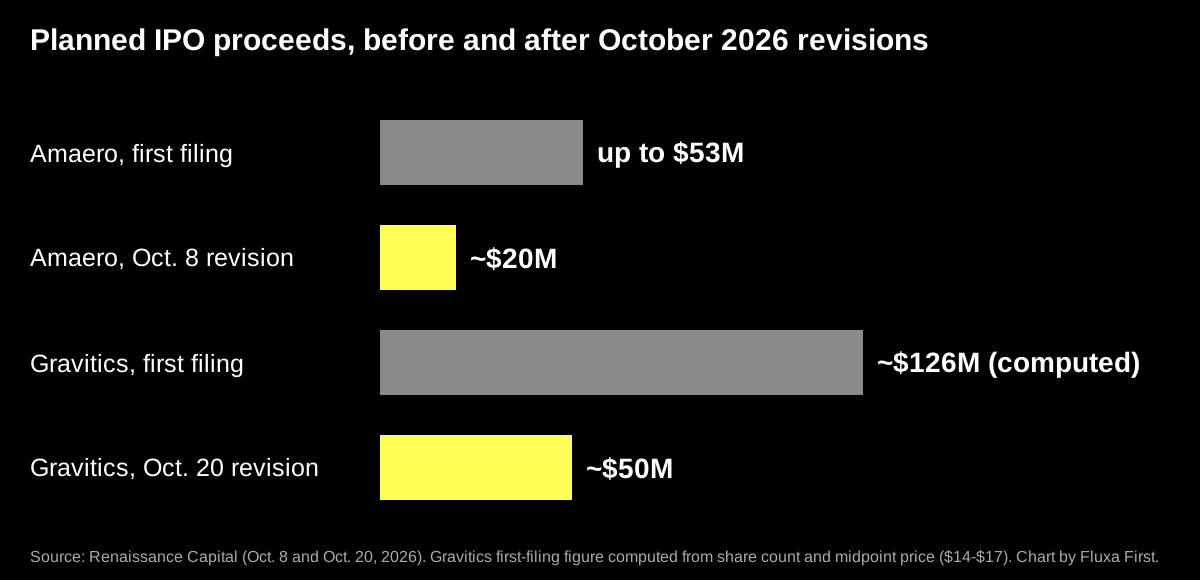
- In October 2026, metal powder maker Amaero cut its planned Nasdaq IPO to about $20 million from up to $53 million, and space structures developer Gravitics cut its planned raise to $50 million, about 60% less than first filed.
- Both companies sit in sectors Washington says it wants to grow, which suggests that a good story does not set the size of an IPO; investor demand at a given price does.
- Small hard-tech IPOs are a financing event more than an exit. Founders should plan for liquidity through strategic sales, revenue and patient capital, and treat a listing as one option among several.
Two hard-tech companies in our corner of the market cut the size of their planned IPOs in October, and the cuts were large. The lesson for founders is simple: policy tailwinds and a strong narrative do not size an offering. Public investors buy revenue, contracts and a clear path to profit, at a price they set.
What happened to the Amaero and Gravitics IPOs?
Amaero makes titanium and refractory metal powders for 3D printing and large parts made by powder metallurgy and hot isostatic pressing, used in hypersonic systems, satellite propulsion, missiles and other demanding uses. The company is already listed in Australia and added a Nasdaq listing in October. On October 8, Renaissance Capital reported that Amaero revived its plan with a smaller deal: about $20 million from 3.9 million shares, down from up to $53 million in its earlier filing, after postponing in September because of market conditions. That is 62% less money, and the implied fully diluted value fell about 35%, to $143 million. It then priced on October 14, selling about 4.7 million shares at $4.25 for about $20 million, and began trading on Nasdaq under the ticker AMRO the next day, according to the company. Amaero reported $12 million in revenue for the year ended June 30, 2026. Its amended registration statement positions the company as a domestic alternative for strained castings and forgings supply, including for the Navy’s submarine industrial base.
Gravitics, which designs large space structures such as orbital carriers, cargo spacecraft and station modules, cut its share count by 60% on October 20. It now plans to sell 3.2 million shares at $14 to $17, instead of 8.1 million, raising about $50 million at the midpoint. By our arithmetic, 8.1 million shares at the $15.50 midpoint would have been about $126 million; Renaissance does not state that figure. The company plans to list on Nasdaq through a merger with a dormant OTC-listed shell, and it highlights a $125 million fixed-price contract with Axiom Space, which Renaissance notes is a related party.
Why would strong sectors still see smaller deals?
Both companies work in areas Washington says it wants to grow: advanced materials for defense and domestic manufacturing in one case, commercial space infrastructure in the other. Yet both companies shrank their deals.
We read three things into that.
- Revenue scale still sets the ceiling. A company with $12 million in annual revenue is small by public market standards, whatever its strategic importance. Public investors compare it with every other small-cap stock they could own.
- Concentration and related-party contracts get discounted. When a large share of the backlog sits with one customer, and that customer is a related party, investors want proof that the demand will broaden.
- Deal structure signals risk. Listing through a dormant shell, or cross-listing a stock that already trades abroad, are legitimate routes. They can also suggest the traditional underwritten IPO path was harder to reach.
None of this is a verdict on the technology. It suggests the public market is pricing them on what they have proved so far, not on the size of the opportunity. We made a related point about the gap between private marks and real exits in our look at the IPO window for hard tech.
What should hard-tech founders take from this?
A small IPO is a financing event, not an exit. It raises capital for the company, but early holders are usually locked up, and trading in a $100 million to $600 million company can be thin. The founders and investors still need the business to grow into its public price.
That changes how founders should plan exits:
- Build toward more than one buyer. In hard tech, strategic acquirers often pay for qualified production, customers and capability long before public investors will. Keep that path warm from the first partnership.
- Make revenue the headline. The fastest way to a good public outcome is a revenue line that public investors do not need to imagine. Contracts with several unrelated customers matter more than one large one.
- Fund the plan without a listing. If the business only works when an IPO window opens at the right size, the capital plan is fragile. Order-backed financing, project debt and patient equity give a company time. We wrote about those financing paths earlier.
- Price private rounds with the exit in mind. A private valuation that sits far above where a small-cap market would trade the company sets up a down round at listing.
How we see it
Durable hard-tech companies are designed so a public listing is a choice rather than a rescue. The Amaero and Gravitics revisions are not failures; Amaero completed its smaller deal, and Gravitics kept its deal alive by offering fewer shares. They are useful signals of where public market demand sits today for small hard-tech issuers: real, but disciplined, and focused on revenue that already exists.
For investors, the takeaway is to underwrite liquidity through several routes. For founders, it is to treat the IPO as one tool on a longer road, and to make the business strong enough that the size of the window does not decide the size of the company.
Figures are as reported in the linked sources and filings, and IPO terms can change before pricing. This post is general analysis, not investment advice.
Frequently asked questions
Why do companies cut the size of an IPO?
An IPO is sized to the demand underwriters find at a given price. When investors want fewer shares, or only at a lower price, the company can sell fewer shares, cut the price, wait, or withdraw. Selling fewer shares raises less money but keeps the deal alive, which is what both Amaero and Gravitics chose in October 2026.
Is a small IPO a good exit for venture investors?
Usually not by itself. A small listing raises money for the company, but early holders are typically locked up and trading in small stocks can be thin. It creates a path to liquidity rather than liquidity itself, so investors still depend on the company growing into its public valuation.