
A strategic minerals reserve: what Project Vault can and cannot fix
Key takeaways
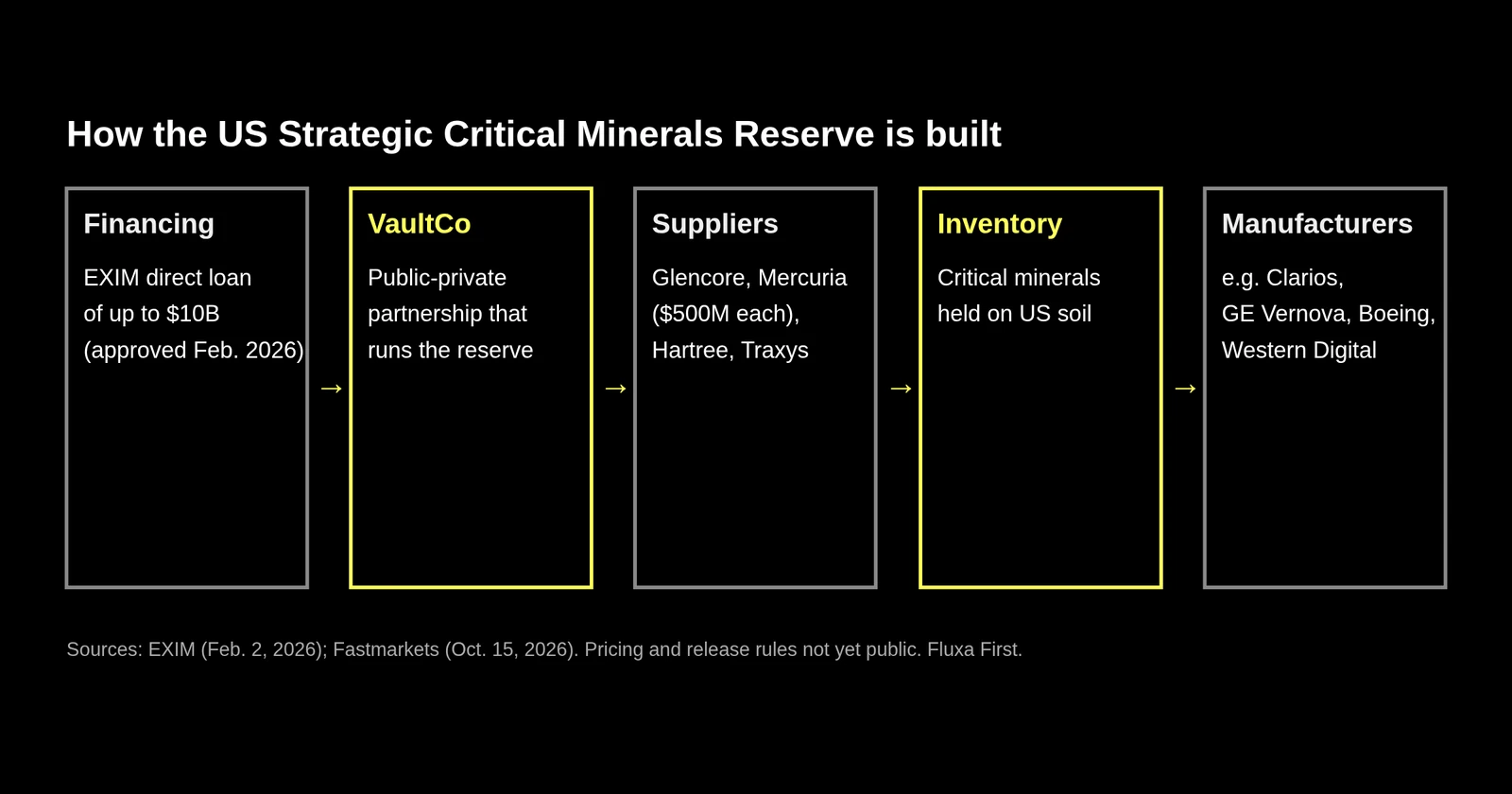
- Project Vault, the US Strategic Critical Minerals Reserve, is a public-private partnership backed by an EXIM direct loan of up to $10 billion approved in February 2026.
- It moved into its operating phase after Glencore and Mercuria each committed $500 million, as announced on September 23 and reported by Fastmarkets.
- A reserve can protect manufacturers from short supply shocks, but by itself it does not build mines, refineries or magnet plants, and its pricing and release rules are not yet public.
- The lasting fix is domestic and allied processing capacity, which creates openings in refining, recycling, substitution and supply chain data.
The United States now has a strategic reserve for critical minerals, and it has started operating. Project Vault, formally the US Strategic Critical Minerals Reserve, is meant to keep inventories of essential raw materials on American soil so manufacturers can ride out supply shocks. It is a real step for supply chain security. It is also worth being clear about what a stockpile can and cannot do, because the answer shapes where the real opportunities are for builders and investors.
What is Project Vault?
In February 2026, the Export-Import Bank of the United States approved a direct loan of up to $10 billion for Project Vault. EXIM describes it as an independently governed public-private partnership between equipment manufacturers and private capital providers that will store essential raw materials at facilities across the country. EXIM named Clarios, GE Vernova, Western Digital and Boeing among manufacturers indicating participation, and Hartree Partners, Mercuria Americas and Traxys as suppliers.
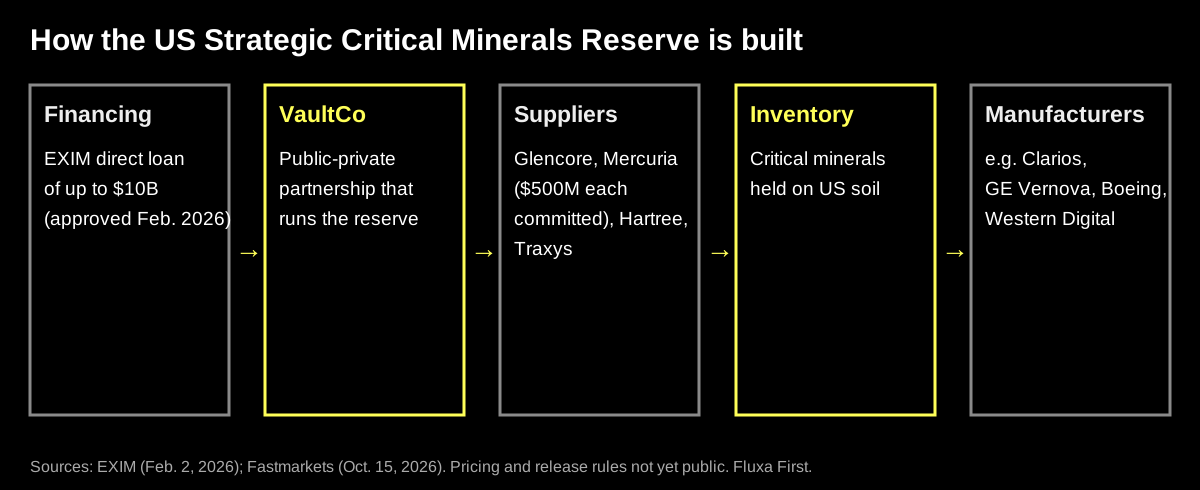
According to Fastmarkets, VaultCo, the partnership that runs the reserve, announced on September 23 that trading houses Glencore and Mercuria had each committed $500 million, the first participation in the reserve. The primary releases are Glencore’s and Mercuria’s. Glencore frames its $500 million as a commitment to source and deliver minerals for VaultCo, financed by EXIM, so it is not clear how much is the trading houses’ own capital. That moved the project from a financing framework into operations. The reserve is separate from the National Defense Stockpile managed by the Defense Logistics Agency and has a broader industrial mandate.
What can a reserve fix?
A reserve buys time. If a supplier country restricts exports or a key mine or refinery goes down, manufacturers can draw on material already held in the United States while they find alternatives. For companies making batteries, grid equipment, aircraft or data storage, a few months of buffer can be the difference between a slowdown and a shutdown.
It also changes the demand side of the market. Fastmarkets notes that most federal support so far, such as grants and loans to mining, refining and recycling projects, has targeted supply. A reserve that buys and holds material adds a new kind of buyer.
What can it not fix?
A stockpile does not build mines, refineries, separation plants or magnet factories. If most processing still happens in one country, a reserve slows the effect of a disruption but does not remove the dependence. We discussed that processing gap in our post on rare earth export controls.
Key rules are also still unclear. Fastmarkets reported that market sources questioned how the reserve would buy and price material, and what it would offer that trading houses do not already provide. One source questioned its purpose without a price floor or other support for producers when prices are weak. The report said eligible minerals, sourcing restrictions, purchase prices, release conditions and how EXIM financing will be allocated had not been answered.
Price support matters because new producers outside China often struggle when prices fall. Fastmarkets pointed to the government’s deal with MP Materials, which set a floor price of $110 per kilogram for NdPr oxide, as a reference point. We looked at how allies are approaching critical minerals price floors in an earlier post.
Where are the openings for builders?
A reserve creates steady demand and attention, but the durable value will come from companies that add capacity and visibility. We see openings in:
- Processing and refining. Separation, refining and metal-making are where dependence is deepest and where new process technology can win.
- Recycling. Recovering critical materials from scrap, magnets and batteries creates domestic supply that is less exposed to mining timelines.
- Substitution and efficiency. Designs that use less of a scarce material, or swap it for a common one, reduce the need for stockpiles at all.
- Supply chain data. Traceability, origin verification and inventory software help manufacturers, and the reserve itself, know what they hold and where it came from.
- Logistics and storage. Secure, monitored storage for high-value materials is a specialized service.
What should manufacturers do now?
Do not treat the reserve as your supply plan. Map which critical materials your products depend on, where they are processed and how long you could run without them. Keep your own buffer for the items that would stop your line, qualify alternative suppliers and watch for VaultCo’s rules on eligibility and release.
How we see it
We welcome Project Vault as one tool among several. Inventory is insurance, and insurance is valuable. But sovereignty in critical minerals comes from capability: American and allied companies that can mine, refine, recycle and make the materials modern industry needs, at prices that can survive a downturn. We build and back durable companies working on exactly those problems, and we think a reserve will do the most good if it helps those companies reach scale rather than standing in for them.
This article is general information, not investment advice.
Frequently asked questions
What is Project Vault?
Project Vault is the initiative that establishes the US Strategic Critical Minerals Reserve, an independently governed public-private partnership that stores critical raw materials at facilities in the United States. EXIM approved a direct loan of up to $10 billion for it in February 2026. It is separate from the National Defense Stockpile run by the Defense Logistics Agency.
Does Project Vault set a price floor for critical minerals?
Not that has been announced, although US government sources have said price floors could be used. Fastmarkets reported in October 2026 that market participants questioned how the reserve would buy and price material without a defined price floor or other support mechanism. Eligible minerals, purchase prices and release conditions had not been published.