
Solid rocket motors: the munitions bottleneck is drawing new builders
Key takeaways
- In October 2026 alone, L3Harris opened a Camden, Arkansas motor plant designed to double capacity and won a $250 million GMLRS follow-on that the company says is its highest quantity in program history.
- Lockheed Martin signed with Avio, whose US unit is building a Virginia plant as part of more than $500 million of US capacity investment.
- Newer companies also won Navy work, with Ursa Major receiving $137 million and X-Bow an agreement worth up to $69.7 million that includes tooling for a 500-motor-a-year line.
- More suppliers, merchant capacity and modern manufacturing make the propulsion base more resilient, and the bottleneck is now qualification and scale, not ideas.
Precision munitions and interceptors depend on a component most people never think about: the solid rocket motor. Demand has surged, and supply has struggled to keep up; X-Bow’s chief executive described it this month as a production bottleneck decades in the making. October 2026 showed how quickly that is changing. In a single month, an incumbent opened a new plant and won a record order, a European specialist signed with Lockheed Martin to build motors in Virginia, and two newer American companies won Navy contracts. For anyone watching the American industrial base, propulsion is where capacity is being rebuilt fastest.
What happened in October?
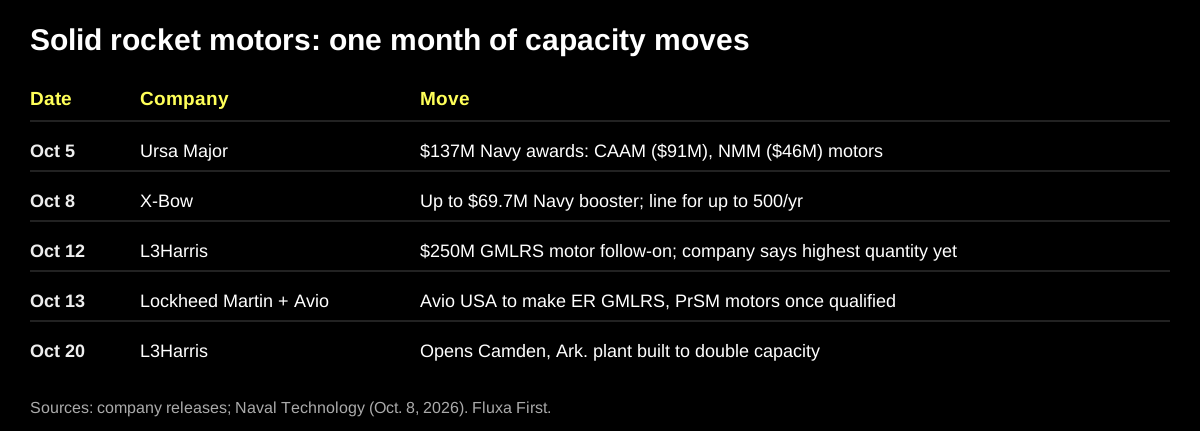
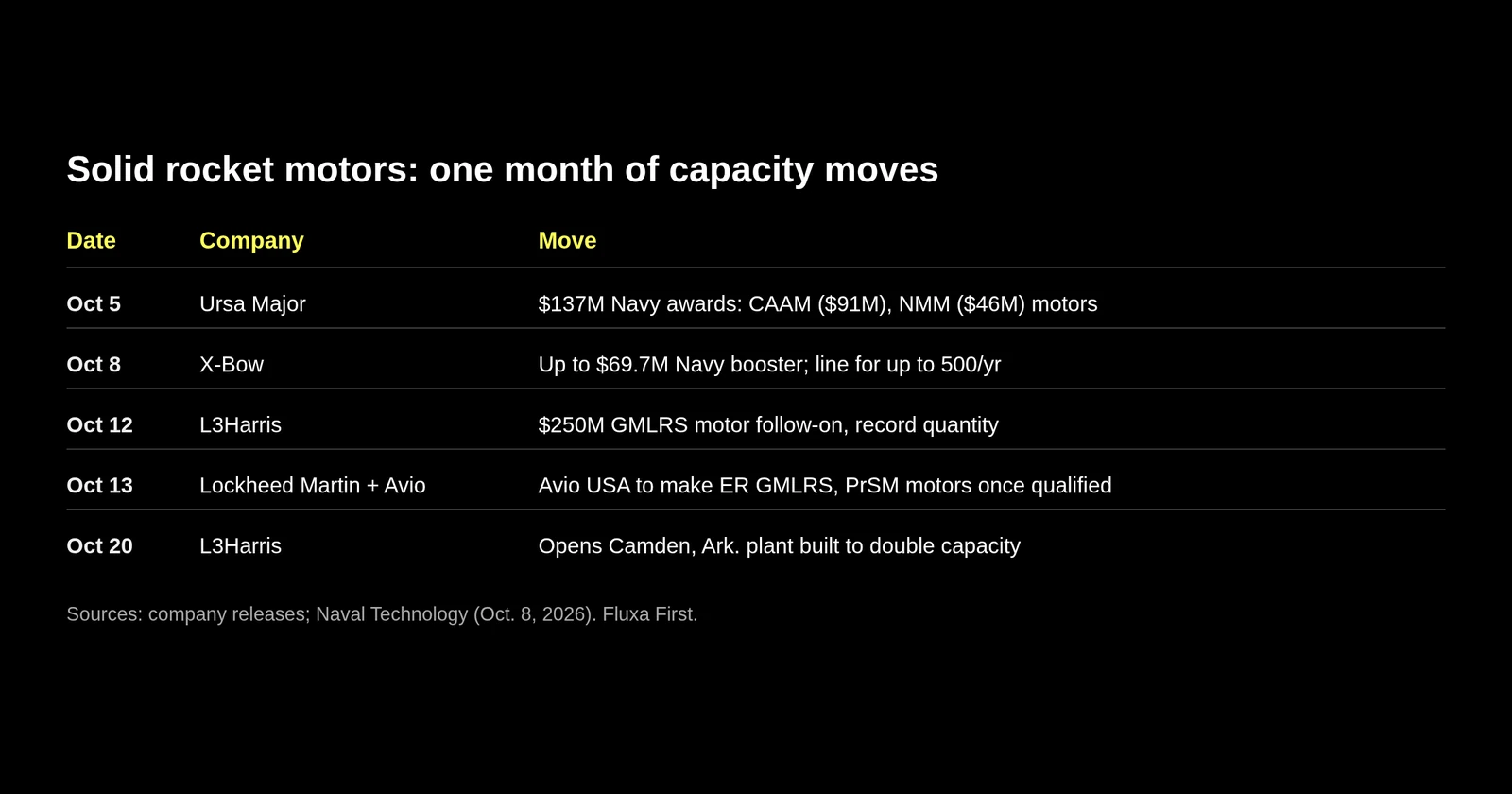
- Ursa Major, October 5. The Navy awarded Ursa Major $137 million across two contracts: $91 million for a 7-inch motor for the Compact Air-to-Air Missile and $46 million for a 10-inch motor for the Naval Modular Missile. The company says both use its Lynx approach, combining expanded energetics capacity with additive manufacturing, and that the CAAM motor is being developed with the same methods planned for full production, while the NMM motor is designed for high-rate production.
- X-Bow Systems, October 8. X-Bow won a prototype agreement worth up to $69.7 million to develop and qualify a booster for a Navy next-generation weapon program, with $50 million obligated at award. It includes production-rate tooling at its Luling, Texas site, where it plans a line for up to 500 motors a year. X-Bow said it recently finished its first major production contract, delivering more than 2,100 motors.
- L3Harris, October 12. L3Harris received a $250 million follow-on from Lockheed Martin for standard-range GMLRS propulsion, the highest quantity in the program’s history, according to the company.
- Lockheed Martin and Avio, October 13. The two companies announced a cooperation agreement under which, after qualification, Avio USA’s new plant in Hurt, Virginia will produce motors for Extended Range GMLRS and the Precision Strike Missile. Avio says it is investing more than $500 million in US capacity to become a merchant supplier to several defense customers.
- L3Harris, October 20. L3Harris opened its Arsenal of Freedom plant in Camden, Arkansas, designed to double current GMLRS motor capacity with room to grow. It was built under a $216 million Defense Production Act Title III agreement signed in 2023, and the company says it is building about 60 new facilities across four states.
Why does this matter for sovereignty?
A country that cannot produce enough propulsion cannot sustain its own defense or support its allies. The same industrial skills, energetic materials, casting propellant, case manufacturing and testing, also matter for space launch and hypersonics. When only a few suppliers make a critical component, demand spikes are hard to absorb. More plants, more suppliers and more competition reduce that risk.
Three shifts stand out.
Merchant capacity. Avio’s model, selling motors to several primes, gives contractors a choice of suppliers instead of a single source. That is how resilient supply chains work in most other industries.
Manufacturing-first design. Both Ursa Major and X-Bow emphasize that they design motors around how they will be produced at scale. Ursa Major says its CAAM motor is being developed with the same methods planned for full production. X-Bow’s award funds production tooling, not just a prototype. Designing for production from day one is the right lesson for any hard-tech company.
Government as an early customer. The Defense Production Act agreement behind the Camden plant, and the Navy’s development awards to newer firms, show how public money can buy down the cost and risk of new capacity. Ursa Major notes earlier cost-shared work with the Navy and the Office of Strategic Capital.
What should founders and investors take from this?
Energetics is hard. Facilities need safety distances, permits and specialized equipment. Qualification takes years of testing. That is exactly why the companies that get through it build real moats. Lessons that apply well beyond propulsion:
- Production is the product. Customers buy rate and reliability, not a single impressive test.
- Qualification is a milestone to plan and fund, not an afterthought.
- Early government contracts can finance capacity, but founders should plan for the commercial or multi-customer business that follows.
- Adjacent markets matter. Space launch and hypersonics draw on the same skills and can diversify revenue.
We covered parallel shifts in the drone components industrial base, castings and forgings and qualified manufacturing capacity.
How we see it
Defense is one of several areas where we build and invest, and propulsion is a clear example of the broader pattern we care about: essential, hard-to-make components where American capacity fell behind demand. The answer is not one more prime contract. It is a deeper base of durable companies, incumbents and new entrants alike, that can design for production, qualify quickly and keep shipping. October suggests that base is finally being built.
Frequently asked questions
Why are solid rocket motors a bottleneck?
Solid rocket motors power many US tactical missiles and interceptors, as well as some space launch boosters. Making them requires energetic materials, specialized facilities, strict safety processes and long qualification. When demand surges, capacity limits show up quickly, which is why the Pentagon is funding new plants and new entrants.
What is a merchant supplier of solid rocket motors?
A merchant supplier sells motors to several prime contractors rather than building only for its own missiles. Avio says its US investment is aimed at becoming a merchant supplier to various defense customers, which gives primes more options and adds competition.