
Robotaxis are scaling one permission at a time
Key takeaways
- On October 14, 2026, Waymo opened fully autonomous rides to anyone in San Antonio, San Diego and Tampa, including San Antonio’s airport, after serving hundreds of thousands of riders there since earlier in the year.
- Waymo also announced Toronto, its first Canadian market, starting with manual mapping and supervised testing and aiming for first riders in 2028.
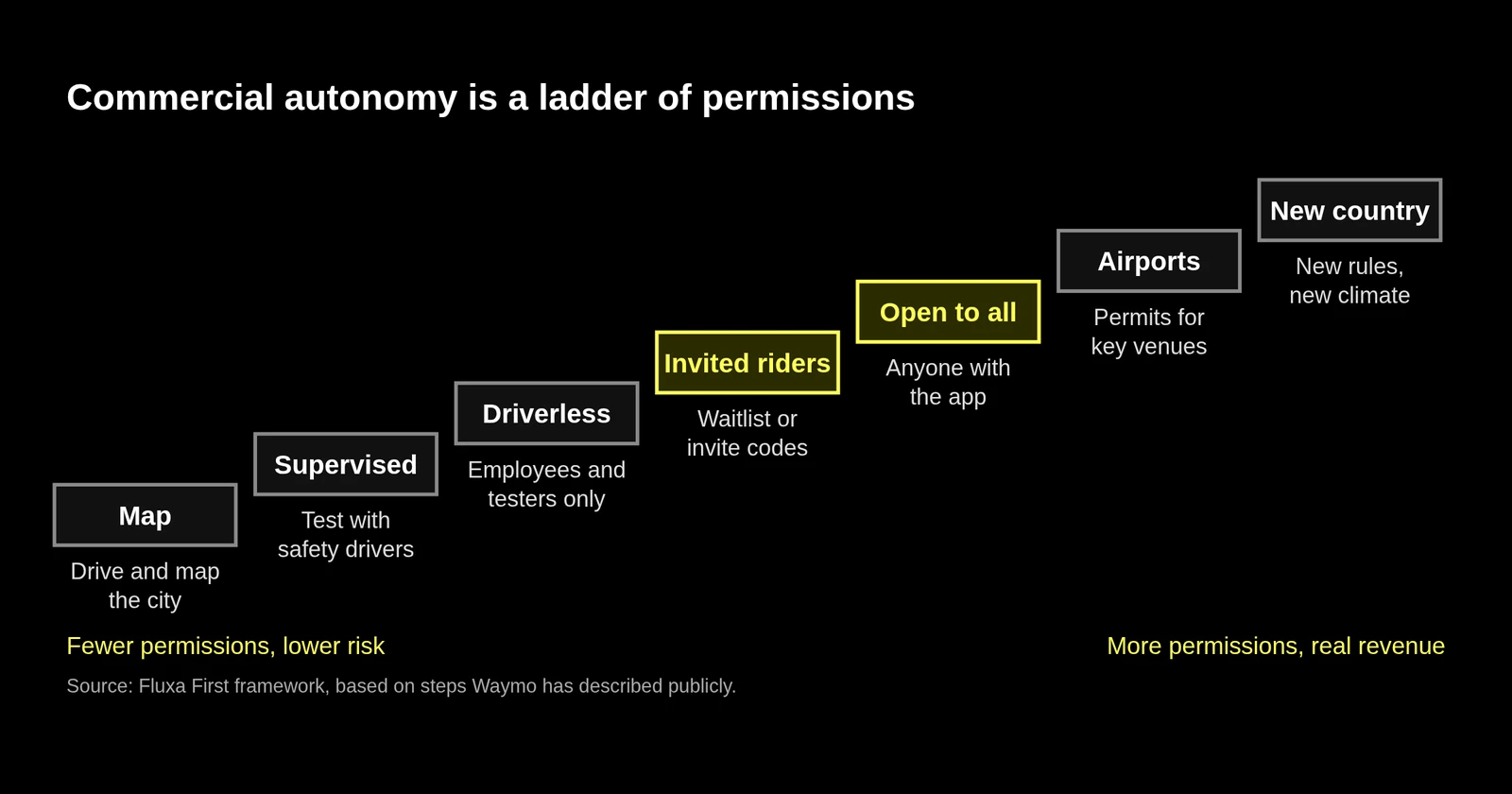
- Each step, from mapping to open service to airports, needs its own evidence and permission, which is why autonomy scales city by city rather than all at once.
- For autonomy founders in any domain, the permission ladder is the real go-to-market plan, and operations partners and safety data are part of the product.
Autonomous vehicles do not scale like software. They scale one permission at a time: a city, then a set of riders, then an airport, then a country. October showed that ladder clearly. Waymo removed its invite lists in three cities and announced its first Canadian market. For founders building autonomy in any domain, from trucks to ships to drones, the same ladder is the real go-to-market plan.
What happened in October?
On October 14, Waymo said anyone in San Antonio, San Diego and Tampa could now download its app and hail a fully autonomous ride, including at San Antonio International Airport. The company said it had welcomed hundreds of thousands of riders in those cities since opening service earlier in the year.
Days later, Waymo announced Toronto, its first Canadian city. It will start by driving manually and building high-definition maps, then test with trained specialists behind the wheel, with the goal of first riders in 2028. A local company, Element Fleet Management, will support the operation. TechCrunch covered the provincial pilot approval that allows the work to begin. The approval covers testing under Ontario’s pilot framework, not commercial driverless ride-hailing, which Ontario does not yet regulate.
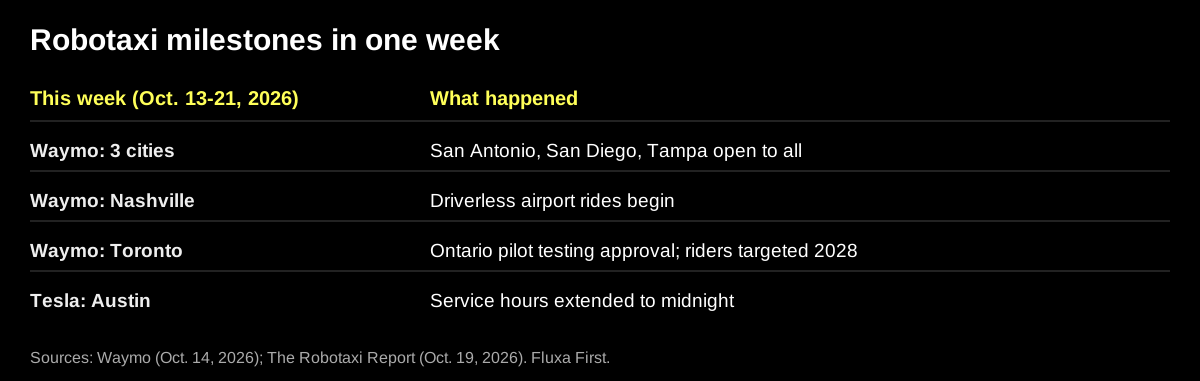
Others moved too. The Robotaxi Report, a weekly industry briefing, noted that Waymo began driverless rides to and from Nashville International Airport and that Tesla extended its Austin robotaxi hours to midnight.
Why does autonomy scale as a ladder?
Every rung needs its own evidence and its own permission.
Mapping and supervised testing build local knowledge: road layouts, weather, traffic behavior. Driverless testing proves the system works without a human backup. Invited riders let the operator learn from real demand while limiting exposure. Open service turns a pilot into a business. Airports and venues often need their own agreements. A new country brings new laws, new insurers and, in Toronto’s case, a real winter.
Skipping rungs is how autonomy companies get hurt. Each step is a trade between speed and trust, and trust, once lost with regulators or the public, is slow to rebuild. Waymo says its data from more than 400 million fully autonomous kilometers shows far fewer serious-injury crashes than human drivers in the cities where it operates. Whatever one thinks of that comparison, publishing safety data is part of how an operator earns the next permission.
What does the ladder look like outside robotaxis?
The same pattern applies across the sectors we care about.
- Autonomous trucks move from supervised runs on one corridor to driverless freight lanes, then to new states and terminals.
- Autonomous vessels move from crewed trials to optionally crewed operations, then to longer missions and new waters.
- Drones move from line-of-sight flights to beyond-visual-line-of-sight operations, then to flights over people and dense airspace.
- Industrial robots move from a fenced cell to shared floors, then to new sites and tasks. Our post on humanoid robots and production lines covers the factory version.
In each case the technology is necessary but not sufficient. The business grows only as fast as the company earns permission to operate in more places, with more autonomy, for more customers.
What should founders and investors take from this?
Plan the ladder before the product. Write down each rung you need to climb, the evidence each requires and who grants it. That list is your real roadmap and your real timeline.
Operations are part of the product. Waymo is relying on a local fleet partner for fleet maintenance, validation driving, customer service and operations in Toronto. Autonomy companies need depots, service crews, remote support and customer service. These are hard to build and easy to underestimate.
Safety data is a commercial asset. Clear, published evidence shortens every regulatory conversation. Founders should design data collection from day one with the next permission in mind.
Price time correctly. Each new market takes years from first mapping to open service. Investors who expect software-style rollouts will be disappointed; those who price the ladder honestly can find durable businesses with high barriers to entry.
How we see it
Autonomy on land, at sea, in the air and on the factory floor is one of the areas we build and invest in. The robotaxi market is the most visible test of how autonomy becomes a business, and its lesson is patience with a plan. The companies that win will not be the ones with the flashiest demos. They will be the ones that climb each rung carefully, keep the trust of regulators and riders, and build the operations to serve customers at scale.
Frequently asked questions
Why do robotaxi companies launch city by city?
Every city has its own roads, weather, traffic patterns and rules. Operators typically map the area, test with safety drivers, run driverless tests, open to invited riders and only then open to everyone. Airports and other venues often need separate permits. Each step requires evidence that the system is safe in that specific place, so expansion is incremental.
What does open to all mean for a robotaxi service?
It means anyone can download the app and request a ride, without a waitlist or invite code. It is usually the last step after a period of limited access, and it turns a controlled pilot into a commercial service.