
Autonomous vessels move from sea trials to production lines
Key takeaways
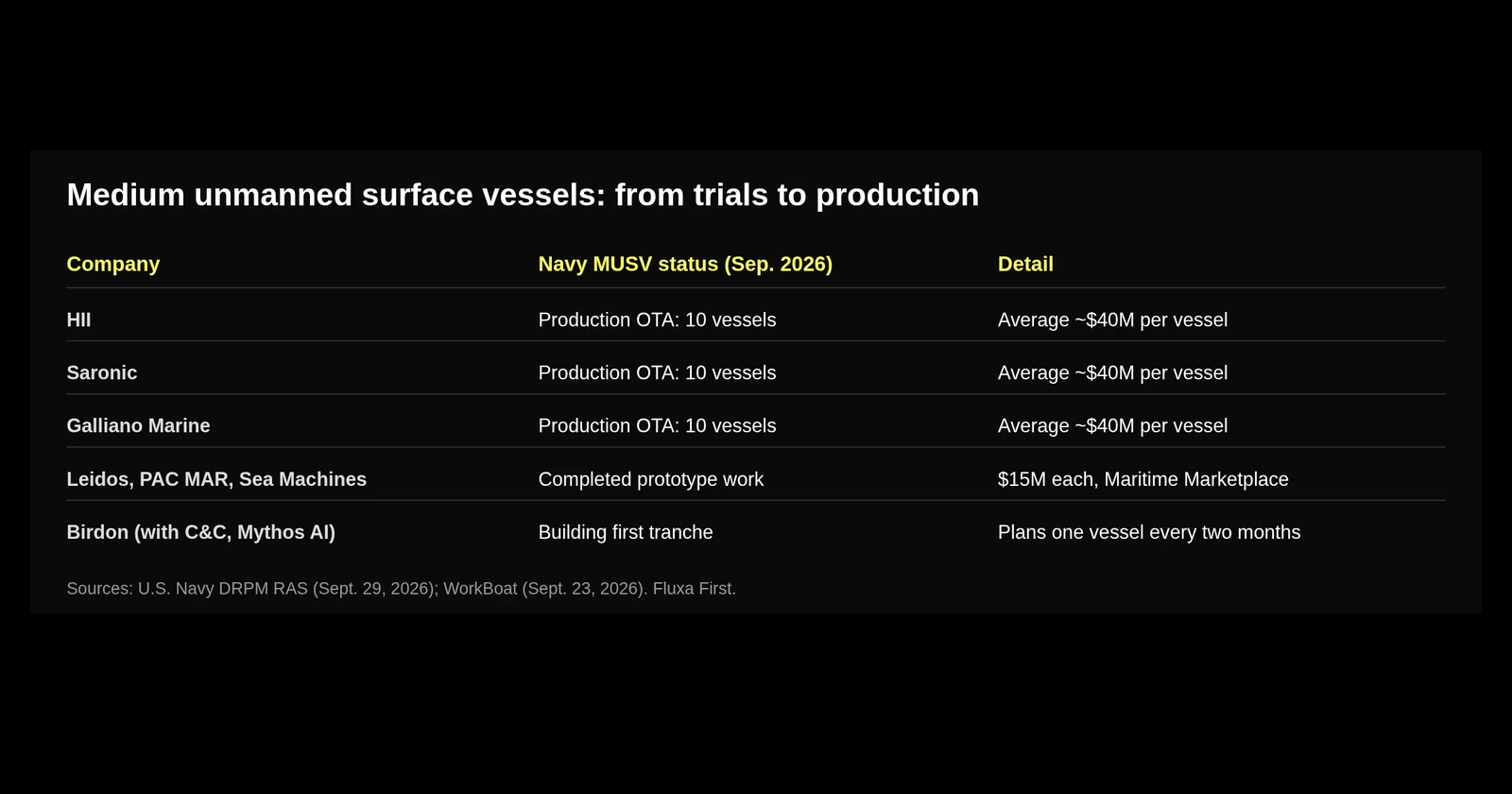
- The US Navy awarded production agreements for 30 medium unmanned surface vessels in late September, 10 each to HII, Saronic and Galliano Marine Services, at an average of about $40 million per vessel.
- The Navy’s marketplace approach rewards vessels that are tested and ready to build, shifting development risk to industry.
- Builders are pairing autonomy software with serial shipbuilders, and new yards are breaking ground on the Gulf Coast.
- The opportunity for founders sits in autonomy, payloads, sensors, manufacturing capacity and support, not only in whole vessels.
Autonomous ships are leaving the demonstration phase. In the space of a few weeks this fall, the US Navy placed production orders for medium unmanned surface vessels, a new shipyard broke ground in Texas, and a Louisiana yard started cutting steel on uncrewed hulls. Abroad, South Korea moved to make autonomous ship testing permanent. For maritime founders and investors, the question is no longer whether autonomy works at sea. It is who can build it reliably, at scale and at a price.
What did the Navy buy?
On September 29, the Navy announced plans to procure 30 medium unmanned surface vessels after completing Phase I at-sea testing. Production agreements went to Galliano Marine Services, HII and Saronic Technologies, 10 vessels each, at an average procurement cost of $40 million per vessel. The first deliveries are scheduled before the end of fiscal 2027.
Three other companies, Leidos, PAC MAR and Sea Machines, completed their prototype work, receive $15 million each and join a Maritime Marketplace where they can compete for follow-on production. Testing covered the vessels’ ability to perceive their surroundings, navigate autonomously under international collision rules and complete a long-duration mission. The Navy also opened a Phase II call for solutions in September to widen its supplier pipeline.
Why does production readiness win?
WorkBoat reported that the marketplace replaced an earlier program and shifts development risk onto industry by favoring mission-ready platforms over government-funded prototypes. The requirements are demanding: at least 2,500 nautical miles of range at 25 knots, up to 25 metric tons of cargo or weapons in at least two 40-foot containers, and autonomous operation in sea state 4. WorkBoat also reported roughly $2.1 billion set aside for the vessels in the reconciliation bill and fiscal 2027 budget plans for 47 hulls over five years.
Shephard noted that the award went to a mix of an established military shipbuilder and non-traditional suppliers, and that Saronic’s 180-foot Marauder went from initial design to sea trials in under a year.
The signal for builders is clear. The buyer wants to test a real vessel before it signs, then buy it in quantity. That rewards companies that can show a working ship and a credible plan to build many of them.
Who is building the capacity?
Shipyard capacity is now part of the competition.
- Saronic broke ground on Port Alpha, a purpose-built shipyard in Brownsville, Texas, at the end of September, according to Maritime Global Network.
- Birdon started building the first tranche of its MUSV at C&C Marine and Repair in Belle Chasse, Louisiana, pairing C&C’s shipbuilding with Mythos AI’s autonomy software, with a planned pace of one vessel every two months. Birdon is separately building a 400,000-square-foot shipyard in Pensacola, backed by a $76 million state grant, with operations slated for the third quarter of 2027, per WorkBoat.
Outside the US, South Korea’s South Gyeongsang province has applied to designate a permanent autonomous ship test zone off Geoje Island, where Samsung Heavy Industries has been testing a 12-meter autonomous vessel under a temporary exemption that expires at the end of December. Commercial autonomy will need that kind of predictable testing and rules, and allies are moving.
Where are the opportunities for founders?
Whole vessels are capital-heavy, and the leaders now have production orders and yards. We see more room for new companies in the layers around them:
| Layer | Why it matters now |
|---|---|
| Autonomy and perception software | Must pass collision-rule navigation and long missions |
| Containerized payloads | Requirements center on standard 40-foot containers |
| Sensors and communications | Long-range missions need resilient links and perception |
| Manufacturing and outfitting capacity | Serial production at small and mid-size yards |
| Maintenance and fleet support | Uncrewed fleets still need upkeep, data and repair |
The Birdon arrangement is a model worth studying: a prime with design authority, an experienced serial builder and a specialist autonomy supplier. Many founders will win as the specialist in that structure rather than as the prime.
How we see it at Fluxa First
This shift favors a particular kind of company: one that turns a hard technical capability into a product a buyer can test, order and depend on. Production orders reward discipline in cost, reliability and manufacturing, not just demonstrations.
It also changes the capital plan. When buyers expect industry to fund development until a vessel passes testing, founders need financing that carries them to a tested product without giving away the company. That is where a studio model helps: shared engineering and business infrastructure, partnerships with existing yards instead of building everything from scratch, and capital matched to milestones. We wrote about the other side of this shift in our post on distributed shipbuilding and small yards.
The autonomous fleet is going to be built by many companies, not one. The ones that last will be the ones that can deliver, on time, again and again.
Frequently asked questions
What is a medium unmanned surface vessel?
A medium unmanned surface vessel, or MUSV, is an uncrewed ship that can operate autonomously for long missions. Navy requirements reported by WorkBoat call for at least 2,500 nautical miles of range at 25 knots, up to 25 metric tons of payload in at least two 40-foot containers, and autonomous operation in sea state 4.
How is the Navy buying autonomous vessels differently?
Through a marketplace model. Companies submit vessels that already exist, the Navy tests them at sea, and those that pass become eligible for production orders. That favors production-ready designs over government-funded prototypes and puts more development cost on industry.