
Drone Dominance orders show the Pentagon now buys drones by the thousand
Key takeaways
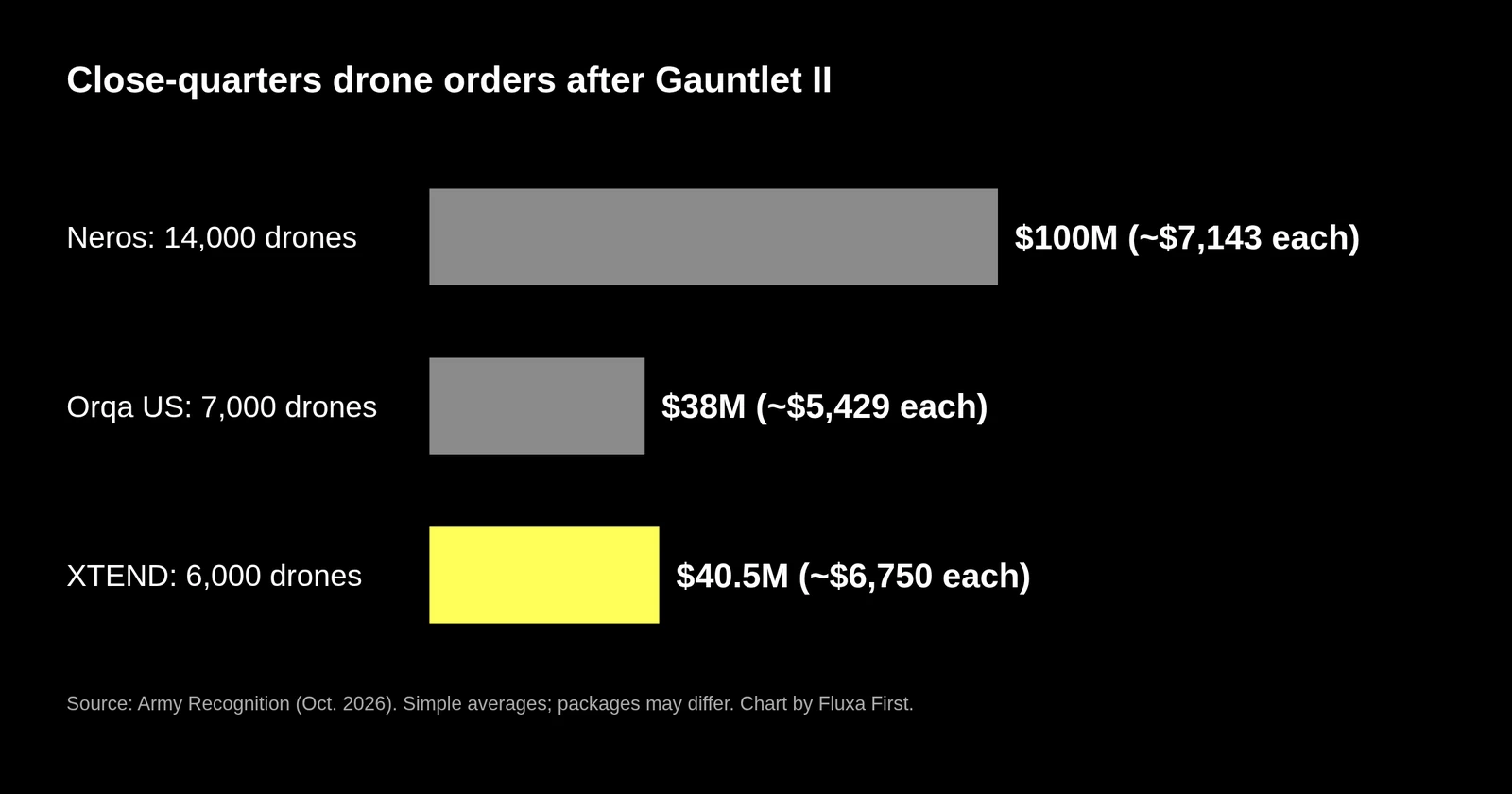
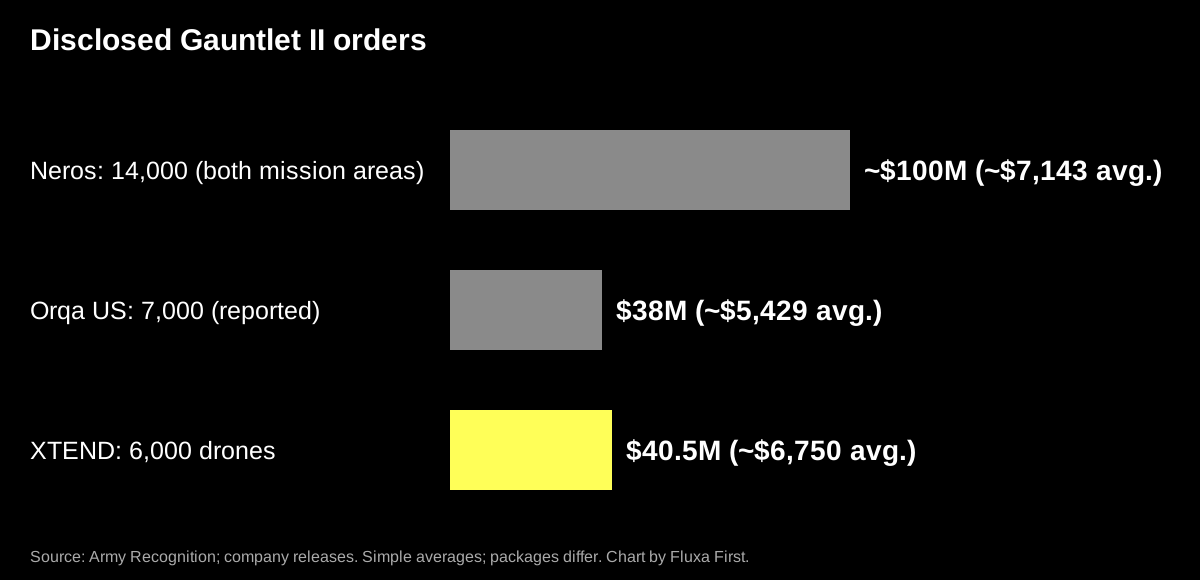
- After the Drone Dominance Gauntlet II evaluation, three Gauntlet II winners, Neros, Orqa US and XTEND, disclosed orders worth about $178.5 million for roughly 27,000 drones, according to Army Recognition and the companies. Neros’s 14,000 drones cover both mission areas.
- Reported averages ran from about $5,400 to $7,100 per drone, though the packages differ, and the program aims to push average costs toward $3,000 as volumes grow.
- Gauntlet II required motors, battery packs and GPS modules to be assembled outside China and other covered countries, with tighter rules due in February and August 2027. Winning now depends on domestic supply chains and manufacturing scale as much as flight performance.
The US military has started buying small drones the way it buys ammunition: in thousands, on short timelines, from several suppliers at once. The latest orders under the Pentagon’s Drone Dominance program make the shift concrete. For autonomy and robotics founders, the lesson is that production, cost and supply chain now decide who wins, alongside the quality of the autonomy.
What did the Pentagon order?
On October 13, XTEND announced a $40.5 million order from the Defense Department for 6,000 Striker drones designed for close-quarters work inside buildings and in places where satellite navigation fails, as Army Recognition reported. XTEND finished third in the close-quarters category of the Gauntlet II evaluation at Fort Carson, Colorado, behind Neros Technologies and Orqa US.
Across the three companies, disclosed orders total about $178.5 million for roughly 27,000 drones: Neros about $100 million for 14,000 (covering both close-quarters and deep-strike mission areas, with explosive payloads), Orqa US $38 million for a reported 7,000, and XTEND $40.5 million for 6,000. Orqa’s own announcement gives the dollar value but not a drone count. Simple averages come to roughly $7,100, $5,400 and $6,750 per drone, but the packages differ in mission mix, munitions and support, so the figures are not like-for-like prices. Army Recognition is a secondary trade source, and it is our source for the Neros figure and for the DIU estimate below; the XTEND and Orqa links go to the companies’ own releases.
How does the program work?
Drone Dominance followed a June 2025 executive order and a July 2025 directive from the Secretary of Defense. Army Recognition describes a four-phase effort run through the Defense Innovation Unit, the Test Resource Management Center and Naval Surface Warfare Center Crane. The first phase started with $150 million for 30,000 drones. Later rounds raise the targets, and the stated aim is to cut average costs from about $5,000 toward $3,000 a drone.
The evaluations are designed to look like use, not like demos. Gauntlet I at Fort Benning in February 2026 put 25 manufacturers in front of nearly 100 military operators who had about two hours of training per design. Gauntlet II qualifying at Camp Grayling in June drew 49 manufacturers and 79 configurations, and 19 advanced to the Fort Carson finals, which added night operations and confined-space attacks and raised the count to 120 drones per maker.
Why does the supply chain matter so much?
The program has tied sourcing rules to each round. DIU’s supply chain framework, revised July 23, 2026, requires motors, battery packs and GPS modules to be assembled outside covered countries such as China starting with Gauntlet II. It tightens the rules on electronics, motors and batteries again in February 2027 and August 2027. Army Recognition attributes to a DIU official an estimate that most first-phase drones probably contained Chinese motors; we did not find a primary source for that.
That is a big ask. Small drones are mostly motors, batteries, flight controllers, cameras and radios, and their supply chains have been concentrated overseas. We wrote about the scale of the parts problem in our post on drone components and the industrial base. Every round of Drone Dominance turns that problem into a buying criterion.
What does this mean for autonomy founders?
We see four lessons for anyone building drones, ground robots or autonomy software for defense and dual-use markets.
- Production is the product. Orders now come in thousands. A design that cannot be built at volume, at a stable price, on schedule, does not win, however good its demo.
- Cost curves are set by the buyer. The program’s stated target of about $3,000 a drone tells makers where prices must go. Plan the bill of materials and manufacturing process around that target, not around today’s price.
- Domestic supply chains are a moat. Gauntlet II scoring weighed each vendor’s production and supply-chain capacity alongside flight results. We expect that to matter more as sourcing rules tighten in 2027.
- Operators decide. Evaluations by soldiers with little training reward simple, reliable systems and good interfaces. Autonomy that reduces operator workload is a selling point, not a feature.
There is also an opening for the suppliers behind the drone makers: motors, batteries, flight controllers, sensors and test services made in the United States or by allies. Those businesses can sell to every winner rather than betting on one.
How we see it
We think the Drone Dominance model, with fast competitive rounds, real operators, production orders and rising supply-chain standards, is a sign of how a lot of defense hardware will be bought in the future. It rewards teams that think like manufacturers from day one.
The same lesson applies well beyond defense: commercial buyers of drones and robots also want reliable supply, predictable costs and parts they can trust. Founders who design for production and domestic sourcing early will be ready for both markets.
Figures are as reported in the linked sources; per-unit prices are simple averages and packages may differ. This post is general analysis, not investment advice.
Frequently asked questions
What is the Drone Dominance program?
It is a Pentagon effort to buy large numbers of low-cost attack drones quickly through rounds of competitive flight evaluations called Gauntlets. Winners receive production orders, and each round raises quantities and tightens supply-chain rules. It is run by the Defense Innovation Unit with the Test Resource Management Center and Naval Surface Warfare Center Crane.
Why are Chinese parts excluded from US military drones?
Most small drone motors, batteries and other components have historically come from China, which creates a security and supply risk for military buyers. The program required motors, battery packs and GPS modules to be assembled outside covered countries for Gauntlet II and plans tighter rules in 2027, which pushes makers toward domestic and allied suppliers.