
Robots leave the demo stage: production lines, platforms and a public listing
Key takeaways
- Tesla said it began Optimus humanoid production at its Fremont, California factory, while calling the ramp early and slow.
- NVIDIA expanded its Isaac robotics platform with a reference humanoid, new runtime and learning tools and a safety stack.
- Agility Robotics’ SPAC merger is set for a Nov. 2 shareholder vote, with more than $620 million in expected gross proceeds.
- The bottlenecks are moving from capability demos to manufacturing, safety and deployment data, where many startup opportunities sit.
For years, humanoid and general-purpose robots lived in demo videos. This week, three announcements pointed at the same shift: the industry is moving from showing what robots can do to building, certifying and deploying them in volume. That shift changes where the hard problems are, and where founders can build.
What happened this week?
Tesla started Optimus production. In its third-quarter results, Tesla said it had begun producing its Optimus humanoid robot in Fremont, California, in factory space that once built electric vehicles, and described the robots coming off the line as its first production-quality units, per TechCrunch. On the earnings call, CEO Elon Musk described it as early production with a slow and uneven ramp, said design and AI work remained before the robot is truly useful for open-ended tasks, and still projected very high weekly output by the end of 2027. The same quarter showed the cost of the bet: Tesla’s net income fell 43% from a year earlier as spending on AI and Optimus rose.
NVIDIA expanded its robotics platform. At GTC Berlin on Oct. 21, NVIDIA announced a broad update to Isaac, its open robotics development platform. It includes a reference humanoid from Agile Robots built on NVIDIA’s GR00T models and Jetson Thor computer, slated for early 2027; the general availability of Isaac Lab 3.0 for robot learning; a new open-source runtime called Isaac OS; a library of more than 2,000 simulation-ready assets; and its Halos safety platform for moving robots into real-world deployment.
Agility Robotics moved closer to a public listing. Agility said the SEC declared its merger registration with Churchill Capital Corp XI effective on Oct. 13, with a shareholder vote set for Nov. 2. The company expects more than $620 million in gross proceeds, including roughly $424 million in trust (assuming no redemptions) and about $200 million from a PIPE led by Foxconn. Agility reports more than 65,000 hours of real-world operation for earlier Digit robots, a factory designed to build up to 10,000 robots a year, and more than $300 million in committed orders for its next model, subject to contractual milestones.
Where are the bottlenecks now?
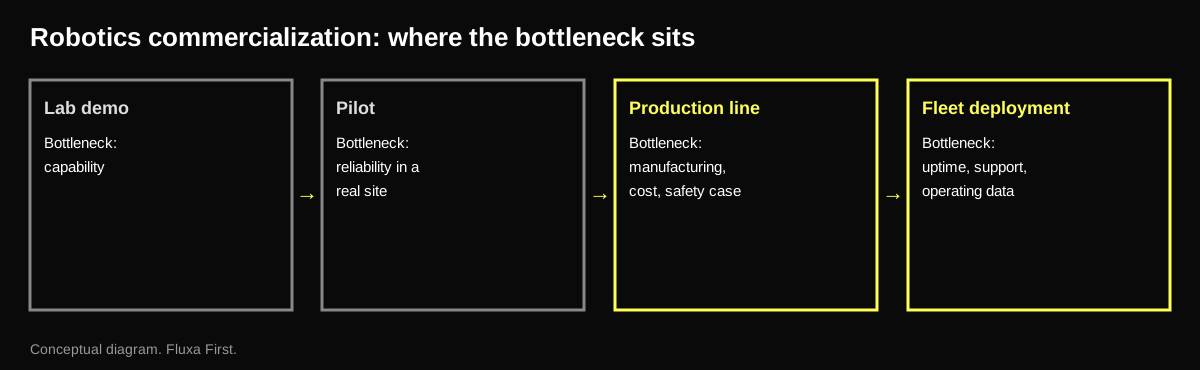
When robots were demos, the constraint was capability: could it walk, grasp, balance? Those problems are far from solved, but this week’s news shows the frontier moving to three other places.
Manufacturing. Building thousands of robots is a different problem than building ten. Actuators, gearboxes, motors, sensors, batteries and hands all have to be produced reliably and at a cost customers will pay. Every company scaling up will need suppliers that can do this domestically.
Safety. Robots that work near people need a safety case that customers, insurers and regulators accept. NVIDIA’s investment in a full safety stack, and Agility’s emphasis on cooperative safety, signal that this is now a gating item for deployment, not an afterthought.
Deployment data. Real operating hours in real facilities are becoming a competitive asset. They improve the models, reveal failure modes and give customers confidence. Companies with robots already working in warehouses and factories have a head start that simulation alone cannot match.
What does this mean for founders?
We see the most durable opportunities in the layers around the robot rather than in building another general-purpose humanoid:
| Layer | Examples of the work |
|---|---|
| Components | Actuators, hands, sensors, power systems built in the US |
| Safety and certification | Testing, safety cases, monitoring for robots near people |
| Integration | Fitting robots into existing plants, ports and warehouses |
| Fleet operations | Uptime, maintenance, remote support, software updates |
| Vertical applications | Specific tasks in energy, maritime, aerospace or manufacturing where labor is scarce |
Many of these businesses can earn revenue long before humanoids are everywhere, and they gain from the platform investments the largest companies are making.
Our view
Robotics and autonomy are core to how America rebuilds its industrial base, and we are glad to see the industry focused on production rather than promotion. But a production line is the start of the hard part, not the end. We expect the winners in this phase to be the companies that solve unglamorous problems: reliable parts, credible safety, and deployments that keep running after the launch video. Those are the companies we want to build alongside at Fluxa First.
See more of our sector coverage under topics.
Company statements are forward-looking and as reported in the linked sources. This post is general commentary, not investment advice.