
Outbound investment rules expand to hypersonics and biotech: what investors need to know
Key takeaways
- On October 22, 2026, Treasury proposed rules implementing the COINS Act, which codifies the outbound investment program and adds high-performance computing, hypersonic systems and biotechnology to the covered sectors.
- The proposal extends countries of concern beyond China (including Hong Kong and Macau) to Cuba, Iran, North Korea and Russia, and treats Venezuela separately in its FAQ, which says Venezuela does not meet the proposed definition. Comments are due December 7, 2026.
- US limited partners in non-US funds are excepted only if their commitment is $2 million or less or the investment is subject to a specific binding contractual assurance. Investors should check fund documents and diligence processes now.
The United States is widening the net on where American capital can go. On October 22, Treasury proposed rules that extend outbound investment limits to hypersonics, biotechnology and supercomputing, and to more countries. For American investors, and for the founders who raise from them, the practical message is that capital flows are now part of national security policy, and diligence needs to reflect that.
What did Treasury propose?
Treasury issued a notice of proposed rulemaking to implement the Comprehensive Outbound Investment National Security Act, known as the COINS Act, which Congress passed in the fiscal 2026 defense authorization bill. The act puts into law the outbound investment program Treasury has run since early 2025 and broadens it.
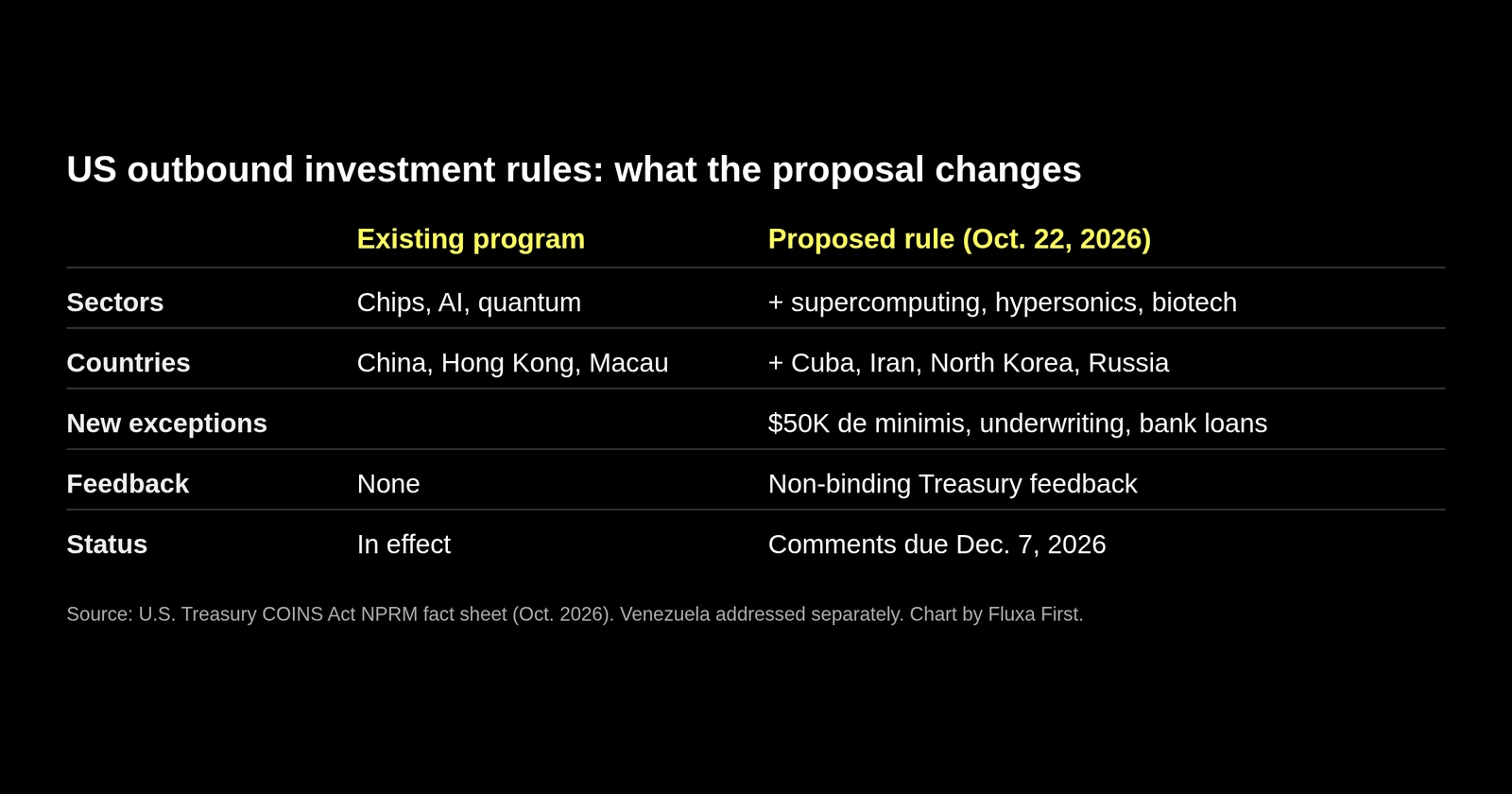
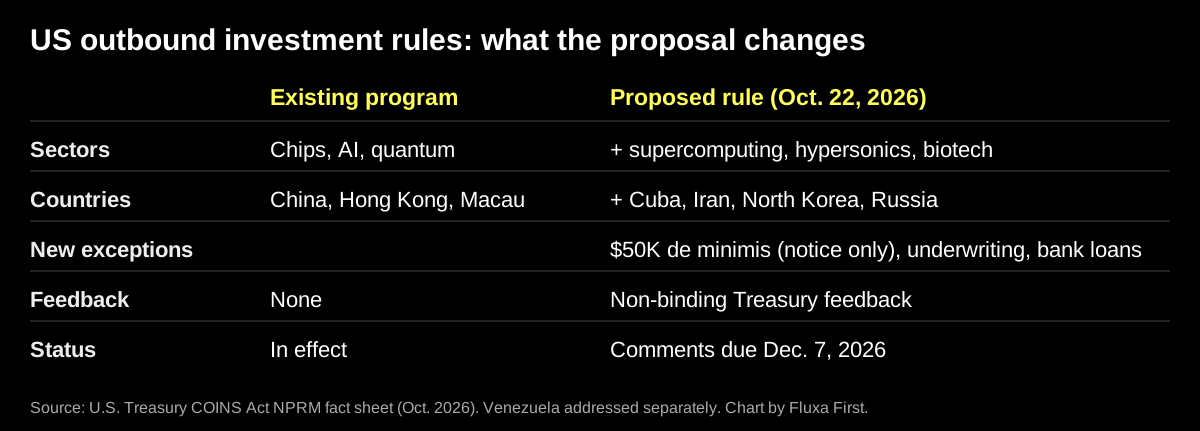
According to Treasury’s fact sheet, the key changes are:
- New sectors. High-performance computing and supercomputing, hypersonic systems and biotechnology join semiconductors, artificial intelligence (now termed super intelligence systems in the rule) and quantum.
- More countries. Countries of concern would include Cuba, Iran, North Korea and Russia in addition to China, Hong Kong and Macau. The statute also lists Venezuela under the Maduro regime, but Treasury’s FAQ says that regime no longer exists, so Venezuela does not meet the proposed definition. Treasury still warns investors that the rule could apply to some Venezuelan entities.
- Broader chip prohibitions. Radiation-hardened, photonic and high-bandwidth memory chips are among the added prohibited categories.
- New exceptions. Transactions totaling $50,000 or less over 12 months (excepted from the notification requirement only), underwriting services and bank lending would be excepted.
- A feedback process. Parties with a financial interest could ask Treasury for non-binding feedback on whether a deal is prohibited.
For hypersonics, the proposal would prohibit US investment in covered foreign persons working on hypersonic systems, propulsion that enables hypersonic flight, related materials and test facilities. For biotech, the prohibitions include certain bio-derived materials, brain-computer interfaces, biomanufacturing equipment, sequencing and design tools, bioinformatics and automated discovery systems. Comments are due December 7, 2026, and final rules will set the effective date.
What does it mean for venture investors and LPs?
The proposal is not a screening process like CFIUS. Each US person has to decide whether a transaction is prohibited, notifiable or outside the rule, after a reasonable and diligent inquiry. That puts the work on investors.
A few provisions matter most for venture and private funds:
- LP commitments to non-US funds. A US LP is excepted only if its commitment is $2 million or less, or the investment is subject to a specific binding contractual assurance. Larger LPs in offshore funds may want to ask their managers about such assurances.
- Covered deal types. Equity, certain convertible debt, joint ventures, greenfield expansions and some LP investments are covered. Procurement and most ordinary commercial contracts are not, except technology transfer.
- Directing a foreign deal. US persons can still work at companies that receive or make such investments, but directing a foreign person’s covered transaction can itself be covered.
- Public markets. Publicly traded securities and index funds remain excepted.
What should hard-tech founders know?
Most American hard-tech startups will never touch these rules directly; the rules restrict US money going into companies tied to countries of concern, not money coming into US companies. But founders should pay attention for three reasons.
- Your investors will diligence more. Funds with international LPs or cross-border portfolios will ask more questions about foreign subsidiaries, joint ventures and research partners.
- Cross-border structures need care. A US company planning an overseas subsidiary, joint venture or acquisition in a covered sector should check the rules before signing.
- The direction of policy is clear. Hypersonics and biotech join chips and AI as technologies where Washington treats capital, export controls and know-how as one system. We covered the export side in our post on rare earth export controls, and allied investment in chips in our post on allied chip fabs.
How we see it
We build and invest in American hard tech, so a policy that keeps US capital out of adversaries’ military technology is aligned with what we do. The proposal also adds useful clarity, with de minimis and lending exceptions and a way to ask Treasury for feedback.
The cost falls mainly on diligence. Investors and LPs will need cleaner fund documents and clearer records of where money goes. We would rather see that built into standard practice now, during the comment period, than discovered after the rules are final.
This post summarizes a proposed rule as described in Treasury’s linked materials; final rules may differ. It is general information, not legal or investment compliance advice.
Frequently asked questions
What is the US outbound investment program?
It is a Treasury program that prohibits some investments by US persons in companies tied to countries of concern that work on certain sensitive technologies, and requires notification of others. It covers equity, certain convertible debt, joint ventures, greenfield projects and some LP investments. The COINS Act, passed in the FY2026 defense bill, puts the program into law and broadens it.
Does the proposed outbound rule affect LP investments?
Yes, in some cases. A US person’s LP investment in a non-US venture or private equity fund is excepted only if the commitment is $2 million or less or the investment is covered by a specific binding contractual assurance. Larger LP commitments without such assurances could be covered if the fund invests in covered foreign persons.
When do the new outbound investment rules take effect?
Not yet. The October 2026 notice is a proposal. Comments are due December 7, 2026, and Treasury will publish final regulations later that set the effective date. Until then, the existing program rules continue to apply.