
China is putting know-how, not just materials, under export control
Key takeaways
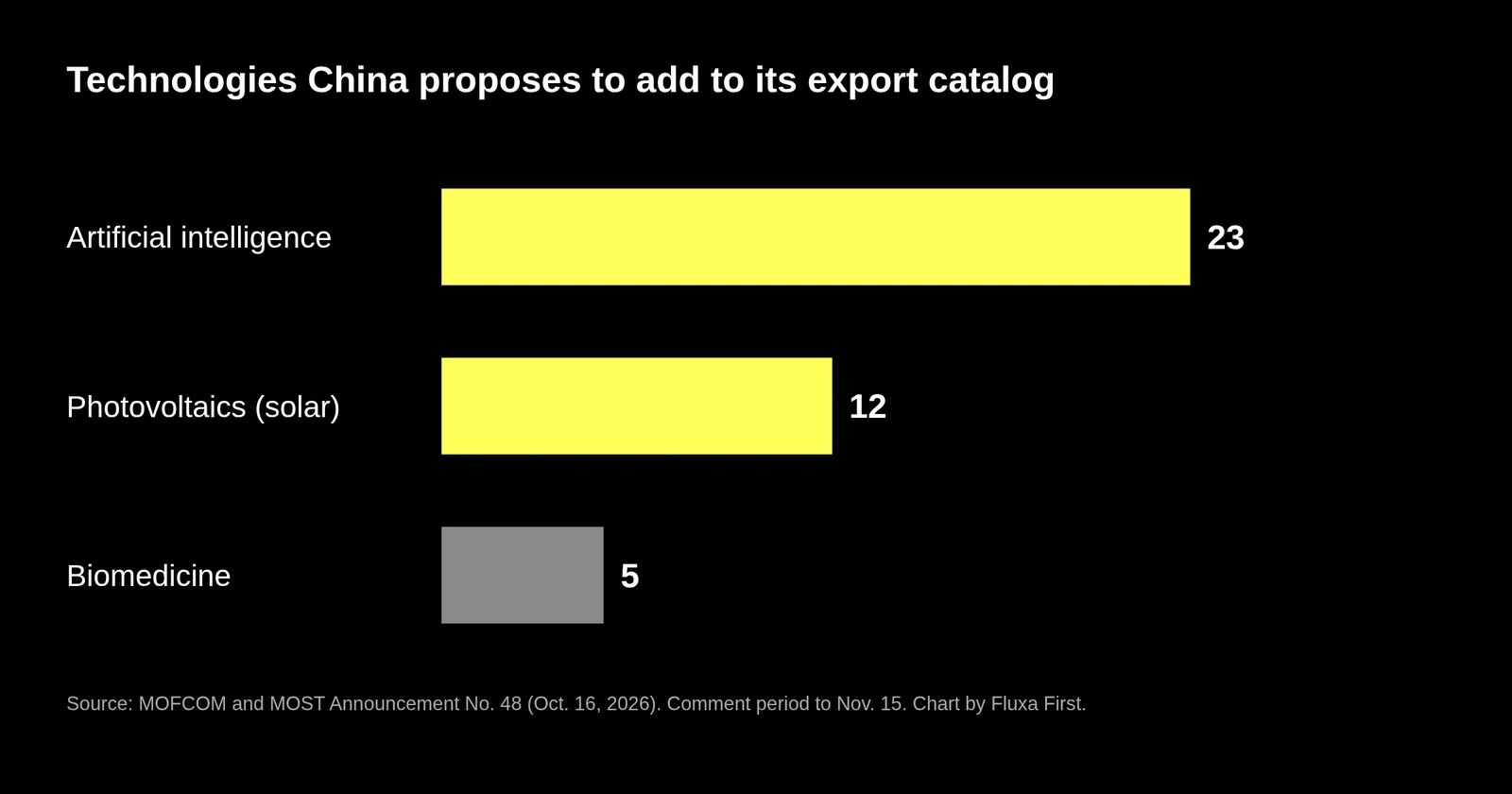
- On October 16, 2026, China’s commerce and science ministries proposed adding 40 technologies, 23 in AI, 12 in solar manufacturing and 5 in biomedicine, to the catalog of technologies restricted or banned from export.
- Exporters must register before transferring or licensing those technologies abroad starting immediately, even before the catalog is final; comments close November 15.
- Separate rules effective November 18 require licenses to export certain drones, motors, propeller blades, autopilots and flight-control and navigation know-how.
- The shift from controlling materials to controlling manufacturing know-how is a reason for Western builders to own their process technology rather than license it.
For most of the past few years, the export controls that worried Western manufacturers were about materials: rare earths, gallium, graphite. China’s latest moves point somewhere else. In October 2026, Beijing proposed restricting the export of 40 technologies in artificial intelligence, solar manufacturing and biomedicine, and it tightened controls on drone parts and know-how. The common thread is control over how things are made, not just what they are made from.
What did China announce?
On October 16, China’s Ministry of Commerce (MOFCOM) and Ministry of Science and Technology issued Announcement No. 48 (in Chinese), proposing to add 40 technologies to China’s catalog of technologies that are prohibited or restricted from export.
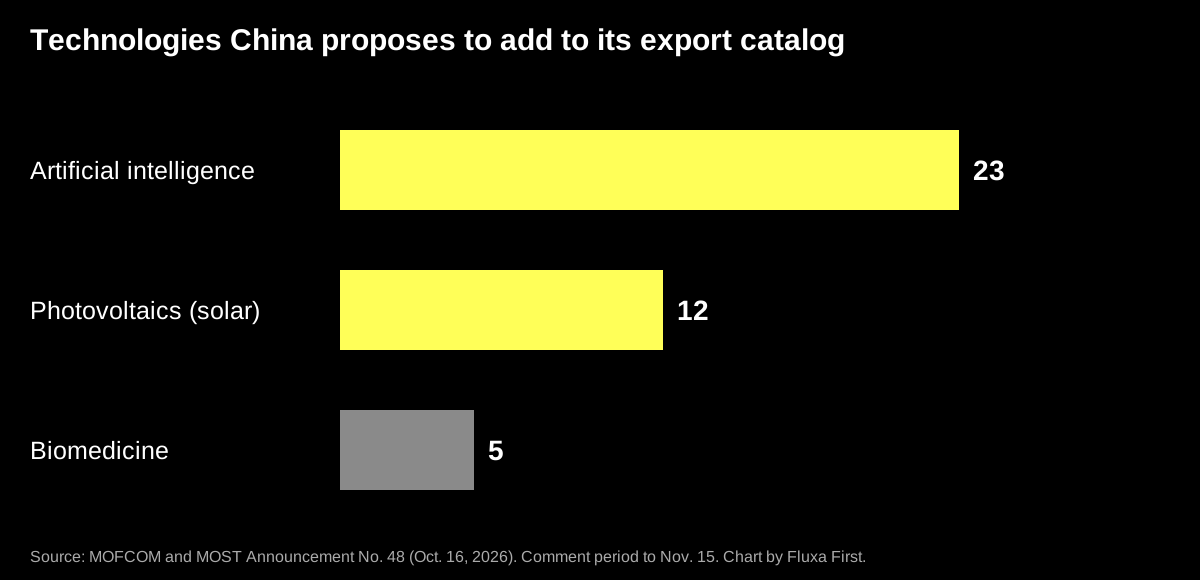
- Artificial intelligence: 23 technologies related to large models, AI agents, computing clusters and information processing. Technology already in the public domain through open source or published papers is excluded.
- Solar photovoltaics: 12 technologies covering polysilicon, wafer and cell manufacturing. The scope also includes the key equipment that carries those technologies.
- Biomedicine: 5 technologies related to cell and gene therapy, small nucleic acid drugs and pathogenic microorganisms. Out-licensing that does not transfer ownership can use simplified procedures.
Public comments run until November 15. But the most immediate effect is already in force. From the date of the announcement, exporters must register before exporting any listed technology, including deals already under way. Registration applies when a Chinese owner transfers ownership of technology abroad, licenses it for use abroad, or when the owner or controller of the technology becomes a foreign entity. That last trigger matters for any acquisition or investment that touches Chinese technology holders.
What changes for drones on November 18?
Three days later, on October 19, MOFCOM, the General Administration of Customs and the equipment department of the Central Military Commission issued Announcement No. 49 (in Chinese), effective November 18. As summarized by Expeditors, it requires export authorization for specified drones, components, software and technologies.
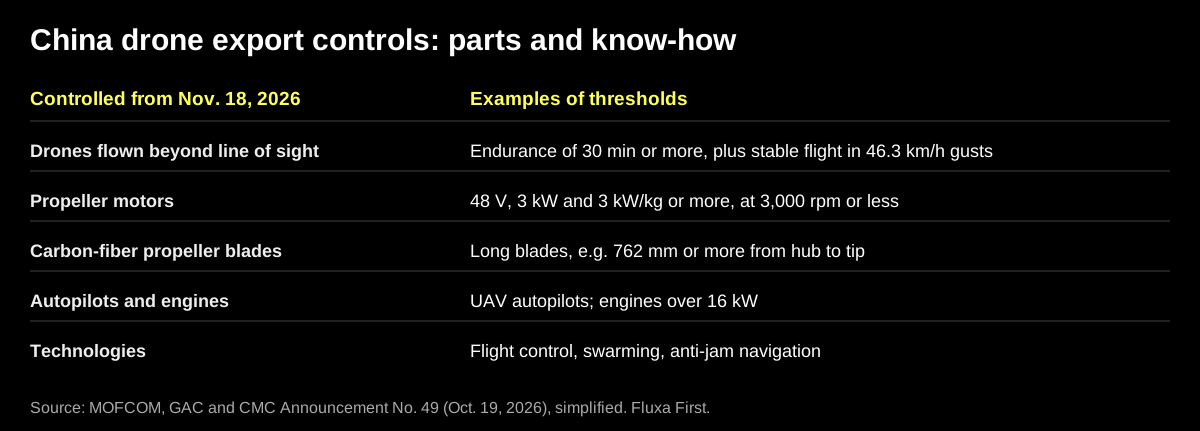
The list goes deep into the bill of materials. It covers drones that can fly beyond the operator’s line of sight with endurance of 30 minutes or more and the ability to take off and fly steadily in gusts of 46.3 km/h (25 knots) or more, or endurance of three hours or more. It includes autopilots, engines above 16 kW, brushless propeller motors rated at 48 volts or more, 3 kW or more and 3 kW per kilogram or more and running at 3,000 rpm or less, matching speed controllers rated at 48 volts and 3 kW or more, and long carbon-fiber propeller blades, for example 762 mm or longer from hub centre to tip. It also covers technology for flight control, including swarm control, autonomous and anti-jamming navigation and sense-and-avoid, as well as counter-drone technology.
Exporters must declare technical specifications to customs, even for products that fall just below the thresholds, and shipments can be held while customs questions a declaration. Companies with established compliance programs can use general licenses and other simplified procedures.
Why does this matter?
Know-how is the new chokepoint. In its 2022 solar supply chain report, the IEA found China’s share of manufacturing capacity at every main stage of solar panel production, using 2021 data, exceeded 80%, and China dominates global production of drones and drone components, as Aviation Week has reported. Restricting the transfer of process technology, and not just finished goods, makes it harder for other countries to build their own production by licensing Chinese methods or buying Chinese production lines. It also gives Beijing a lever over foreign investment in its technology firms.
Registration is a data tool. Even before the catalog is final, pre-export registration gives the government a detailed view of who is buying which technologies, from whom and for how much. That information could inform future licensing decisions.
It mirrors what others already do. The United States and its allies control exports of advanced chips, chipmaking tools and related technology. China is building a parallel system across a wider set of industries. For companies on both sides, controls are becoming a permanent feature of technology trade rather than an occasional shock.
What should builders do?
For American and allied hard-tech companies, the practical steps are clear:
- Audit your bill of materials. Drone, robotics and electric propulsion makers should check motors, controllers, propellers and autopilots against the new thresholds and plan for licensing delays.
- Own your process technology. If your production plan depends on licensing manufacturing methods or buying turnkey lines from China, assume that path may close or slow down.
- Review deals and partnerships. Any acquisition, license or joint venture involving a Chinese technology holder may now trigger registration or approval.
- Build domestic suppliers early. Motors, magnets and composite structures are where new American suppliers can win, as we argued in our post on the drone components industrial base.
How we see it
We take a measured view. The technology catalog changes are still proposals open for comment, and the drone rules are licensing requirements rather than bans. Much will depend on the final catalog and on how the rules are applied. But the direction is consistent with China’s controls on rare earths and critical minerals: use leadership in production as leverage.
The durable answer is capability, not complaint. The opportunity is in companies that bring manufacturing know-how back under American and allied control, from materials processing to components to production equipment. The more of that know-how lives in our own factories, the less any single country’s export rules can slow us down.
Frequently asked questions
What technologies did China propose to restrict in October 2026?
MOFCOM and MOST Announcement No. 48 lists 40 technologies. The 23 AI items relate to large models, agents, computing clusters and information processing, excluding technology already public through open source or papers. The 12 solar items cover polysilicon, wafer and cell manufacturing, including core equipment. The 5 biomedical items relate to cell and gene therapy, small nucleic acid drugs and pathogenic microbes.
When do China's new drone export controls take effect?
Announcement No. 49, issued October 19, 2026 by MOFCOM, the General Administration of Customs and the Central Military Commission’s equipment department, takes effect on November 18, 2026. It requires export licenses for specified drones, engines, motors, speed controllers, propeller blades, autopilots, software and technologies.