
Allied capital, American fabs: what Japan's pledge means for mature-node chips

Key takeaways
- Japan and the US agreed on their first semiconductor project under Japan’s strategic investment initiative - two GlobalFoundries fabs in Malta, New York.
- The initial investment is about $10 billion for a 300mm fab expected online in 2029, with up to about $21 billion if a second fab is built.
- The fabs target mature-node chips used in cars, industrial machinery, phones and data centers, the unglamorous parts that supply chain shocks expose.
- Allied capital can speed up American manufacturing, but project selection and timelines are political, so founders should plan around delivery dates, not announcements.
Some of the most important chips in the American economy are not the most advanced ones. They are the mature-node chips inside cars, factory equipment, power systems and phones. This month, those chips became the first semiconductor project under Japan’s large investment pledge to the United States. It is a useful case study in how alliances are now being used to fund American industrial capacity.
What was announced?
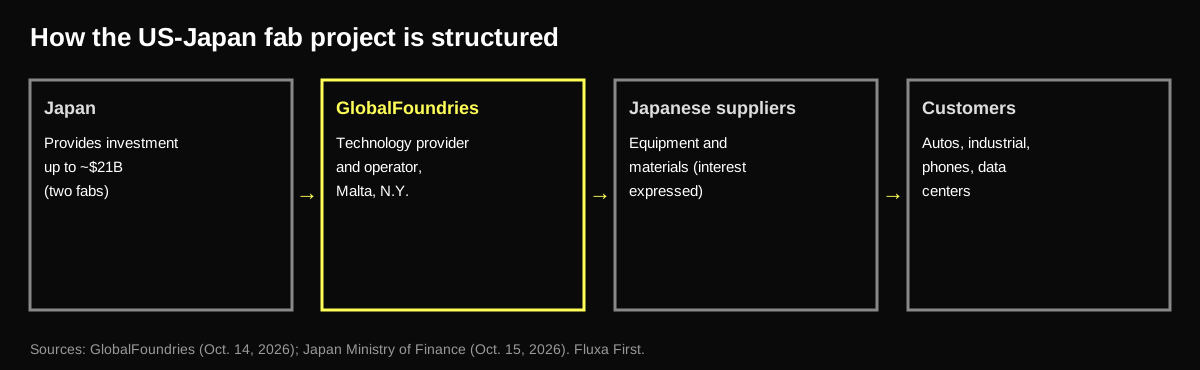
On Oct. 14, GlobalFoundries said it had been selected as technology provider and operator for two new fabs at its Malta, New York site under a US-Japan initiative providing up to $21 billion. Japan provides the investment; GlobalFoundries contributes technology and operations.
Key details from the company:
- An initial investment of about $10 billion for a new 300mm fab expected to come online in 2029.
- About $10 billion more would fund a second fab.
- The first fab would add roughly 900,000 300mm wafers a year of US capacity when fully running, and a second would add about the same.
- About 27,000 construction and ecosystem jobs and more than 1,000 manufacturing jobs are expected.
- The company expects to break ground on the first fab later this year.
Japan’s Ministry of Finance described it as the first semiconductor project under the two governments’ strategic investment initiative, aimed at strengthening production of mature-node chips that are essential to autos, industrial machinery, smartphones and AI data centers. The ministry also noted that Japanese equipment and materials suppliers, including Tokyo Electron, SCREEN and Tokyo Ohka Kogyo, have expressed interest in supplying the project, and that Renesas has expressed interest in buying its output.
How does this fit the broader pledge?
The project sits inside Japan’s pledge of up to $550 billion in US investment, made with the current administration in return for lower tariffs. As the Japan Times reported, under that deal the US president selects the projects. Earlier tranches announced this year, totaling about $109 billion, focused mostly on energy, including oil, gas and mineral investments, gas-fired power plants and a nuclear development, according to Quartz’s summary of Bloomberg reporting. That summary also notes that investments are meant to be completed by Jan. 19, 2029.
The Japan Times also pointed out a tension: Japan is pushing to revive its own chip industry at home at the same time as it funds US fabs.
Why do mature-node chips matter for sovereignty?
Supply chain shocks in recent years showed that a shortage of inexpensive, older-generation chips can idle entire auto plants and delay industrial equipment. These chips are not glamorous, but they sit inside almost every physical system we care about: vehicles, grid equipment, machine tools, drones and defense hardware.
Capacity for them is concentrated, and new fabs are expensive relative to the price of the chips they make, which is why private investors have been cautious. Allied capital changes that equation. A partner willing to fund construction in exchange for trade terms can get capacity built that the market alone might not.
What are the risks?
We think it is worth being clear-eyed:
| Strength | Open question |
|---|---|
| Large, patient capital for capacity the market underbuilds | Project selection runs through politics, which can change |
| Allied suppliers co-locate with the fab | The second fab depends on future decisions |
| Mature-node output serves broad industrial demand | First output is expected in 2029, years away |
| Strengthens an alliance relationship | Japan balances investment at home and abroad |
None of these make the project less valuable. They do mean that builders should plan around delivery dates, not press releases.
What does this mean for founders?
New fabs create ecosystems. Each one needs equipment service, specialty materials, gases, water treatment, metrology, automation, workforce training and logistics. When allied suppliers set up near a US fab, there is room for American companies to partner, supply and build complementary products.
For hardware founders who buy mature-node chips, more domestic capacity later this decade could ease the supply risk that has haunted electronics planning. Until then, design for second sources and keep inventory strategy close to the product roadmap.
Our view
We see allied investment as one of the most practical tools for rebuilding American industrial capacity, especially in capital-intensive sectors where private returns alone have not justified new plants. The goal is not to replace American investment but to add to it with partners who share an interest in resilient supply chains. At Fluxa First we look for the companies that will grow up around this new capacity and turn it into durable American businesses.
More of our geopolitics coverage is under topics.
This post is general analysis, not investment or policy advice. Figures are as stated in the linked sources.