
Chip tool export controls only work with allies: the MATCH Act debate
Key takeaways
- The MATCH Act, a bill advanced by the House Foreign Affairs Committee in April 2026, aims to close gaps between US and allied export controls on key chipmaking equipment sold to China.
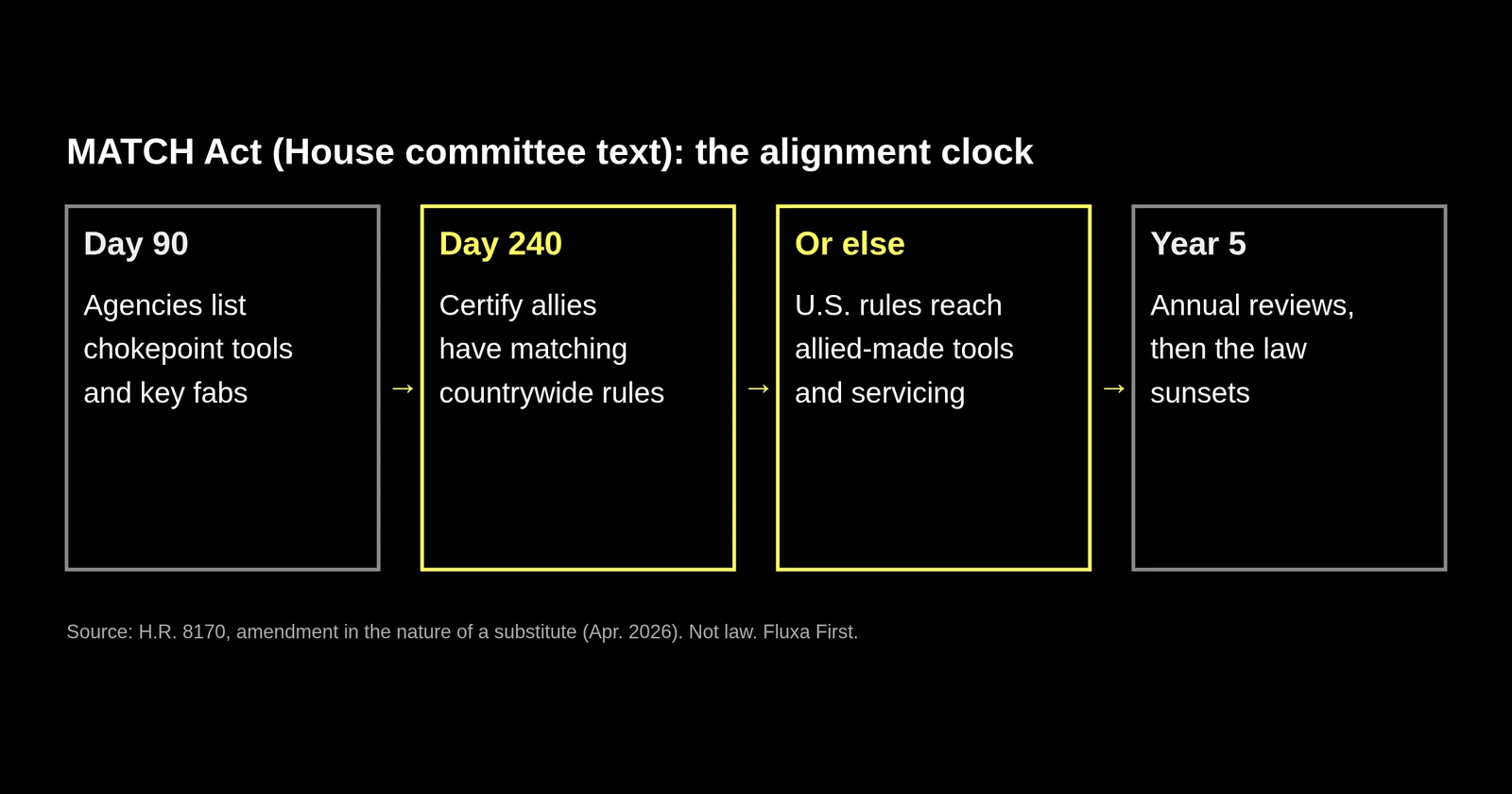
- In the committee text, agencies would identify chokepoint tools and facilities within 90 days and, within 240 days, either certify that allied supplier countries have matching countrywide controls or apply US controls that reach allied-made equipment.
- The Netherlands has objected to the bill’s potential reach over exports from other countries; the bill has not become law.
- We think durable technology controls depend on allied alignment, and that founders in semiconductors and tooling should plan for tighter, more extraterritorial rules either way.
Export controls on chipmaking equipment are only as strong as the weakest supplier. A handful of companies in a few allied countries make most of the world’s advanced tools, and when their rules differ, buyers in China can turn to whichever supplier faces fewer limits. The MATCH Act, a bill now in Congress, is an attempt to close that gap by pressing allies to match US controls, and it shows how technology policy is shifting from national rules to allied ones.
What would the MATCH Act do?
The Multilateral Alignment of Technology Controls on Hardware Act, introduced in the House as H.R. 8170, targets key semiconductor manufacturing equipment and the servicing of that equipment at covered facilities in countries of concern. The amended text considered by the House Foreign Affairs Committee on April 22, 2026 sets a clock.
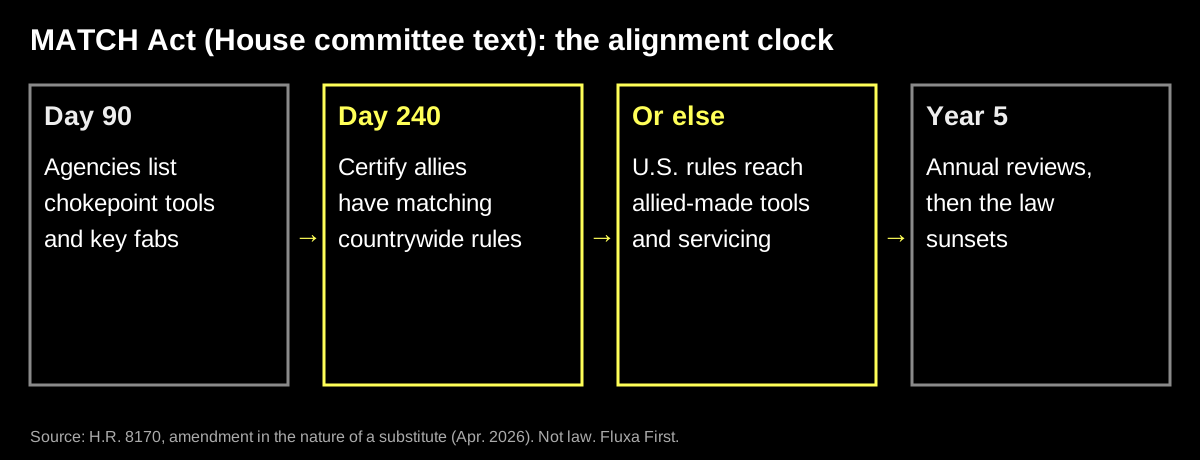
- Within 90 days of enactment, and annually for five years, US agencies would identify all key chokepoint semiconductor manufacturing equipment and key chipmaking facilities in countries of concern.
- Within 240 days, they would either certify to Congress that all allied supplier countries have put in place matching countrywide controls, or the Commerce Department would apply US controls that reach chokepoint equipment exported from those countries, including by restricting essential US-origin components.
- Controls on a country could be lifted if it later aligns, and the act would sunset after five years.
A Senate companion, S. 4281, was introduced on April 13, 2026, and the House Foreign Affairs Committee ordered the amended House bill reported on April 22 by a vote of 36 to 8 (Congress.gov). The Senate version uses a shorter timeline and explicitly covers all deep ultraviolet immersion lithography machines. The bill has not become law, and no date for a final vote has been set.
Why are allies the issue?
Controls work only if buyers cannot simply switch suppliers. A House Select Committee on the CCP investigation found that gaps between US and allied rules let non-US suppliers sell equipment to some Chinese customers facing tighter limits on US suppliers. In its analysis, China accounted for 70% of ASML’s deep ultraviolet immersion system sales by unit volume in fiscal 2024, up from 26% in fiscal 2022. That is the Committee’s estimate from data it reviewed, not a figure from ASML’s public filings. A September study by the Center for Technology and Statecraft estimated that more than 330 such systems were imported for Chinese-owned fabs from 2012 through early 2026. Those are estimates, and the researchers note that other bottlenecks limit what the machines can produce.
The tension is real on both sides. In a June 15 response to questions in its parliament, the Dutch government said it had raised objections with US officials and lawmakers about the bill’s potential reach over exports from other countries, and warned that broad restrictions could hurt semiconductor companies’ revenue and market position. Allies want security cooperation without giving up control of their own export policy or their companies’ largest markets.
We covered China’s own use of export controls in rare earth export controls, and how allied capital is flowing into American chip fabs.
What does this mean for founders and investors?
Expect tighter and broader rules. Whether or not this bill passes, the direction is toward controls that follow components and services across borders. Companies that sell tools, subsystems or services into chipmaking should map where their products end up and who owns those facilities.
Servicing is part of the control. Both versions of the bill address servicing equipment at covered facilities. Service revenue that looks steady today may be exposed to policy risk.
Allied supply chains are an opportunity. If allied countries align their controls, demand rises for tools, parts and fabs inside the allied network. US and allied startups in metrology, components, materials and equipment can benefit from that shift.
Policy timelines are uncertain. Bills can change or stall. Founders should plan for a range of outcomes, not a single forecast.
How we see it
We think technology controls protect American and allied capabilities only when allies move together. Unilateral rules can cost US companies market share without slowing competitors much. Coordinated rules, built with partners who share the burden, are more durable and more credible. The MATCH Act debate is ultimately about how to get there: by diplomacy, by pressure or by both.
For hard-tech companies, the practical lesson is to design for a world where the most strategic technologies trade inside a trusted network. That means knowing your customers, qualifying suppliers in allied countries and treating export compliance as a core capability rather than paperwork.
This article is general information, not legal or export compliance advice.
Frequently asked questions
What is the MATCH Act?
The Multilateral Alignment of Technology Controls on Hardware Act, H.R. 8170 in the House, is a proposed US law on semiconductor manufacturing equipment. It would require US agencies to identify chokepoint tools and key facilities in countries of concern and push allied supplier countries to adopt matching controls, with US controls applying to allied-made equipment if they do not. It has not been enacted.
Why do allies matter for chip export controls?
A handful of companies in a few countries, including the United States, the Netherlands and Japan, make most of the world’s advanced chipmaking tools. If one country restricts sales and another does not, buyers can switch suppliers, and the control loses much of its effect while still costing the restricting country’s companies revenue.