
Layer your moats: an IP strategy for hard-tech founders
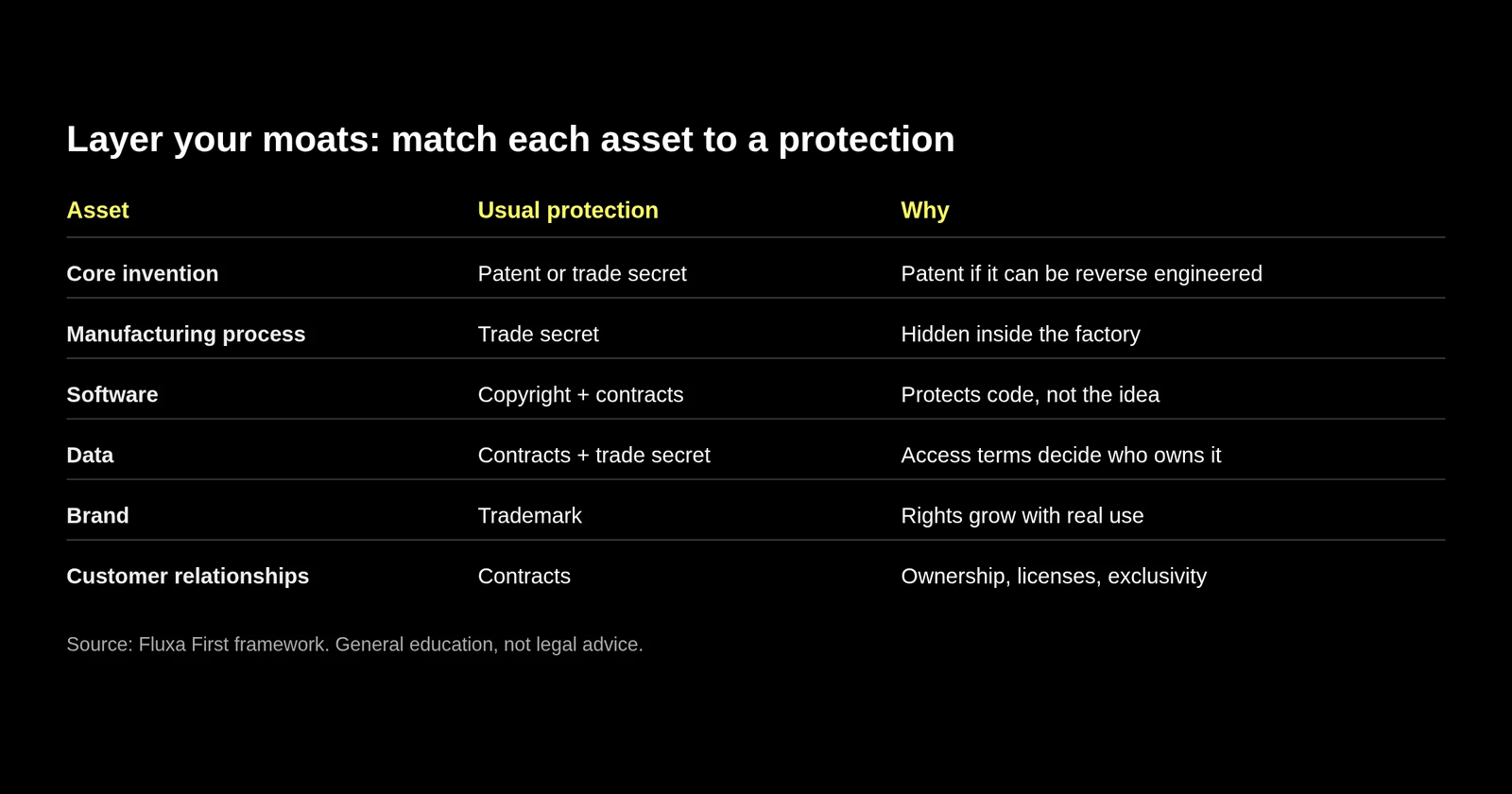
Key takeaways
- Intellectual property is a business tool for defensibility, making your position slow, hard or expensive to copy, not just a legal formality.
- Different assets need different protection; patents suit inventions that can be reverse engineered, trade secrets suit know-how that stays inside the company.
- Durable advantage comes from layering patents, trade secrets, software, data, brand and execution, so no single failure exposes the company.
- Common mistakes are publishing before filing, unclear ownership, weak contractor agreements and overstating legal advice to investors.
When investors ask about defensibility, many hard-tech founders answer with a patent count. That is the wrong frame. Intellectual property is a business tool whose job is to make your position slow, hard or expensive to take away. Patents are one tool in that kit. The strongest companies layer several kinds of protection so that no single gap exposes the business.
Why does IP matter to a hard-tech company?
A good product can be copied and strong execution can be matched. Defensibility is what lets you keep an advantage as the market grows and better-funded players arrive. Done well, IP strategy supports pricing power and margins, raises the value of the company, opens licensing and partnership revenue, and raises the cost of imitation.
Start by assuming competition exists. Claiming you have none tells an experienced investor you have not looked. Your real competitors include direct rivals, companies solving the same problem another way, future entrants who will show up once you have traction, and the customer’s default option of doing nothing. Early partners can become competitors too, which is why IP planning should start before the first pilot.
What is in the IP toolkit?
Each tool protects a different kind of asset:
- Patents protect functional inventions. The invention must be useful, new and non-obvious, you must disclose it publicly, and a utility patent generally lasts about 20 years from filing.
- Prior art is any earlier public disclosure, whether a patent, paper, product or public use, that can limit or invalidate your claims. Rules differ by country, so search before you file and before you publish.
- Trade secrets protect know-how and processes. They can last indefinitely with no public disclosure, but they vanish the moment secrecy is lost.
- Copyright protects original expression such as source code and documentation. It does not protect the underlying idea or function.
- Trademarks protect brand names, logos and slogans, and can last indefinitely as long as you keep using the mark and, for registrations, file the required maintenance and renewal documents.
- Contracts decide who owns, controls and may use IP: invention assignments, NDAs, licenses and collaboration agreements.
- License records track the third-party and open-source components you depend on, so you can prove you have the rights you claim.
How do you choose the right protection?
Match each asset to its protection, and write down why.
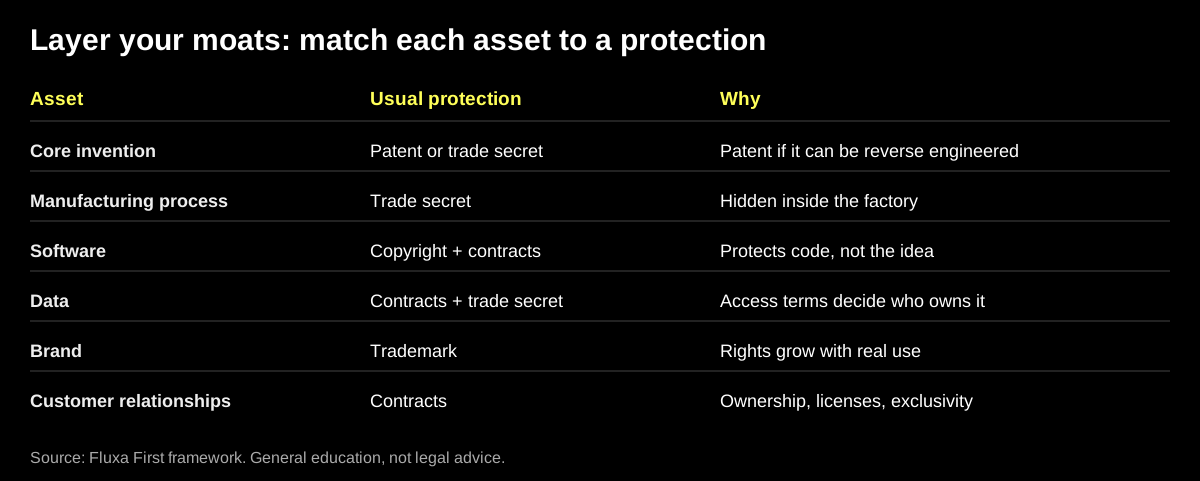
A few questions decide most cases:
- Can a competitor reverse engineer it from your product? If so, secrecy will not hold and a patent may be worth it.
- Can you keep it secret? A sintering recipe or calibration method that never leaves your factory may be better as a trade secret.
- Is public disclosure acceptable? A patent teaches the world how your invention works.
- Is the cost worth it? Patent prosecution and international filings are expensive for a seed-stage company.
- How do you balance protection with speed? Waiting to file can delay demos, papers and sales.
In hard tech, the most valuable know-how often lives in manufacturing: process windows, tooling, test methods and yield fixes. That is usually trade secret territory, protected by access controls, documentation and contracts, not patents.
What does layering your moats look like?
Durable advantage combines several layers: patents on what can be seen, trade secrets on what cannot, software and data that improve with every deployment, a brand customers trust, and execution speed that competitors cannot match. Each layer covers a weakness in another. A patent can be designed around; a qualified production process with years of yield data is much harder to copy. Data rights deserve special care, because customer contracts often decide who owns operating data from your systems.
This connects to how we think about capability milestones and technical inflection points. Each milestone you hit can create new IP and also trigger disclosure, so plan both together.
Which IP mistakes should founders avoid?
Simple mistakes can permanently destroy valuable assets:
- Publishing too early. A conference talk, paper, demo video or grant report can become prior art against your own filing. The US gives inventors a one-year grace period for their own disclosures, but many other countries give none, so file first.
- Ignoring ownership. Every founder, employee and contractor should sign an invention assignment. IP created before incorporation should be formally assigned to the company.
- Weak contractor agreements. Work by outside engineers or universities may not belong to you without clear terms.
- No strategy at all. Investors treat the absence of an IP plan as a red flag.
- Assuming every startup needs patents. Some do not, and spending scarce cash on weak patents is a real cost.
- Overstating legal advice. Never tell investors an attorney approved your strategy unless you have it in writing.
How should you present IP to investors?
Be precise about what you have done. Describe your written IP strategy, whether you have engaged a licensed IP attorney under a signed engagement letter, and any written opinion they have given you. State which milestones will trigger filing deadlines in the US and abroad, which assets you protect now, which you will budget for in later phases, and which are effectively impossible to protect. A freedom-to-operate analysis from a patent attorney is expensive, but for some products it is worth doing before you scale.
How founders should approach it
IP planning belongs alongside problem selection and early customer work, not after the first prototype. Map the assets, decide what to patent, what to keep secret and what to lock down by contract, and make sure ownership is clean from day one. Founders who do this early spend less, raise with more confidence and avoid the painful discovery that their best idea is no longer theirs. It also makes early sales easier, as we discuss in mapping the buying table.
This article is general education, not legal advice. Talk to a licensed IP attorney about your situation.
Frequently asked questions
Does every startup need patents?
No. Patents protect functional inventions that are useful, new and non-obvious, require public disclosure and, for utility patents, generally last about 20 years from filing. If an invention can be kept secret and cannot be reverse engineered, a trade secret may protect it longer and more cheaply. The right answer depends on the asset and the business plan.
What IP mistakes do early founders make?
The most common are disclosing an invention publicly before filing, failing to get written invention assignments from founders, employees and contractors, using third-party or open-source code without tracking licenses, assuming patents are always needed, and telling investors an attorney approved something without written support.