
When Washington takes equity: what founders should know about government stakes
Key takeaways
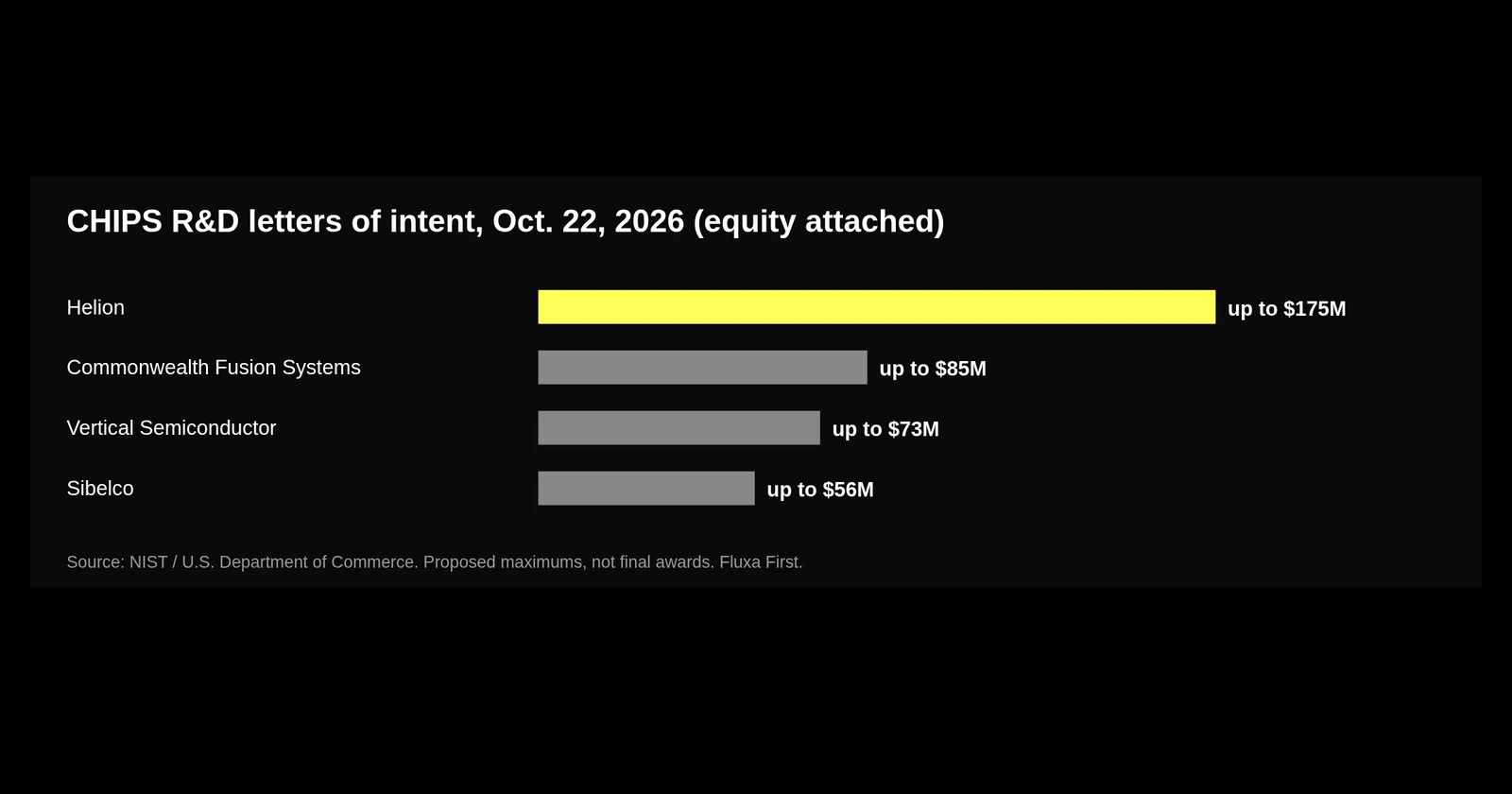
- On Oct. 22, 2026, Commerce signed letters of intent for up to $389 million in CHIPS R&D awards to Helion, Commonwealth Fusion Systems, Vertical Semiconductor and Sibelco, each conditioned on a minority, non-voting equity stake.
- Helion said Commerce would receive a $175 million non-voting interest priced at its latest Series G valuation if a final award is signed.
- Government equity is now a routine condition of CHIPS R&D awards, which turns what founders think of as non-dilutive money into dilutive money.
- Founders should price government stakes like any other equity and weigh the benefits of a strategic public partner against the conflicts critics raise.
For decades, founders could count on one simple rule: government grants are non-dilutive. That rule is fading. On October 22, the Commerce Department announced four new CHIPS research awards, and every one comes with an equity stake for the government. For hard-tech founders building in energy, semiconductors and critical materials, this changes how to think about public money.
What did Commerce announce?
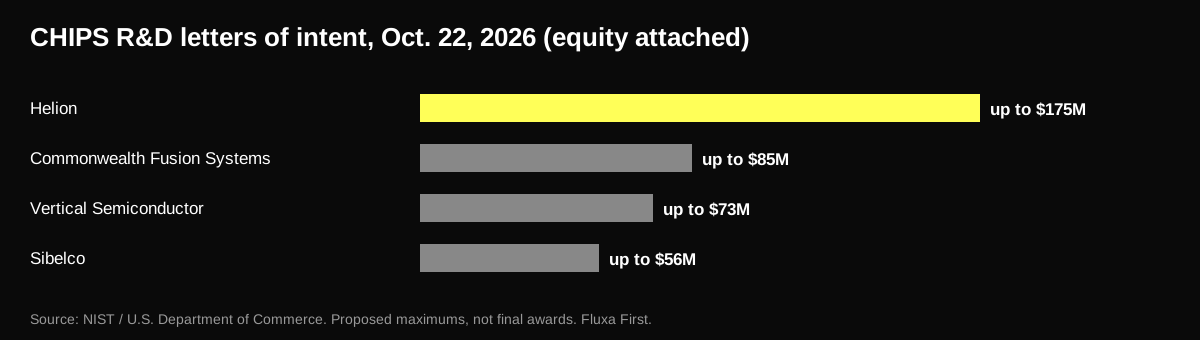
Commerce signed letters of intent for up to $389 million in CHIPS R&D awards focused on power semiconductors and materials:
- Helion, up to $175 million for high-voltage power semiconductors and modules for its fusion generators.
- Commonwealth Fusion Systems, up to $85 million for semiconductors for plasma heating, power electronics, diagnostics and radiation-hardened electronics.
- Vertical Semiconductor, up to $73 million for vertical gallium nitride power devices for data center power delivery.
- Sibelco, up to $56 million for ultra-high-purity quartz used throughout the chip supply chain.
The department said it will receive a minority, non-controlling, non-voting equity stake in each company as a condition of the awards.
Helion’s own announcement gave more detail. If a final agreement is signed, Commerce would receive a $175 million non-voting interest priced at Helion’s most recent Series G preferred valuation. Helion said the semiconductors it needs are currently available only from overseas manufacturers, that the award comes with $50 million of additional private investment, and that more than $100 million will go to work in Everett, Washington, with roughly $80 million for semiconductor tooling R&D with a partner in Vermont.
Is this a one-off?
No. The Cato Institute, which opposes the practice, counted in July that the CHIPS R&D office had announced 19 final or proposed awards since December, covering 18 companies and totaling up to $3.8 billion, all publicly tied to equity. Cato noted that Commerce’s funding rules allow equity, warrants, IP licenses, royalties or revenue sharing as forms of return, and that the same CHIPS R&D money was previously awarded without ownership stakes.
The broader portfolio is larger. CNBC listed earlier this year a roughly 10% stake in Intel funded from CHIPS and secure-chip grants, a Pentagon preferred stock investment in MP Materials that could reach 15%, a 5% stake in Lithium Americas in exchange for deferring debt payments, and proposed stakes in startups such as Vulcan Elements and xLight.
Why do it, and what are the concerns?
Supporters, including Commerce, say equity improves the return for taxpayers: if a funded company succeeds, the public shares in the upside instead of only bearing the risk. It also signals a long-term commitment to strategic industries such as power electronics, fusion and critical materials.
Critics raise real issues. Cato argues the government now acts as regulator, customer, financier and shareholder at once, which can create conflicts in contracting, permitting and trade decisions, and gives Washington a reason to prop up companies that falter. It also notes that public announcements often reveal little about valuations, rights or exit plans.
We think both points deserve weight. A non-voting minority stake is a modest governance change. The bigger questions are pricing, disclosure and what happens over time.
What should founders do?
Treat it as equity, because it is. A grant that comes with shares dilutes existing holders like any other financing. Model it on the cap table before you apply.
Understand the price. Helion’s stake is priced at its latest preferred round. Ask what valuation applies, what class of stock or warrant you are issuing and what rights come with it.
Compare forms of return. Commerce’s rules allow royalties and revenue sharing as well as equity. For some companies, sharing revenue from the funded project may be better aligned than permanent ownership. Ask.
Weigh the strategic value. A government shareholder can be a credible signal to customers and investors in strategic sectors. It can also complicate future financings, acquisitions by foreign buyers or exits. Get counsel early.
| Instrument | Dilution | What the government gets | Best fit |
|---|---|---|---|
| Traditional grant | None | Project results | Early research |
| Equity stake | Yes | Ownership, typically non-voting | Scaling companies with clear valuation |
| Warrants | Possible later | Right to buy shares | Companies with uncertain value |
| Royalty or revenue share | None | Share of project revenue | Revenue-generating projects |
How we see it at Fluxa First
We think public capital belongs in the capital stack for companies in energy, advanced manufacturing and other strategic industries. We have always encouraged founders to use non-dilutive funding before selling equity, as we discussed in our post on hard-tech capital stacks. That advice now needs a footnote: check whether the money is really non-dilutive.
Our own view on alignment is consistent here. Investors, public or private, are best aligned when they share in what a company actually earns. Revenue-sharing structures reward success without permanently taking ownership, and they are already in Commerce’s toolkit. We would welcome seeing them used more. Whatever form it takes, public money that helps build American capability in power electronics, fusion and critical materials is worth pursuing. Founders should just go in with clear eyes and a clean cap table model.
This post is general commentary, not legal or investment advice. Award terms are from letters of intent and may change in final agreements.
Frequently asked questions
Does the US government take equity in companies that receive CHIPS funding?
For CHIPS research and development awards in 2025 and 2026, yes, in many cases. The October 2026 letters of intent all include a minority, non-controlling, non-voting equity stake for the Commerce Department as a condition of the final award. Commerce funding rules also allow other forms of return such as warrants, royalties or revenue sharing.
Is a government grant with equity still non-dilutive?
No. If the government receives shares or warrants in exchange for funding, existing shareholders are diluted, just as they would be by a private investor. The difference is that the government stake is typically non-voting and the funding comes tied to a specific R&D or manufacturing project.